10 Best Therapy Apps for Therapists in 2026
TL;DR: The phrase “therapy app for therapists” covers four distinct categories: care-plan and HEP delivery, EHR/practice management, telehealth video, and secure communication. For rehab providers (PTs, OTs, SLPs, chiropractors) who prescribe home exercises or between-session assignments, AC Health is the strongest fit, offering personalized video care plans, HIPAA messaging, and RTM support starting free. Mental health therapists focused on billing and documentation should compare SimplePractice, TherapyNotes, or Sessions Health. The right choice depends on the specific job you need the app to do, not the longest feature list.
What “Therapy App for Therapists” Actually Means
Search for “therapy app for therapists” and you will find articles that lump scheduling software, video call tools, texting apps, and home exercise builders into the same category. That is misleading. A solo psychotherapist in private practice and a pelvic floor PT running a two-location clinic do not need the same software.
The term “therapy app” is really shorthand for four different jobs:
- Clinical assignment and patient engagement. Home exercise programs, custom videos, care-plan delivery, reminders, adherence tracking, and RTM reporting.
- Practice operations. Scheduling, documentation, billing, claims, intake forms, and client portals.
- Secure communication. HIPAA-compliant phone, text, fax, and file sharing.
- Telehealth video. Secure video visits without a full EHR attached.
This guide ranks the 10 best apps for therapists by the job they actually do. Every recommendation includes pricing, key features, honest tradeoffs, and real practitioner feedback. No single tool wins everywhere, and combining apps across categories is normal.
If you prescribe exercises, assignments, or care plans between visits, start with AC Health’s free tier to see how custom video HEPs and RTM fit your practice.
Quick Picks: Best Therapy Apps by Use Case
- Best for personalized HEPs, custom videos, secure messaging, and RTM: AC Health
- Best all-in-one EHR for mental health private practice: SimplePractice
- Best insurance-focused mental health EHR: TherapyNotes
- Best affordable solo-practice EHR: Sessions Health
- Best video-only telehealth tool: Doxy.me
- Best HIPAA phone/text/fax app: Spruce Health
- Best stock-library HEP and RTM alternative: Physitrack
- Best HEP and CEU bundle: MedBridge
- Best free/basic HEP builder: HEP2Go
- Best multidisciplinary clinic management: Jane
At-a-Glance Comparison
| App | Best for | Starting price | Main strength | Key tradeoff |
|---|---|---|---|---|
| AC Health | Personalized HEPs, messaging, RTM | Free (5 patients); $14/mo+ | Custom video care plans, HIPAA messaging | Not a full EHR |
| SimplePractice | Mental health all-in-one EHR | $49/mo | Scheduling, billing, notes, telehealth | Rising costs, support complaints |
| TherapyNotes | Insurance-heavy mental health | $69/mo solo | Structured documentation, claims | Less customizable |
| Sessions Health | Affordable solo EHR | $39/user/mo | Strong value, simple workflow | Smaller ecosystem |
| Doxy.me | Video-only telehealth | Free; $35/mo Pro | Low-friction browser video | No EHR, billing, or HEP |
| Spruce Health | HIPAA phone/text/fax | $24/user/mo | Secure calls, texts, fax, files | Communication only |
| Physitrack | Stock-library HEP and RTM | $23.99/user/mo | Large exercise library, tracking | Library-first, not custom |
| MedBridge | HEP and CEU bundle | Quote-based | CEUs plus HEP tools | Opaque pricing |
| HEP2Go | Free basic HEP builder | Free/low-cost | Quick, familiar handouts | Security concerns, no RTM |
| Jane | Multidisciplinary clinics | $54/mo | Booking, charting, billing | Not a HEP/RTM tool |
Pricing changes frequently. Verify current rates before purchasing.
How We Evaluated These Therapy Apps for Therapists
Finding the best therapy app for therapists required looking beyond feature checklists. The evaluation criteria:
- HIPAA and BAA compliance. Does the vendor sign a Business Associate Agreement? Where does PHI live?
- Therapy-specific workflow. Does the app serve actual clinical workflows, not just generic healthcare needs?
- Pricing transparency. What do add-ons, per-user fees, and claim charges really cost after the base subscription?
- Patient experience. Will patients actually use it without friction?
- Real user sentiment. What do practitioners say on Reddit, Capterra, and in clinical forums?
- Specialty fit. Mental health EHRs should not be judged on HEP capability, and HEP tools should not be judged on insurance billing.
- RTM and HEP readiness. For rehab providers, does the app support engagement tracking, management-time logging, and report generation?
One principle guided every recommendation: will this app reduce admin time, or just add another dashboard?
1. AC Health
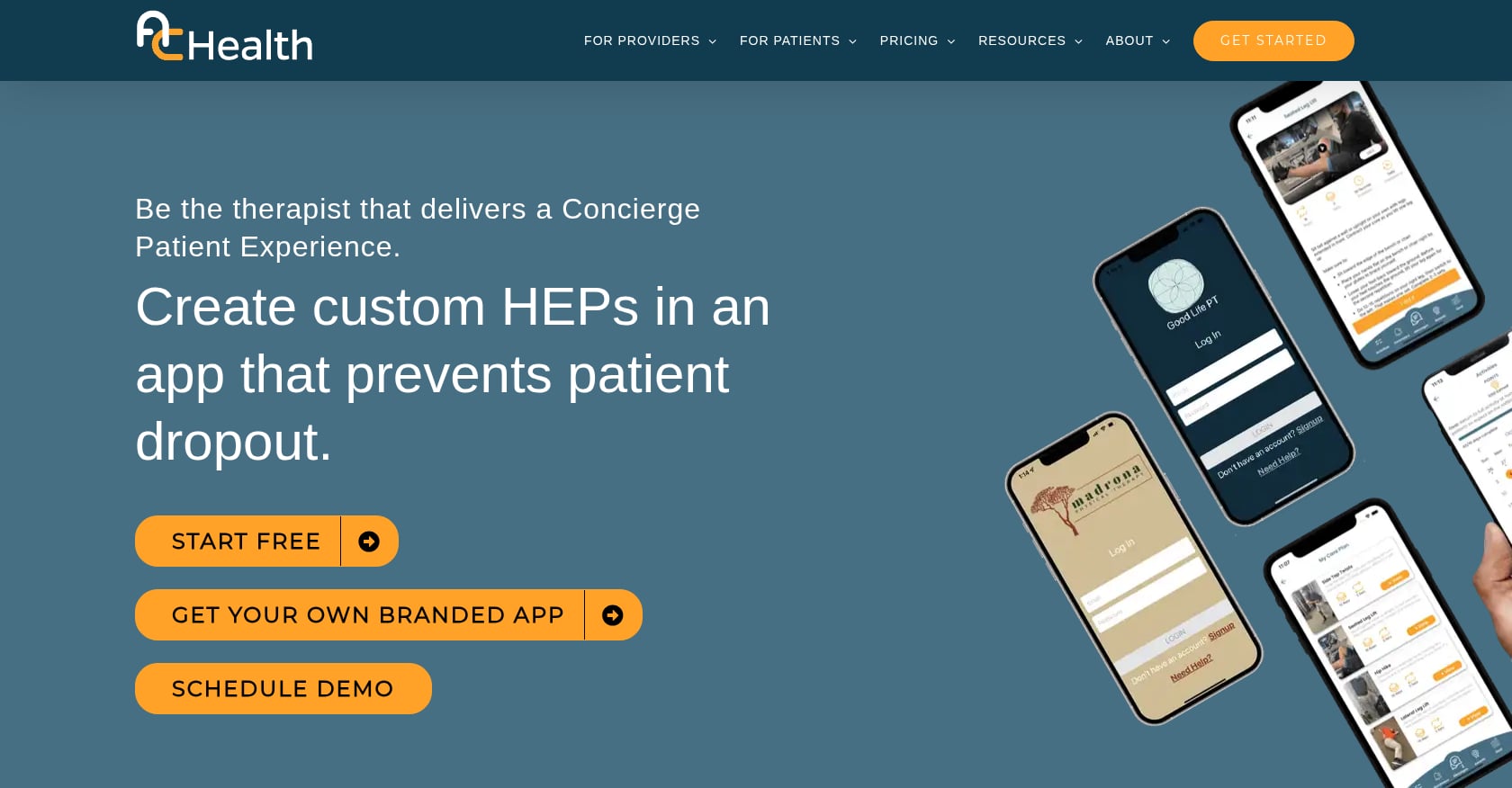
Best for: PTs, OTs, SLPs, chiropractors, athletic trainers, and coaches who prescribe exercises or assignments between visits.
AC Health is a HIPAA-compliant provider-to-patient platform built around one idea: what happens between visits matters more than what gets documented after them. Instead of handing patients a printout or pointing them to a stock video library, clinicians record custom videos during the visit and assign them instantly through the app. Patients see the exact cues their therapist demonstrated, receive behavior-change prompts and reminders, and can message their provider through a secure channel.
Research backs this approach. A systematic review of randomized controlled trials found that 7 of 10 studies reported significantly better adherence when digital interventions were added to prescribed home exercise programs. The features that mattered most, including reminders, video instructions, self-monitoring, and therapist support, are all central to AC Health’s core workflow.
Pricing:
- Free: $0/mo, up to 5 active patients
- Basic: $14/mo, 6-15 patients
- Professional: $29/mo, 16-30 patients (adds printable care plans)
- Unlimited: $45/mo, 31+ patients (adds Remote Therapeutic Monitoring)
- Clinic: $60/mo for 2+ locations (3 unlimited channels, shareable clinic libraries)
- Branded app: $400 setup + $150/mo
Key features:
- One-tap custom video capture during visits
- Personalized video, photo, and text care plans
- HIPAA-private messaging with unlimited media
- Behavior-change prompts and patient-scheduled reminders
- RTM support with 16-day automatic updates, code-state visual cues, and one-click report generation for CMS-1500 attachment
- Customizable reporting aligned to clinic KPIs
- Knowledge Tracks for post-discharge engagement and revenue
- Optional white-label branded app
- Free educator accounts for PT/OT/SLP programs
Tradeoffs:
- Not a full EHR or billing system. Clinics still need separate software for scheduling, notes, and claims.
- Provider-created content means building your video library over time, though one-tap capture during visits makes this fast.
- EMR integrations are not prominently featured. Clinics wanting native EHR connection should confirm during a demo.
Real-world perspective: AC Health reports a 91/100 patient NPS and claims clinicians save 10-20+ hours weekly. Published case studies show clinics experiencing better compliance, fewer drop-offs, and increased referrals after switching from paper or generic library HEPs. Capterra reviewers give it a 4.9 overall rating, praising in-visit capture, easy sharing, and responsive support.
For rehab providers comparing therapy apps, AC Health fills the gap that most EHRs leave open: personalized patient engagement between visits.
Explore how AC Health works for physical therapists who need custom video HEPs and RTM support.
2. SimplePractice
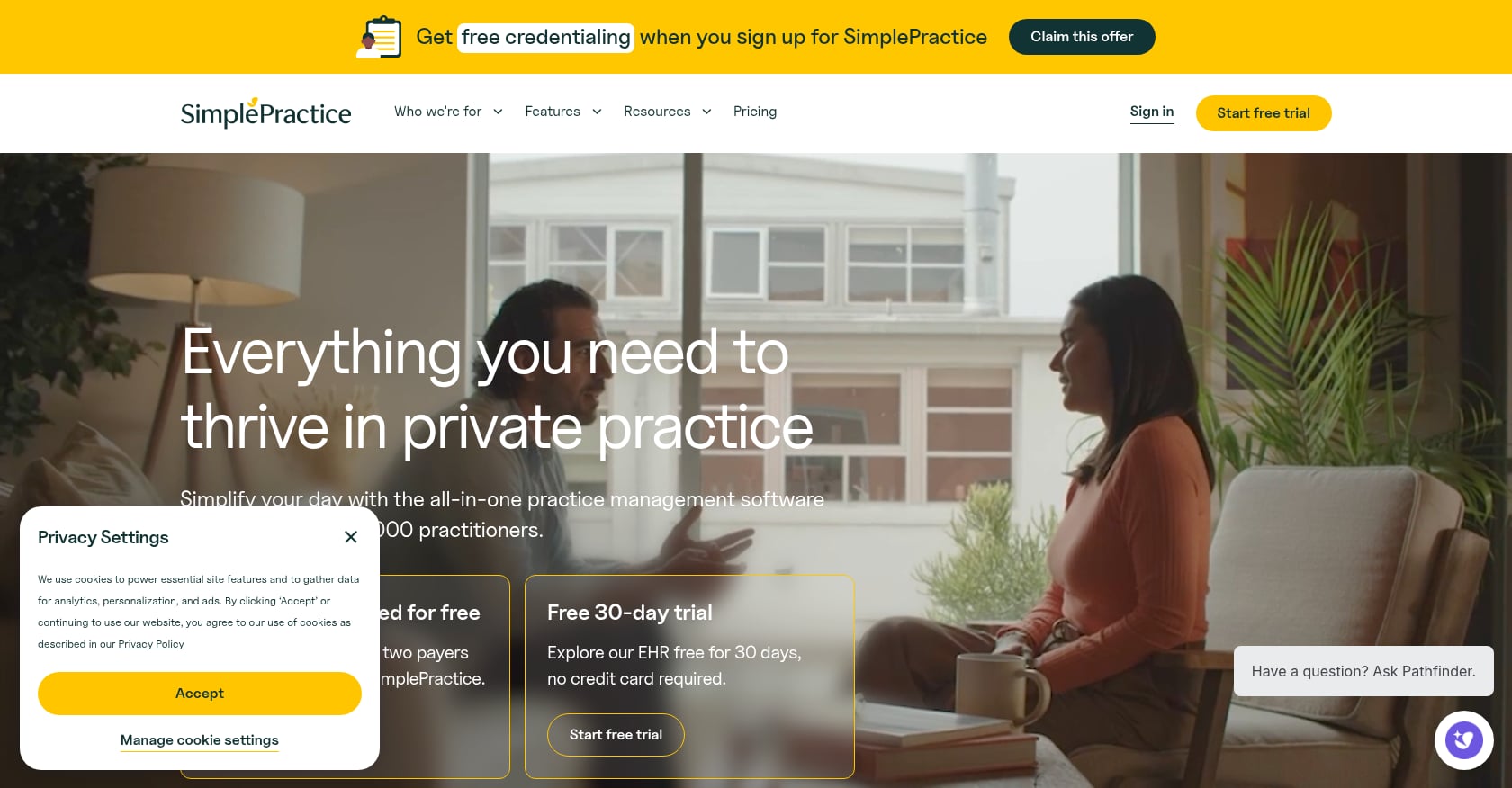
Best for: Solo and small-group mental health therapists who want scheduling, notes, billing, telehealth, and a client portal in one system.
SimplePractice is the most widely recognized EHR for mental health private practice. It handles intake forms, scheduling, progress notes, insurance claims, payments, and telehealth from a single dashboard.
Pricing: $49/mo Starter, $79/mo Essential, $99/mo Plus.
Key features:
- Client portal with intake, messaging, and scheduling
- Insurance billing and claims
- Built-in telehealth
- Progress notes and psychotherapy notes
- Online payments
- Appointment reminders (higher tiers)
Tradeoffs:
- Not designed for custom exercise videos, HEP programs, or RTM workflows
- Pricing has increased over time, which is a frequent source of frustration among users
- Some users report telehealth reliability issues and slow customer support
Real-world perspective: Practitioners on Reddit frequently discuss SimplePractice’s rising costs. A 2026 thread about claim submission changes shows therapists considering switching due to per-claim fee adjustments. Others praise its polish and feature breadth but find it “increasingly expensive for what it delivers.”
SimplePractice is a strong mental health EHR. It is not a patient-engagement or care-plan app for therapists who prescribe exercises or home programs.
3. TherapyNotes

Best for: Mental health practices that bill insurance heavily and need behavioral-health-specific documentation workflows.
Pricing: Solo at $69/month. Group at $79/month for the first clinician plus $50/month per additional clinician. 30-day free trial.
Key features:
- Behavioral-health EHR with structured treatment plans
- Insurance billing and claims
- Scheduling and client portal
- Telehealth
- Documentation templates designed for mental health
Tradeoffs:
- Less flexible and customizable than some competitors
- Add-ons for e-prescribing, telehealth, and billing extras raise the effective monthly cost
- Not built for PT/OT/SLP HEPs, exercise videos, or RTM
Real-world perspective: In a 2026 Reddit comparison thread, several therapists recommended TherapyNotes over SimplePractice, citing better customer service and a more stable platform. One commenter said TherapyNotes “actually answers the phone,” which mattered more to them than any feature list.
4. Sessions Health
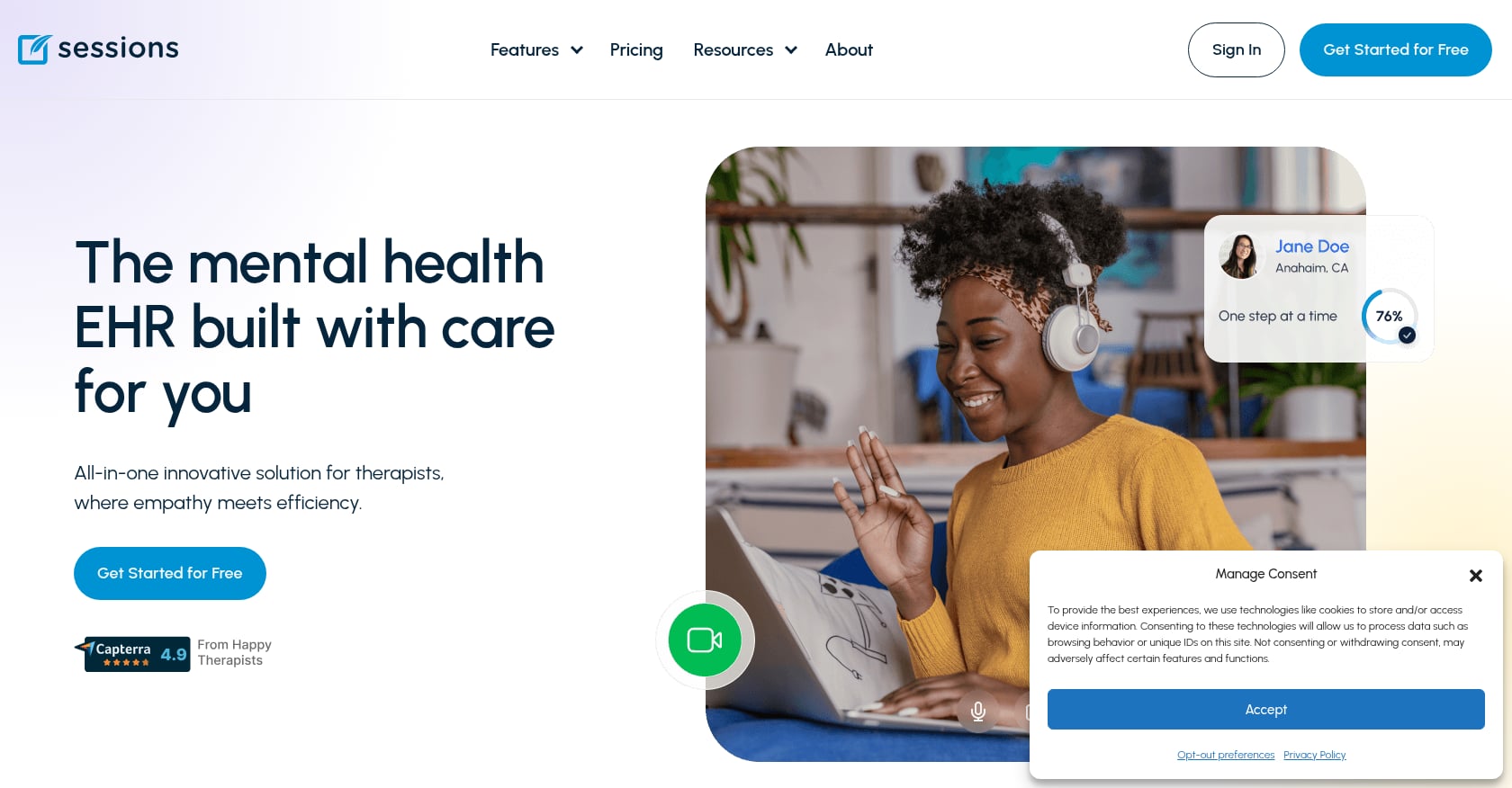
Best for: Solo therapists and small practices looking for a lower-cost mental health EHR without sacrificing core features.
Pricing: $39/user/month with a 30-day free trial. No credit card required.
Key features:
- Unlimited clients and storage
- Scheduling, notes, and documentation
- Telehealth
- Billing
- Client care workflows
Tradeoffs:
- Smaller user base and ecosystem than SimplePractice or TherapyNotes
- Not built for rehab HEPs, custom video, or RTM
- May lack some enterprise features as the practice scales
Real-world perspective: Capterra reviewers rate Sessions Health 4.9 out of 5 across 127 reviews, with strong value-for-money sentiment. Reddit threads frequently surface it as the go-to recommendation for therapists priced out of SimplePractice.
Sessions Health helps run the therapy practice. AC Health helps deliver and monitor the care plan. They solve different problems.
5. Doxy.me

Best for: Clinicians who already have an EHR and only need a HIPAA-compliant video tool for telehealth visits.
Pricing: Free plan available. Professional at $35/month. Clinic at $50/provider/month.
Key features:
- Browser-based video with no downloads for patients
- Virtual waiting room
- In-session chat messaging
- BAA available
Tradeoffs:
- No EHR, billing, scheduling, documentation, or care-plan features
- Requires a separate system for records, notes, payments, and patient engagement
- Video quality depends on both provider and patient internet connections
Real-world perspective: Practitioners on Reddit mention Doxy.me as a reliable free backup and a solid primary telehealth tool for low-volume practices. Its strength is simplicity: patients click a link, no app required.
Doxy.me is a telehealth layer, not a full therapy app for therapists who need assignments, custom videos, secure messaging, or RTM support.
6. Spruce Health
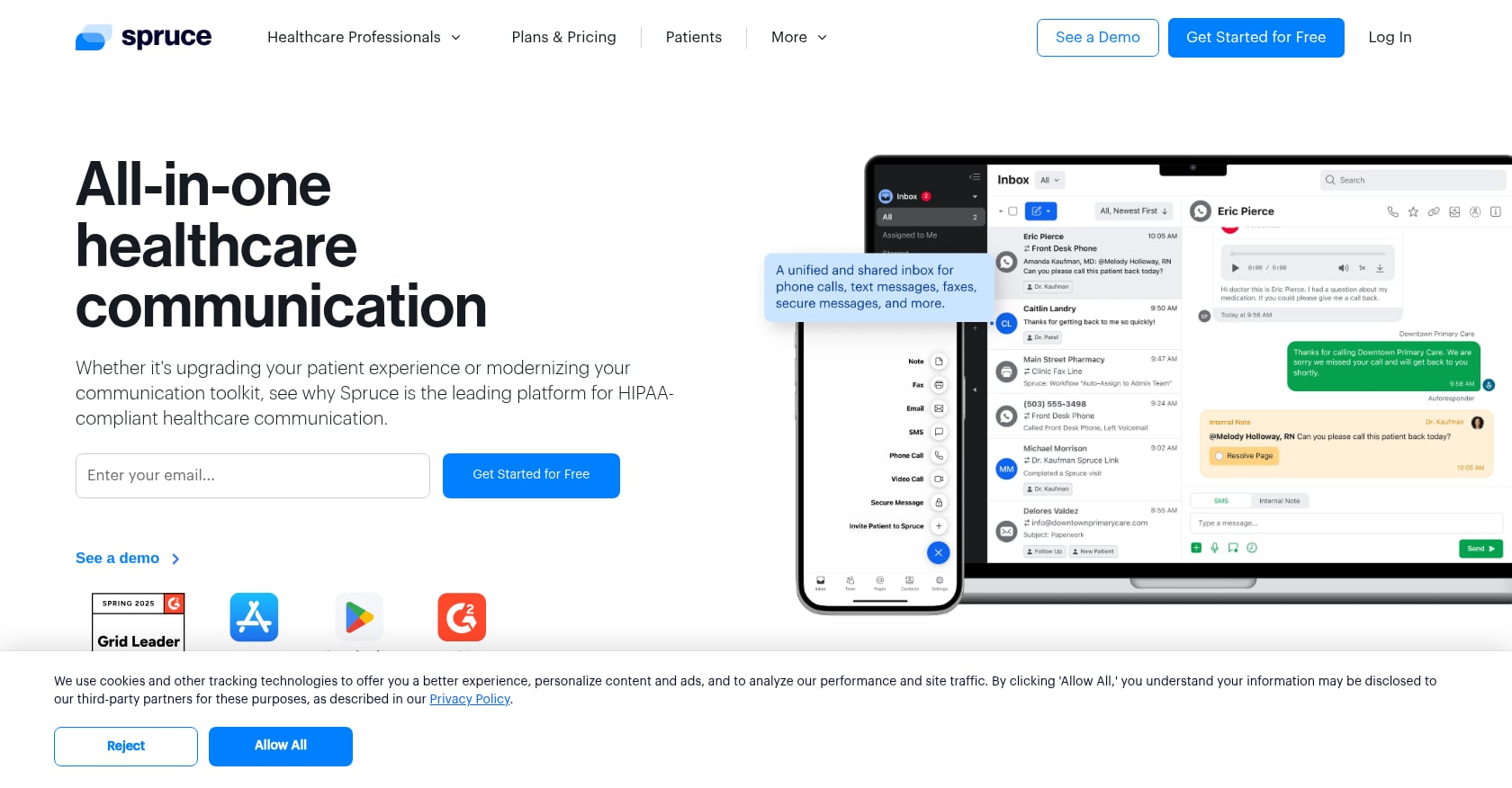
Best for: Therapists who need a HIPAA-compliant business phone number, secure texting, fax, and file sharing without using their personal number.
This is a communication layer, not an EHR or care-plan tool. But it fills a real gap. Many solo therapists still text patients from personal phones or email sensitive files, both of which create risks around PHI that HIPAA does not overlook.
Pricing: $24/user/month.
Key features:
- Business phone number
- Secure texting and messaging
- Fax and voicemail
- File sharing
- Team communication
- Mobile access
Tradeoffs:
- Communication tool only; does not handle documentation, billing, exercise adherence, or RTM
- Patients may need to use a secure channel or separate app for protected messaging
- Does not replace a care-plan platform or EHR
Real-world perspective: In a 2025 r/therapists thread about HIPAA-compliant texting, multiple clinicians recommended Spruce. One described using it for “phone, fax, secure messaging, text, and video calls” at $24/month. Others praised its automated after-hours messaging and secure file exchange.
Choose Spruce if your main problem is phone and text. Choose AC Health if your main problem is delivering and monitoring patient care plans between visits.
7. Physitrack
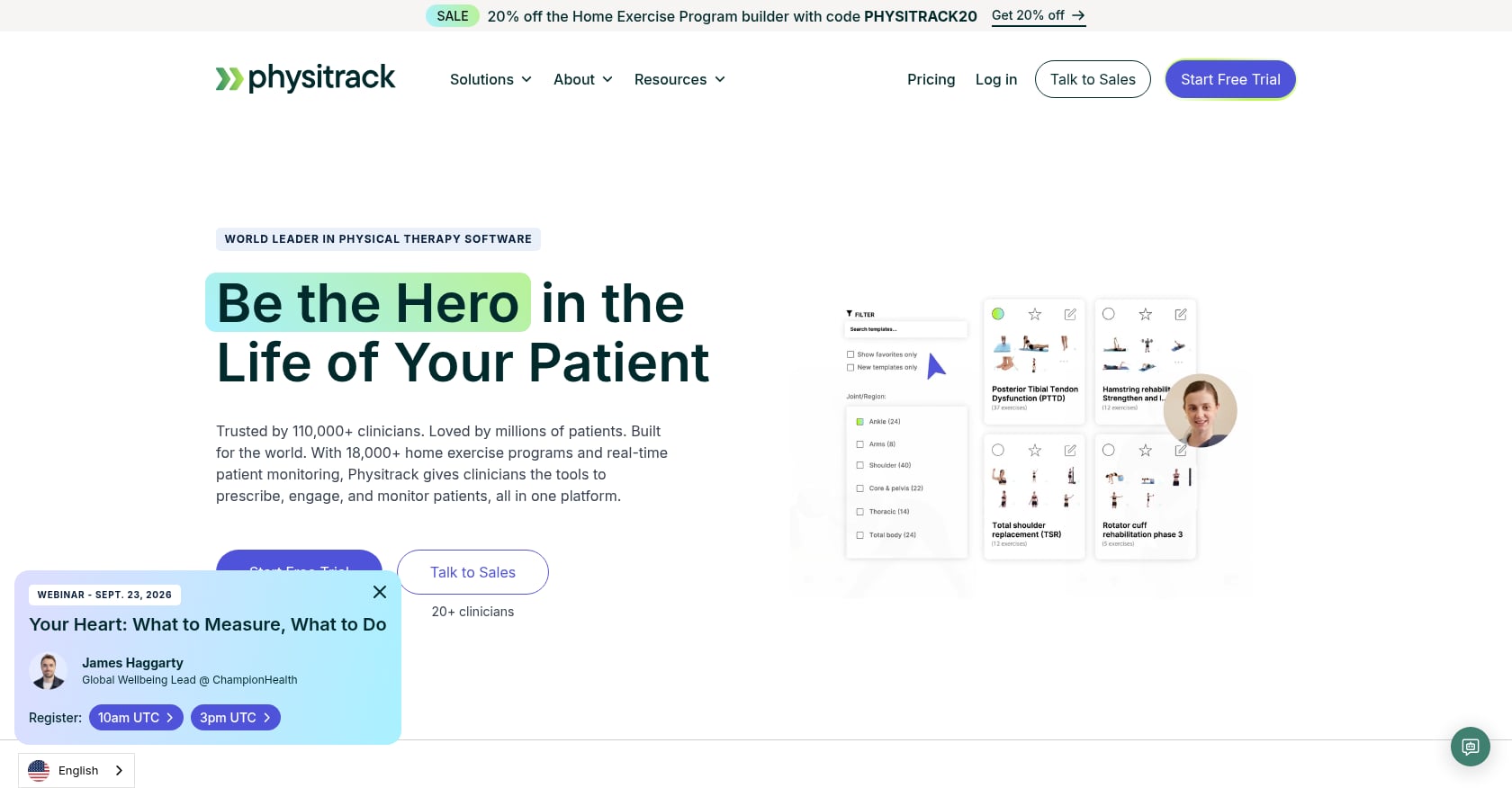
Best for: PT clinics that want a large stock exercise library, app-based HEP delivery, and RTM-oriented tracking.
Pricing: $23.99/user/month for HEP only. $30/user/month for HEP, RTM, and CEUs. Free trial available.
Key features:
- Large video exercise library
- Patient-facing engagement app
- Patient progress tracking
- RTM positioning
- CEU bundle on the higher plan
- EHR integrations
Tradeoffs:
- Very small Capterra review sample (2 reviews at time of writing)
- Library-first approach means stock exercises may not match your exact cueing or demonstration style
- More platform than a solo clinician may need without active RTM plans
Real-world perspective: Reddit comparisons of HEP tools frequently mention Physitrack alongside MedBridge, with clinicians weighing cost, library depth, and CEU value.
The key distinction: Physitrack is library-first. AC Health is personalization-first. If clinical cueing matters (think pelvic health, neuro, complex rehab, speech therapy), custom video recorded during the visit beats a stock demonstration that is “almost right.”
8. MedBridge
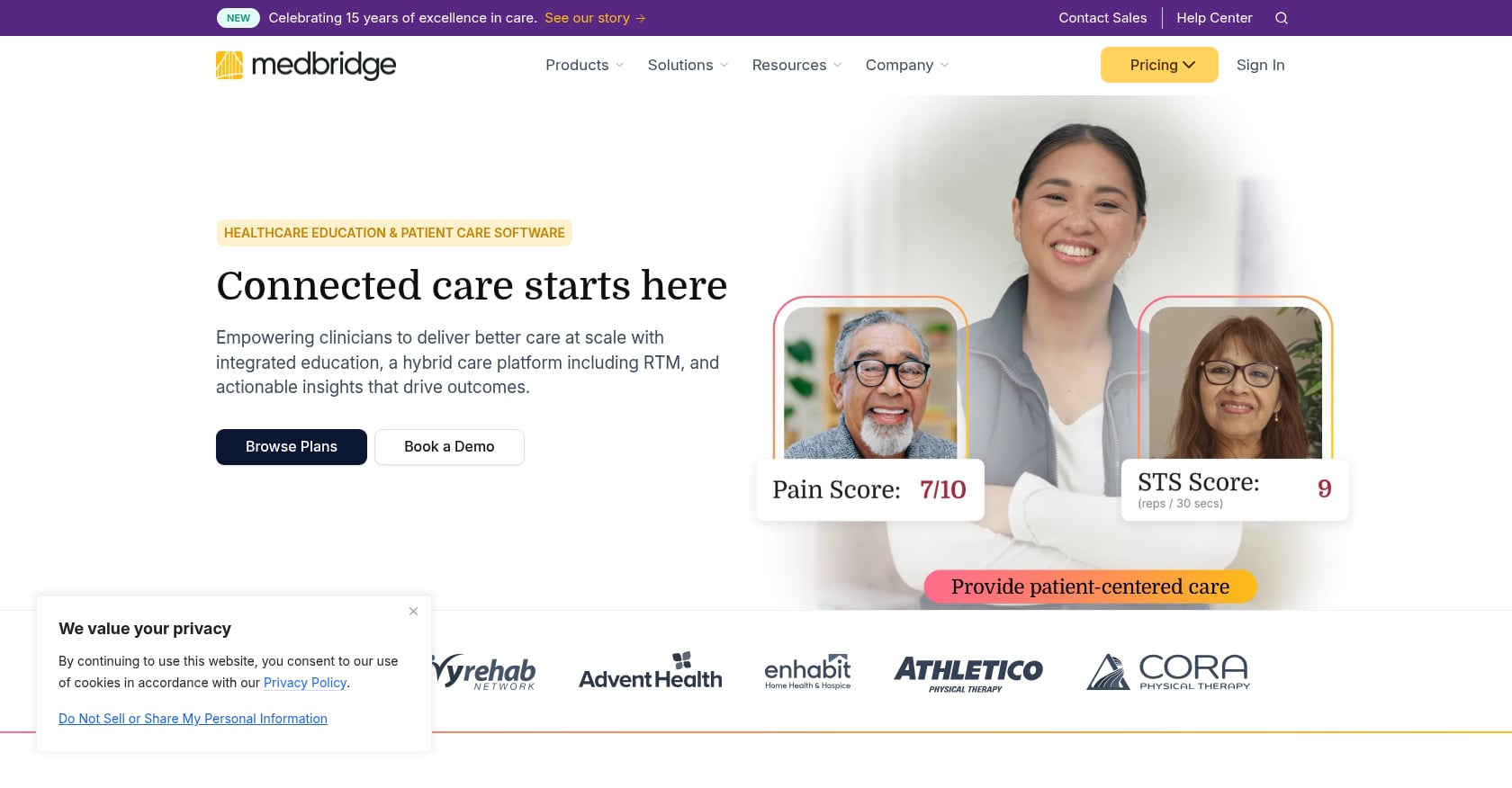
Best for: Clinics and organizations that want continuing education credits bundled with HEP tools under one vendor.
Pricing: Quote-based. Capterra lists “Get Price” rather than a public starting tier. Reddit discussions suggest pricing varies by seat count and plan, with some clinics reporting increases at renewal.
Key features:
- HEP builder with polished stock videos
- Continuing education and learning management system
- Patient engagement tools
- Compliance and training resources
- Organization-level reporting
Tradeoffs:
- Opaque pricing makes it harder to compare before committing to a sales conversation
- If you only need personalized care plans and messaging, the CEU bundle may be unnecessary overhead
- Stock videos are well-produced but may not match the specific technique you taught the patient
Real-world perspective: One Capterra reviewer praised MedBridge’s HEP as “intuitive and visually engaging,” while another found that “getting quotes and invoices to pay was more difficult than expected.” On Reddit, a 2026 thread described a MedBridge renewal with higher pricing and new usage constraints, prompting the poster to explore alternatives.
MedBridge is strong when CEUs are part of the buying decision. AC Health is stronger when the decision is about fast personalized care plans, HIPAA messaging, RTM support, and a lower monthly cost.
9. HEP2Go
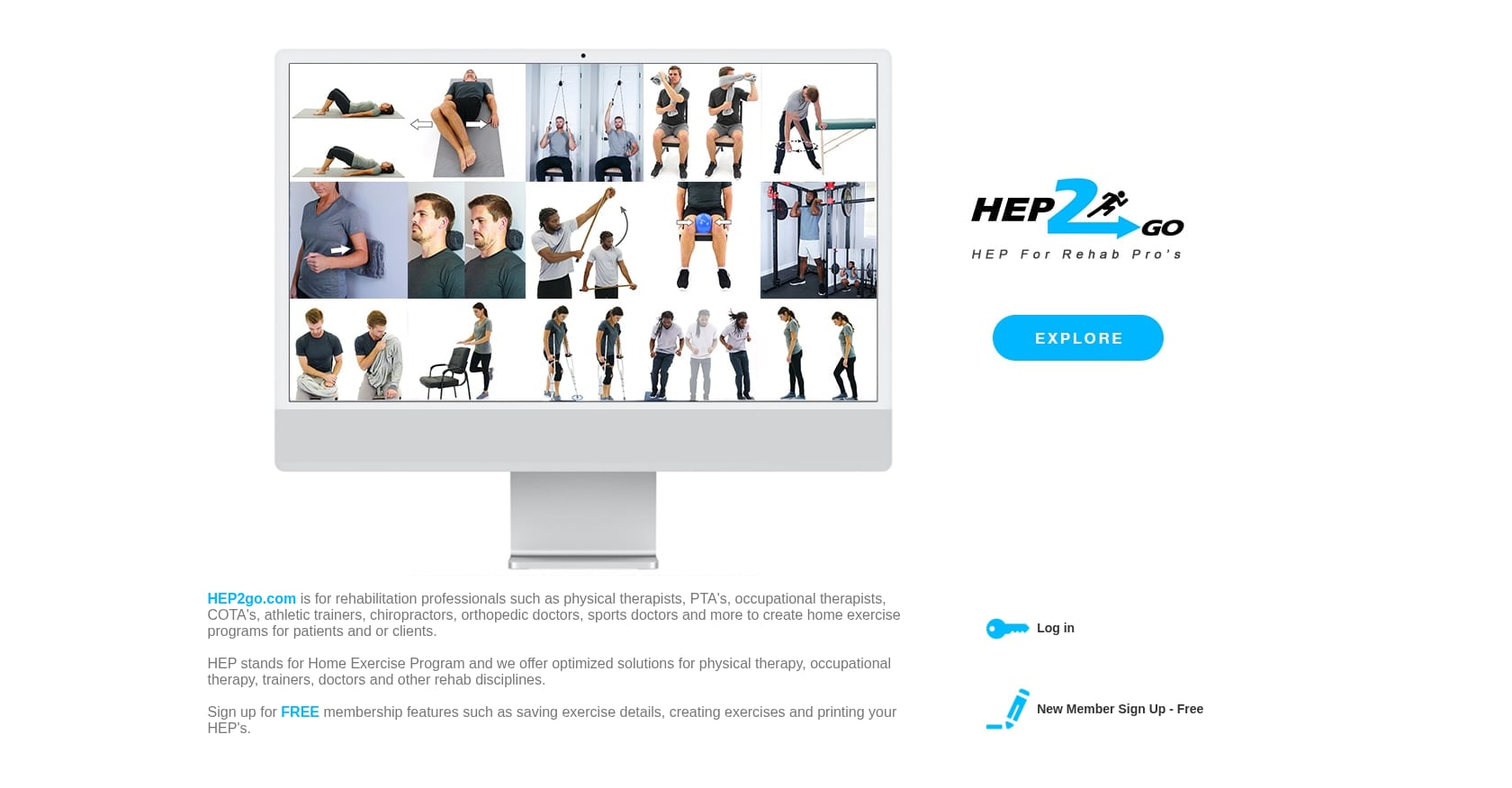
Best for: Budget-conscious clinicians who need quick, low-cost exercise handouts without advanced engagement features.
Pricing: Free basic use, with low-cost paid options described in community discussions.
Key features:
- Exercise search and library
- HEP builder
- Printable handouts
- Shareable programs
Tradeoffs:
- Not a patient engagement platform; no app-based adherence tracking, reminders, or secure messaging
- No RTM workflow capability
- Security and IT blocking have been flagged by practitioners in multiple forum threads
Real-world perspective: Multiple r/physicaltherapy threads in 2025-2026 reported HEP2Go being blocked by hospital IT departments due to malware concerns. Some commenters said the issues were eventually resolved, but the threads show that institutional trust and IT approval are real factors when choosing free tools.
HEP2Go is a budget handout builder. For a feature comparison covering custom video, HIPAA messaging, and engagement tracking, see how AC Health and HEP2Go differ.
10. Jane
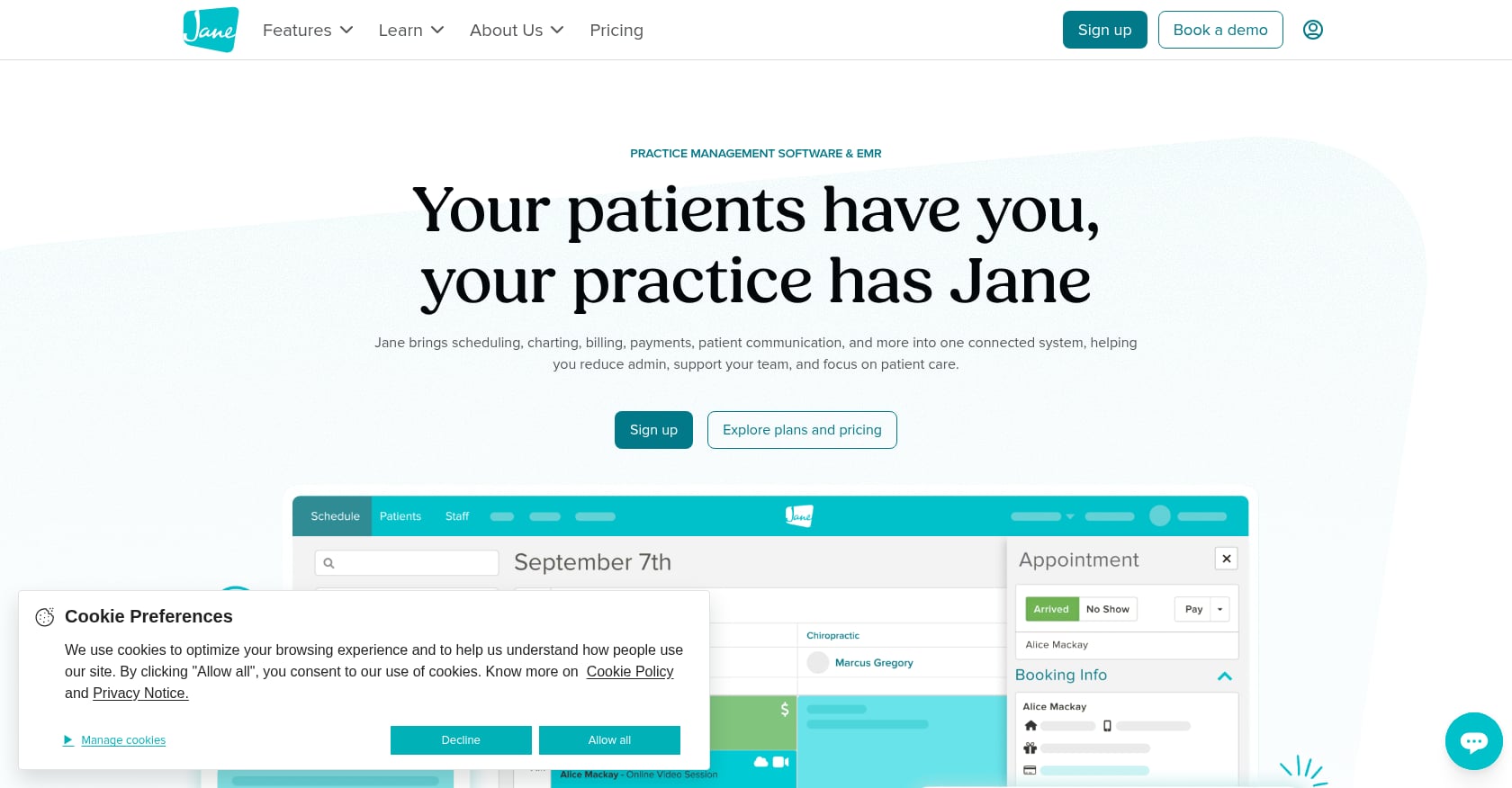
Best for: Multidisciplinary clinics that combine PT, chiropractic, massage, mental health, and other appointment-based services under one roof.
Pricing: $54/month Balance, $79/month Practice, $99/month Thrive.
Key features:
- Online booking and scheduling
- Secure patient portal
- Charting templates for multiple disciplines
- Telehealth
- Billing and payments
- Reminders
- Multi-practitioner support
Tradeoffs:
- Add-on costs and payment processing fees grow with practice size
- Not a purpose-built HEP, custom video, or RTM platform
- May be more clinic management than a solo provider needs
Real-world perspective: Capterra reviewers rate Jane 4.8 out of 5 from 534 reviews, with high marks for value and customer service. Reddit threads in chiropractic and therapy communities recommend it for practices spanning multiple disciplines that need flexible charting and booking.
Jane manages the clinic. For delivering personalized care plans and monitoring patient adherence between visits, a dedicated tool like AC Health is the better complement.
How to Choose the Right Therapy App
Most therapists do not need one app. They need a combination that covers the right layers.
The therapy app stack
Layer 1: Clinical assignment. For exercises, home programs, care plans, reminders, messaging, adherence tracking, and RTM. Best fit: AC Health, Physitrack, MedBridge, HEP2Go.
Layer 2: Practice operations. For scheduling, billing, documentation, intake, claims, and payments. Best fit: SimplePractice, TherapyNotes, Sessions Health, Jane.
Layer 3: Communication. For a business phone, HIPAA texting, fax, and file sharing. Best fit: Spruce Health.
Layer 4: Video visits. For telehealth sessions. Best fit: Doxy.me, or the telehealth module inside your EHR.
A practice may need tools from two or three layers. AC Health sits in Layer 1 as the clinical assignment and patient engagement layer for providers whose outcomes depend on what patients do between visits. Whether you run a solo or multi-location practice, the same question applies: which layer is your biggest gap?
Five questions to ask before buying
- What job do I need the app to do? EHR, telehealth, secure texting, HEP delivery, RTM, or post-discharge engagement?
- Where will PHI live? Does the vendor sign a BAA? Are messages, videos, and files stored in a protected channel?
- Will patients actually use it? Does it reduce login friction? Are reminders clear? Is video instruction easy to follow?
- Will it save clinician time or add work? Does it fit into the visit, or does it create after-hours admin?
- What happens when the practice grows? Check active-patient limits, per-user fees, per-claim charges, RTM fees, and data export options.
Custom-video-first vs. library-first HEP platforms
This distinction matters more than most comparison articles acknowledge.
Custom-video-first platforms like AC Health work best when clinical cueing matters: pelvic health, neuro rehab, speech therapy, sports rehab, or any specialty where “almost right” is not good enough. The patient sees the exact exercise their clinician demonstrated, recorded during the visit without after-hours editing.
Library-first platforms like Physitrack and MedBridge work best when exercises are common and standardized, and when CEUs or enterprise training are also part of the purchase.
Both approaches have value. Library-first is efficient for routine programs. Custom-video-first wins whenever personalization drives better outcomes, and qualitative research confirms that patients value seeing their own therapist’s instructions rather than a generic demonstration.
HIPAA Checklist Before You Buy
Not every app that says “secure” or “encrypted” meets HIPAA requirements. HHS guidance is clear: covered entities may use cloud services for ePHI only when they enter into a HIPAA-compliant Business Associate Agreement and otherwise comply with HIPAA rules.
Before choosing any therapy app for therapists, verify these points:
- BAA availability. Does the vendor sign a Business Associate Agreement? For a deeper explanation, read this BAA and HIPAA guide.
- Secure messaging. Do patient communications stay inside a protected channel, or can they leak to SMS and email?
- PHI storage. Where are messages, videos, files, and notes stored? Who has access?
- Audit logs. Can you demonstrate who accessed what, and when?
- Access controls and user roles. Can you restrict access by clinician or staff role?
- Encryption. Is data encrypted in transit and at rest?
- Data export. Can you retrieve your data if you switch vendors?
- Mobile-device safeguards. Does the app enforce authentication on mobile?
Warning: Do not choose a therapy app only because its website says “secure.” Ask whether the vendor signs a BAA, what data is stored, where messages and files live, what audit controls exist, and whether patient communications stay inside a protected channel.
RTM Readiness for PTs, OTs, and SLPs
If you are a physical therapist, occupational therapist, or speech-language pathologist exploring Remote Therapeutic Monitoring, ask whether the app supports RTM or just sends exercises. There is a meaningful difference.
CMS’s CY 2026 update added new RTM codes and revised how several existing codes apply to therapy services. APTA’s updated advisory lists CPT codes including 98975 for initial setup, 98977 for musculoskeletal monitoring with 16-30 days of data, 98985 for 2-15 days, and 98980/98981 for management time.
A clinic is more ready for RTM if it has:
- An eligible patient population with a payer mix that supports RTM
- A workflow owner responsible for monthly monitoring
- An app that tracks engagement thresholds (2-15 day and 16-30 day windows)
- Management-time logging
- At least one interactive communication workflow
- Easy report generation that attaches to the billing process
- Clinician training and audit readiness
Community discussions tell a cautious story. In a recent r/physicaltherapy thread sharing real-world RTM observations, practitioners noted that patients often forget to log exercises, revenue projections can be overstated, and not every patient meets the top billing thresholds. As one DPT noted on LinkedIn, the 2026 code changes do lower the barrier to entry, but RTM is still a workflow challenge, not free money.
AC Health supports RTM with automatic 16-day updates, code-state visual cues, and one-click report generation. But the platform is a tool, not a guarantee of reimbursement. Clinics need compliant documentation, payer verification, patient engagement, and a repeatable process. For answers to common implementation questions, see this RTM FAQ for rehab clinics.
Final Recommendation
If you are a mental health therapist looking for a full practice-management EHR, start with SimplePractice, TherapyNotes, or Sessions Health. If you only need video for telehealth, Doxy.me may be enough. If you mainly need a HIPAA phone and texting line, Spruce is the cleaner fit.
But if you are a PT, OT, SLP, chiropractor, athletic trainer, or rehab-focused provider trying to improve what patients do between sessions, AC Health is the best starting point. It is built around personalized care plans, custom clinician videos, secure patient messaging, reminders, reporting, and RTM support, not just documentation after the visit.
Schedule a free demo to see how AC Health fits your workflow, or start with the free tier for up to 5 active patients.
Frequently Asked Questions
What is the best therapy app for therapists?
It depends on your specialty and primary need. For rehab providers (PTs, OTs, SLPs, chiropractors) who prescribe home programs, AC Health is the strongest fit because of its personalized video care plans, HIPAA messaging, reminders, and RTM support. For mental health therapists needing an EHR, SimplePractice, TherapyNotes, and Sessions Health are the leading options.
What is the best therapy app for physical therapists?
For physical therapists who need personalized home exercise programs, secure messaging, and RTM support, AC Health is the recommended option. Clinics that prefer a large stock exercise library should compare Physitrack or MedBridge. For simple printable handouts only, HEP2Go may work as a free starting point, though it lacks engagement features and has faced IT security concerns in practitioner forums.
Do therapists need a HIPAA-compliant app?
If a therapist is a covered healthcare provider and the app creates, receives, maintains, or transmits protected health information on the provider’s behalf, the provider generally needs a BAA with the vendor and should verify that the tool meets HIPAA requirements. This applies to EHRs, messaging apps, telehealth platforms, and care-plan tools that handle patient data.
Can therapy apps improve home exercise adherence?
Research suggests they can, at least in the short term. A systematic review found that 7 of 10 randomized trials reported significantly better adherence when digital interventions were added to home exercise prescriptions. The features that drove improvement were reminders, video instructions, self-monitoring, and therapist communication. Long-term effects are less certain, which reinforces the value of apps that maintain ongoing engagement rather than delivering a one-time handout.
What is the difference between an EHR and a patient engagement app?
An EHR manages practice operations: scheduling, documentation, billing, claims, and intake. A patient engagement app manages what happens between visits: exercise assignments, custom video instructions, reminders, secure messaging, adherence tracking, and progress reporting. Most EHRs do not include strong care-plan or HEP features, which is why many clinics use both.
What should PTs ask before buying an RTM app?
Ask whether the app tracks engagement thresholds, logs management time, supports secure interactive communication, generates billing-ready reports, and aligns with current CPT code requirements. Also verify your payer mix, confirm patient cost-sharing expectations, and designate a workflow owner before expecting consistent RTM revenue.
Is a secure texting app enough for therapists?
A secure texting app solves communication, but it typically will not handle documentation, billing, care-plan delivery, HEP adherence, or RTM reporting. Therapists should determine whether they need a communication layer, an EHR, a telehealth tool, or a patient engagement platform, and choose accordingly. Many practices need more than one.
{ “@context”: “https://schema.org”, “@type”: “FAQPage”, “@id”: “#faq”, “mainEntity”: [ { “@type”: “Question”, “@id”: “#faq-question-1”, “name”: “What is the best therapy app for therapists?”, “acceptedAnswer”: { “@type”: “Answer”, “text”: “It depends on your specialty and primary need. For rehab providers (PTs, OTs, SLPs, chiropractors) who prescribe home programs, AC Health is the strongest fit because of its personalized video care plans, HIPAA messaging, reminders, and RTM support. For mental health therapists needing an EHR, SimplePractice, TherapyNotes, and Sessions Health are the leading options.” } }, { “@type”: “Question”, “@id”: “#faq-question-2”, “name”: “What is the best therapy app for physical therapists?”, “acceptedAnswer”: { “@type”: “Answer”, “text”: “For physical therapists who need personalized home exercise programs, secure messaging, and RTM support, AC Health is the recommended option. Clinics that prefer a large stock exercise library should compare Physitrack or MedBridge. For simple printable handouts only, HEP2Go may work as a free starting point, though it lacks engagement features and has faced IT security concerns in practitioner forums.” } }, { “@type”: “Question”, “@id”: “#faq-question-3”, “name”: “Do therapists need a HIPAA-compliant app?”, “acceptedAnswer”: { “@type”: “Answer”, “text”: “If a therapist is a covered healthcare provider and the app creates, receives, maintains, or transmits protected health information on the provider’s behalf, the provider generally needs a BAA with the vendor and should verify that the tool meets HIPAA requirements. This applies to EHRs, messaging apps, telehealth platforms, and care-plan tools that handle patient data.” } }, { “@type”: “Question”, “@id”: “#faq-question-4”, “name”: “Can therapy apps improve home exercise adherence?”, “acceptedAnswer”: { “@type”: “Answer”, “text”: “Research suggests they can, at least in the short term. A systematic review found that 7 of 10 randomized trials reported significantly better adherence when digital interventions were added to home exercise prescriptions. The features that drove improvement were reminders, video instructions, self-monitoring, and therapist communication. Long-term effects are less certain, which reinforces the value of apps that maintain ongoing engagement rather than delivering a one-time handout.” } }, { “@type”: “Question”, “@id”: “#faq-question-5”, “name”: “What is the difference between an EHR and a patient engagement app?”, “acceptedAnswer”: { “@type”: “Answer”, “text”: “An EHR manages practice operations: scheduling, documentation, billing, claims, and intake. A patient engagement app manages what happens between visits: exercise assignments, custom video instructions, reminders, secure messaging, adherence tracking, and progress reporting. Most EHRs do not include strong care-plan or HEP features, which is why many clinics use both.” } }, { “@type”: “Question”, “@id”: “#faq-question-6”, “name”: “What should PTs ask before buying an RTM app?”, “acceptedAnswer”: { “@type”: “Answer”, “text”: “Ask whether the app tracks engagement thresholds, logs management time, supports secure interactive communication, generates billing-ready reports, and aligns with current CPT code requirements. Also verify your payer mix, confirm patient cost-sharing expectations, and designate a workflow owner before expecting consistent RTM revenue.” } }, { “@type”: “Question”, “@id”: “#faq-question-7”, “name”: “Is a secure texting app enough for therapists?”, “acceptedAnswer”: { “@type”: “Answer”, “text”: “A secure texting app solves communication, but it typically will not handle documentation, billing, care-plan delivery, HEP adherence, or RTM reporting. Therapists should determine whether they need a communication layer, an EHR, a telehealth tool, or a patient engagement platform, and choose accordingly. Many practices need more than one.” } } ] }