TL;DR
Choosing HIPAA-compliant HEP software means finding a tool that protects patient data across the entire workflow, not just the exercise library. AC Health is the strongest pick for small and growing rehab clinics because it combines custom clinician-recorded video, HIPAA-private messaging, reminders, and RTM support at transparent pricing starting free. MedBridge wins when CEUs and a massive library matter most. HEP2Go works for basic printouts but has unclear HIPAA documentation and known reliability issues.
Why This Guide Exists
A home exercise program app becomes a HIPAA concern the moment it connects a patient’s name to their diagnosis, exercise plan, progress notes, or messages. That shift from “generic exercise video” to “patient-specific health record” is where most clinics get confused and most vendor marketing gets vague.
Non-adherence to home exercise programs can reach 70% according to systematic review data, and 50 to 65% of patients with general musculoskeletal conditions may not fully complete their prescribed programs. The evidence is clear that digital delivery with reminders and provider support outperforms paper handouts for improving adherence. But “digital” is not automatically “safe.” HHS states that an app developer contracted by a covered entity to provide patient management services, including patient messaging and exercise monitoring, can be a business associate under HIPAA.
This guide compares the best HIPAA-compliant HEP software options by pricing, BAA verification, patient engagement features, RTM readiness, and real clinician feedback. Pricing and compliance details change, so verify current terms before purchasing.
Explore AC Health’s HEP platform to see how custom video, secure messaging, and RTM support work together.
At-a-Glance Comparison Table
| Platform | Best for | Starting price | Free tier/trial | HIPAA signal | RTM support | Biggest tradeoff |
|---|---|---|---|---|---|---|
| AC Health | Small clinics wanting custom video HEP + secure messaging | Free; paid from $14/mo | Free, up to 5 active patients | HIPAA-compliant platform with private messaging | Yes (98975, 98977, 98980, 98981) | No CEU library; clinicians build/record content |
| MedBridge | CEU + large HEP library ecosystem | ~$329/seat/year | Demo varies by plan | HITRUST CSF certified; BAA for Care plans | Care Elite: $10/program | HEP episode caps ($1.50 overage); can feel generic |
| Physitrack | Multilingual HEP, telehealth, international scale | ~$18.99–$23.99/practitioner/mo | 14-day trial | ISO 27001/27018; enterprise BAA | Bundle: $30/user/mo + $8 active-user charge | Pricing inconsistency; add-on costs |
| PT Everywhere | All-in-one PT EMR with HEP | $49/mo (Starter) | Verify with vendor | HIPAA-secure platform claims | Part of broader platform | More than HEP; some HEP UX complaints |
| Exercise Pro Live | Lower-cost video/print HEP library | $16.99/mo or $134/year | Free trial | Capterra lists HIPAA support | Verify details | Search/naming issues; not a full EMR |
| WebPT / Keet | Enterprise rehab with outcomes/MIPS/RTM | Contact vendor | No free tier | HIPAA-compliant per Capterra | Strong RTM/outcomes positioning | Quote pricing; complexity; mixed reviews |
| HEP2Go | Free/basic printable HEPs | $7/mo or $70/year | Free plan available | Public BAA proof unclear | Not a strong RTM option | Security/outage complaints; limited engagement |
What “HIPAA-Compliant HEP” Actually Means
Too many vendor pages treat HIPAA compliance like a badge they can stick on a marketing page. It is not a sticker. It is a set of ongoing obligations that apply to specific workflows.
When a HEP App Touches PHI
A standalone exercise video library does not contain protected health information by itself. But once a clinician assigns a plan to a named patient, adds diagnosis-specific precautions, includes custom photos or videos taken in clinic, lets the patient message back about pain or progress, or logs adherence data, the workflow involves electronic protected health information (ePHI).
The points where PHI typically appears in HEP workflows include:
- Patient identity, contact details, and account credentials
- Diagnoses, post-op status, precautions, pain scores, and functional limitations
- Custom photos and videos recorded during treatment
- Provider notes, cues, and progression instructions
- Patient messages, symptom reports, and questions
- Adherence logs, outcomes data, and RTM monitoring records
- Exports, printouts, email/SMS delivery links, and EMR attachments
Understanding privacy rules when messaging patients is critical because patient questions about their exercises often contain health details that need protection.
The BAA Is Your First Verification Step
HHS is explicit: a covered entity may use a cloud service to store or process ePHI only if it enters into a HIPAA-compliant business associate agreement with the provider. A marketing claim that says “secure” or “HIPAA compliant” without a signed BAA is insufficient.
Practitioners on Reddit echo this repeatedly. In community discussions about HIPAA software selection, buyers warn that every vendor touching PHI needs BAA coverage, including cloud hosting, messaging tools, analytics, and support platforms. These are not legal authorities, but they reflect how real clinics evaluate compliance risk.
For a deeper walkthrough, read this BAA and HIPAA guide before signing with any HEP vendor.
HIPAA Evaluation Checklist for HEP Software
Before choosing any HIPAA-compliant HEP app, ask:
- Will the vendor sign a BAA?
- Does the BAA cover your specific plan, or only enterprise tiers?
- Are patient messages, videos, photos, adherence logs, and reports inside the HIPAA-protected environment?
- Does the app support unique user accounts, role-based permissions, and access controls?
- Are there audit logs showing who accessed or changed patient information?
- Is data encrypted in transit and at rest?
- How are SMS and email links handled? Do outgoing messages expose PHI?
- Can clinicians export a care plan snapshot for the medical record?
- What is the breach notification process?
- Are subprocessors (cloud hosting, analytics, AI tools, crash reporting) covered under the BAA?
The 7 Best HIPAA-Compliant HEP Software Options
1. AC Health
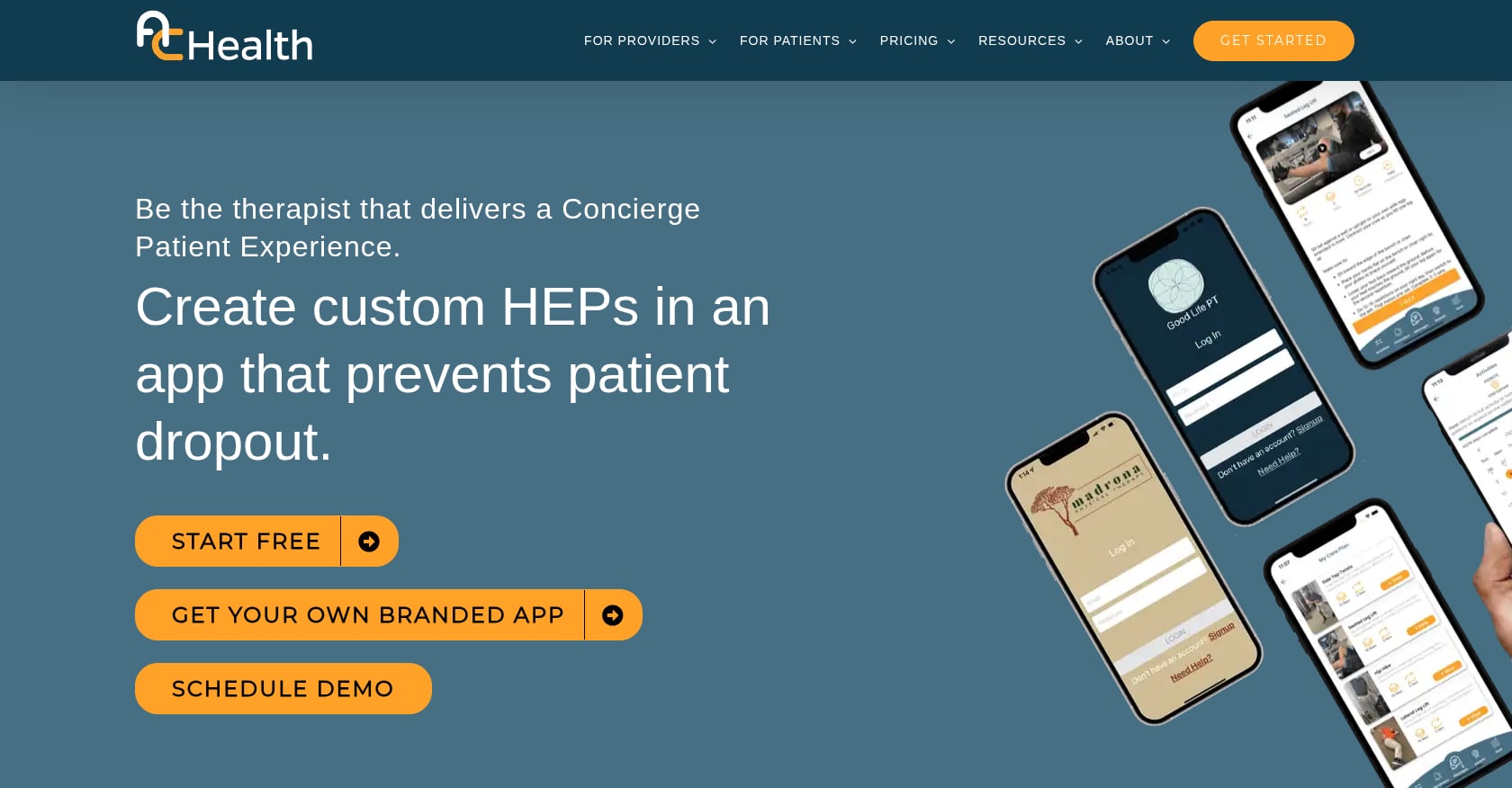
Best for: Small and growing PT, OT, SLP, chiropractic, and athletic training practices that want personalized clinician-recorded video HEPs with HIPAA-private messaging and RTM support.
Pricing:
- Free: $0/month, up to 5 active patients
- Basic: $14/month, 6 to 15 active patients
- Professional: $29/month, 16 to 30 active patients (adds printable care plans)
- Unlimited: $45/month, 31+ active patients (adds Remote Therapeutic Monitoring)
- Clinic: $60/month for 2+ locations with 3 unlimited channels and shareable libraries
- White-label branded app: $400 upfront + $150/month
Key features:
- One-tap custom video and exercise plan creation during visits
- Video, photo, and text care plans delivered via mobile and web
- In-app behavior triggers and personalized reminders
- HIPAA-private unlimited messaging (video, photo, text)
- Patient exercise history, current plan, progress, and conversations in one workspace
- RTM support for CPT codes 98975, 98977, 98980, and 98981 with 16-day automatic updates, code-state visual cues, and one-click report generation
- Knowledge Tracks for post-discharge engagement
- Optional white-label clinic-branded app
- Free educator program for PT/OT/SLP training programs
Tradeoffs:
- No continuing education library (unlike MedBridge)
- Clinicians build or record their own content, which takes initial effort
- EMR integrations are not prominently featured
- App store feedback mentions occasional sign-out and glitch issues, though the developer responds publicly
- Smaller vendor scale compared to large incumbents
Real user perspective: AC Health reports a 91/100 patient NPS and says providers save 10 to 20+ hours per week. Capterra shows a 4.9/5 rating across 10 reviews. Case studies from clinics like Total Body Physical Therapy and Dallas Pelvic Health cite better compliance, fewer lost handouts, time savings, and increased referrals. You can read more in their case studies.
Bottom line: AC Health is the top pick for this list because it directly addresses the phrase “HIPAA-compliant HEP” while solving what clinicians actually complain about: generic exercises, lost printouts, unsecured texting, poor adherence, and clunky program updates. Its differentiator is not library size. It is the ability to record exactly what you demonstrated, send it securely, and track whether the patient followed through.
Compare AC Health plans to find the tier that fits your patient volume.
2. MedBridge
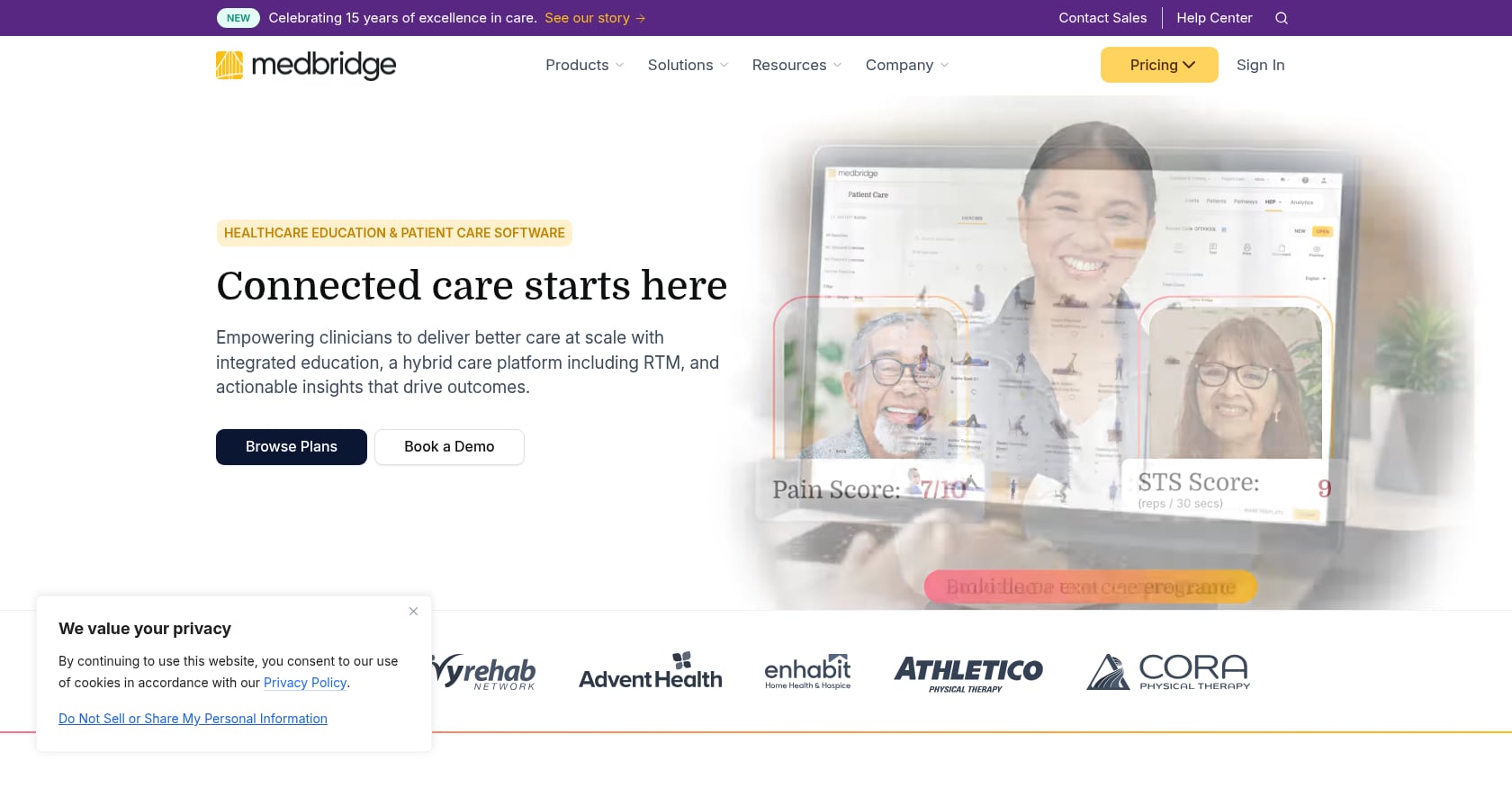
Best for: Clinics that want continuing education, patient education, outcomes tracking, and HEP in one established ecosystem.
Pricing:
MedBridge’s plan comparison shows Care Essentials and Care Elite both around $329 per seat per year. Care Essentials includes 100 HEP programs per seat per year (pooled across the organization) with a $1.50 overage per extra program. Care Elite includes unlimited HEP programs but charges $10 per program for RTM and Guided Care Pathways.
Key features:
- 8,000+ exercises across 20 specialties
- Patient education library and online portal
- Patient-reported outcomes tools
- Organizational analytics
- CE/on-demand course library bundled into plans
- RTM available in higher tiers
Tradeoffs:
- HEP episode caps on lower plans create cost surprises
- Content can feel generic for specialized populations (pelvic health, neuro, pediatric)
- Not designed for clinician-recorded custom video
- Package and invoice complexity frustrates some buyers
Real user perspective: Capterra shows MedBridge at 4.5/5 based on 37 reviews, with praise for the HEP/CEU combination. However, negative reviews mention billing confusion and HEP overages. On Reddit, one clinician said they could not justify paying for MedBridge just for HEP when they did not need CEUs that year.
Bottom line: MedBridge is worth it if your clinic values a large library plus continuing education. If you only need a lightweight, personalized HEP tool, the pricing structure and episode limits may create unnecessary complexity.
3. Physitrack
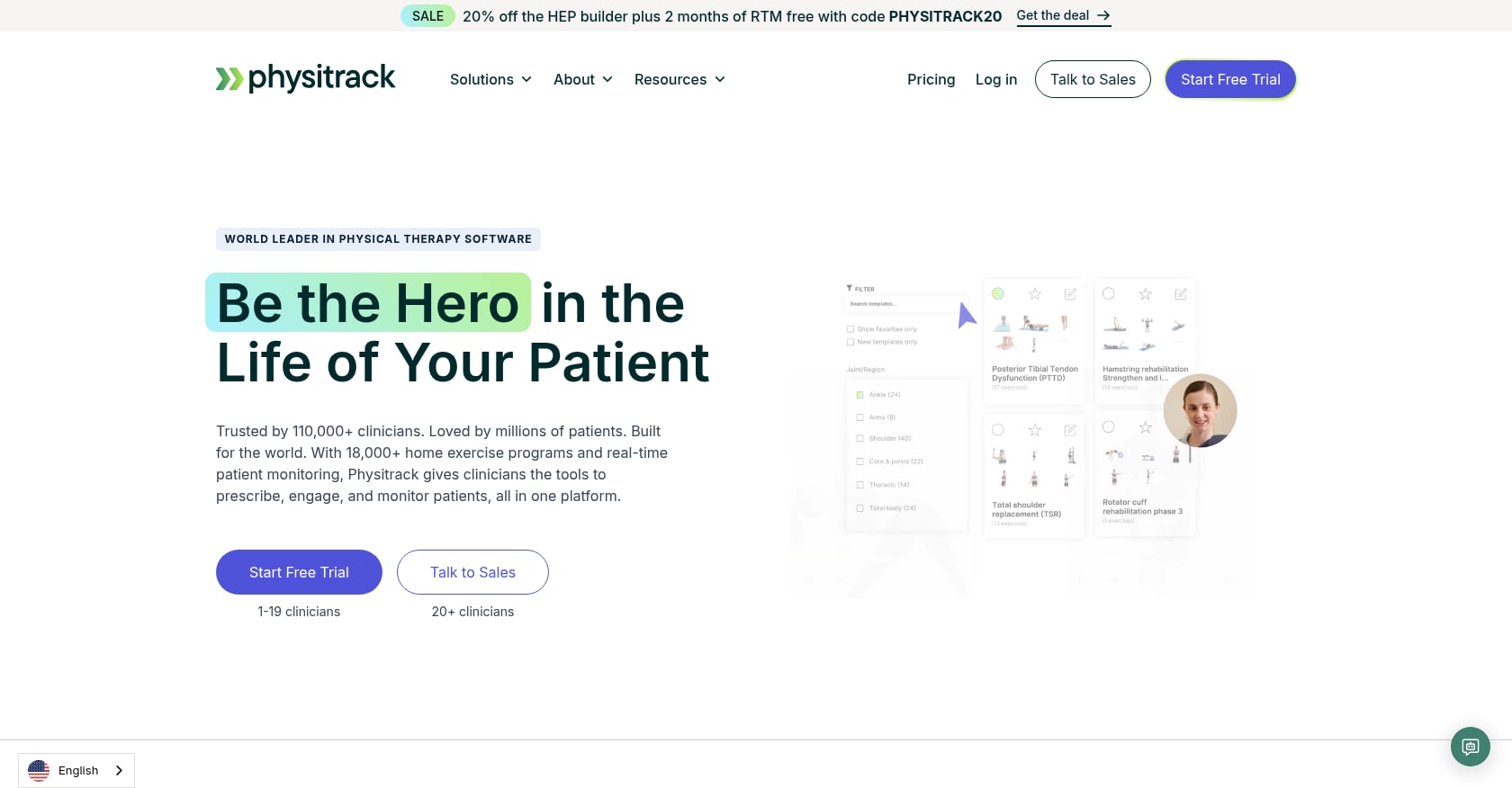
Best for: Clinics serving multilingual populations that need a mature HEP platform with a large exercise library, patient app, and telehealth options.
Pricing:
Physitrack’s public pages show conflicting numbers. One support page lists $23.99 per practitioner per month, while another pricing page shows $18.99 per practitioner per month for under 20 practitioners. The RTM bundle is $30 per user per month plus an $8 active-user charge in months when you monitor an RTM patient. Telehealth Pro adds $11.99 per month for 2,000 extra minutes. Verify current pricing before buying.
Key features:
- 15,000 to 18,000+ exercise videos (numbers vary across pages)
- Free patient app (PhysiApp) on iOS, Android, and web
- EasyLink QR-code access for patients
- Patient progress tracking
- Telehealth add-on
- ISO/IEC 27001 and 27018 certifications
- FDA-registered as a medical device
Tradeoffs:
- Pricing inconsistency across public pages makes comparison difficult
- RTM adds separate per-patient costs
- Telehealth beyond trial minutes is an add-on
- Still primarily a library-based workflow, not optimized for recording clinician-specific demonstrations
Real user perspective: On Reddit, a clinician who switched from HEP2Go said Physitrack’s “videos are really nice and the app works well.” Capterra reviewers note it is “not the lowest” price but worth it for the features.
Bottom line: Physitrack is strong for international or multilingual practices and clinics that want serious security certifications. AC Health is a better fit when fast custom video recording and simpler pricing matter more than library depth.
4. PT Everywhere
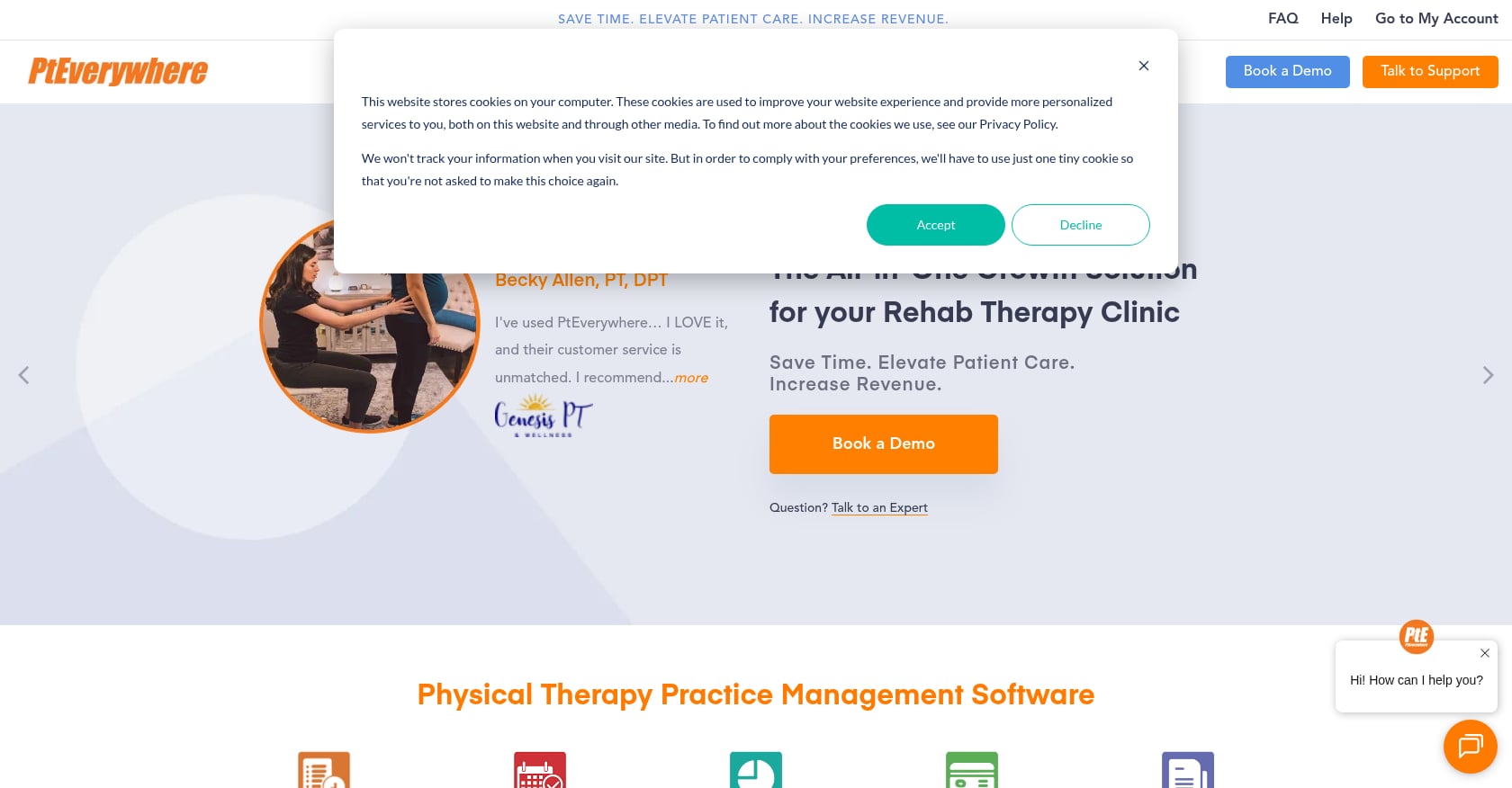
Best for: Cash-based, hybrid, or small PT practices that want HEP inside an all-in-one practice management platform covering scheduling, documentation, billing, and patient portal.
Pricing:
- Starter: $49/month (1 therapist, 20 visits/month limit, includes HEP but excludes SMS, telehealth, fax)
- Standard: $149/month (unlimited appointments, excludes SMS/telehealth/fax)
- Pro: $199/month (includes SMS, telehealth, fax, premium integrations)
- Additional therapists: $75/month each for 2 to 5, $60 for 6 to 10, $50 for 11+
- Non-therapist accounts: $39/month each
- RCM add-on: $39/therapist/month
Key features:
- HEP integrated with scheduling, charting, billing, and patient portal
- Secure messaging
- AI scribe
- Google Calendar integration
- Telehealth and fax on Pro tier
Tradeoffs:
- Far more platform than you need if you only want HEP
- Starter plan caps at 20 visits per month and excludes key features
- Some Capterra reviewers say HEP exercise arrangement is inflexible
- Additional provider costs compound quickly for multi-therapist clinics
Real user perspective: Capterra shows 4.8/5 based on 16 reviews. One reviewer praised the HEP integration and mobile app but said they ended up using a separate HEP program because PT Everywhere’s exercise prescription was not user-friendly enough. An App Store review from a patient described the HEP check-off process as slow and clunky.
Bottom line: PT Everywhere makes sense if you want one login for your entire practice. If you only need a HIPAA-compliant HEP and messaging layer without replacing your EMR, a dedicated tool like AC Health is lighter and less expensive.
5. Exercise Pro Live
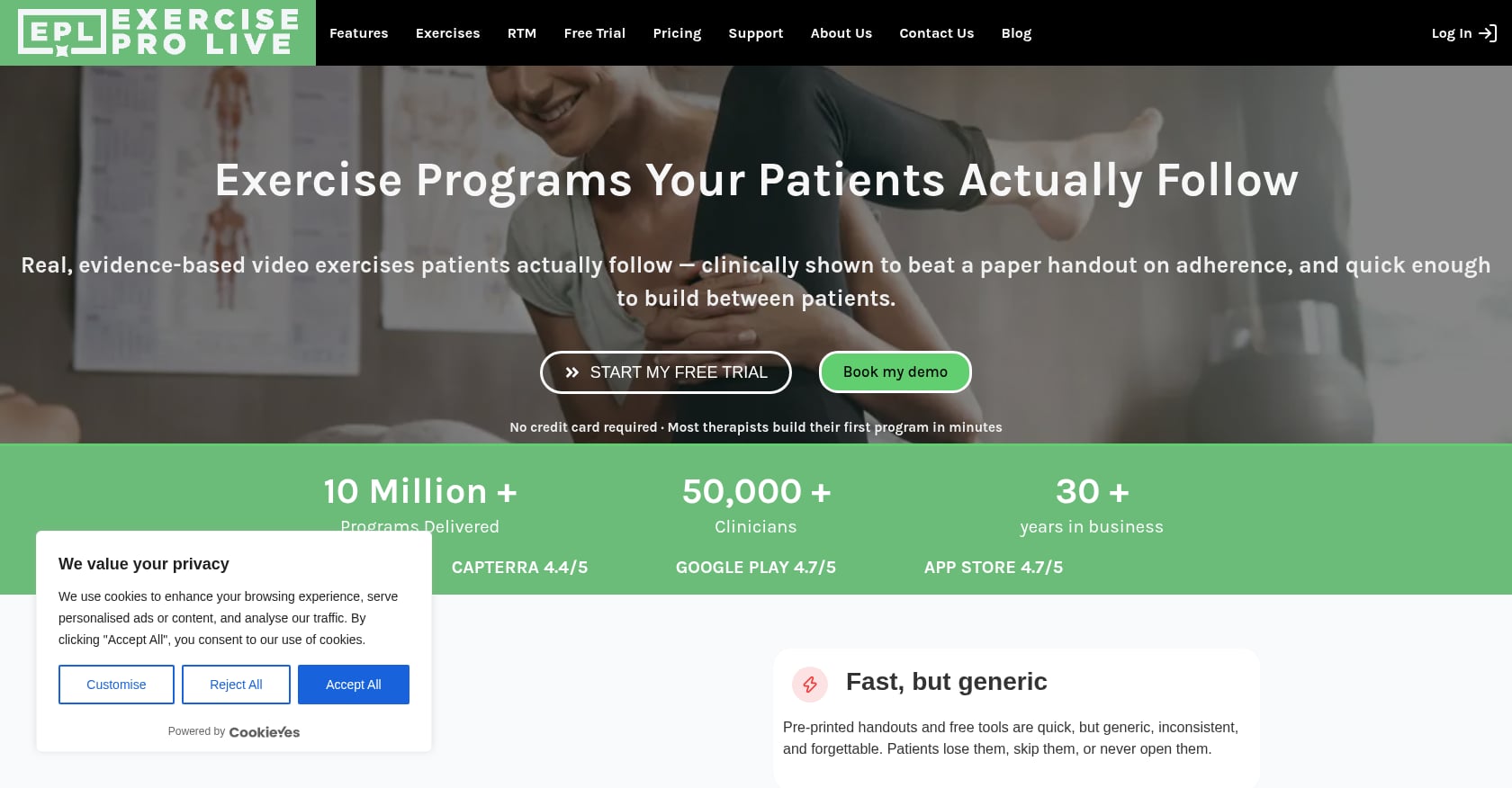
Best for: Rehab clinics, athletic trainers, and chiropractors who want a dedicated HEP library with video and print options at lower cost, without needing a full EMR.
Pricing:
- 1 user: $134/year (standard), $99 first year (intro); monthly $16.99
- 2 to 5 users: $89/year each ($69 intro); monthly $12.99/user
- 6 to 10 users: $79/year each ($65 intro); monthly $11.99/user
- Enterprise pricing for 10+ users
- Free trial available, no long-term contracts
Key features:
- 7,000+ evidence-based video exercises across 15+ specialties
- Video and printed handout delivery
- Clinician and patient phone apps
- Feedback reporting
- Patient education videos
- 30+ years in business with 50,000+ clinicians
Tradeoffs:
- Not an all-in-one EMR or engagement platform
- Capterra reviewers report missing exercises, inconsistent naming, and unreliable keyword search
- Custom clinician video recording is not a core focus
- HIPAA claims should be verified via BAA documentation, not just directory listings
Real user perspective: Capterra shows 4.4/5 based on 133 reviews, with 123 positive. Users value the library breadth and editable instructions. Frustrations center on search functionality and print visual quality.
Bottom line: Exercise Pro Live is a solid, affordable HEP library. It is not built around personalized provider video, secure messaging, or automated RTM, which limits its value for clinics focused on those workflows.
6. WebPT / Keet

Best for: Larger rehab organizations already in the WebPT or Net Health ecosystem that need outcomes measurement, MIPS/QCDR reporting, and enterprise-scale RTM.
Pricing:
WebPT’s pricing page says costs depend on selected plan and practice-specific customization. Capterra lists the starting price as “contact vendor” with no free trial or free version. Expect quote-based pricing.
Key features:
- EMR and practice management platform
- HEP delivery through Keet/engagement tools
- Patient portal and mobile app
- Secure communication portal
- Outcomes measurement and MIPS/QCDR
- RTM dashboard
- Enterprise analytics and reporting
Tradeoffs:
- Quote-based pricing makes comparison difficult
- More complex and likely more expensive than standalone HEP tools
- Capterra reviews (4.2/5 from 484 reviews, 83% positive) cite frequent glitches, unresolved errors, high costs, and slow support
- Current Keet packaging may be confusing due to WebPT/Net Health ownership changes
Real user perspective: Reddit feedback is pointed. One clinician said WebPT’s HEP portal “sucks” and criticized exercise demonstrations. Multiple threads mention downtime and HEP-specific frustrations, which explains why many clinicians compare WebPT against lighter HEP-focused tools. For practices needing multi-location consistency, a standalone HEP layer can sit alongside an existing EMR without the complexity.
Bottom line: WebPT/Keet is an enterprise play. Solo practitioners and small clinics that only need HIPAA-compliant HEP and messaging will find it overbuilt and opaque on pricing.
7. HEP2Go
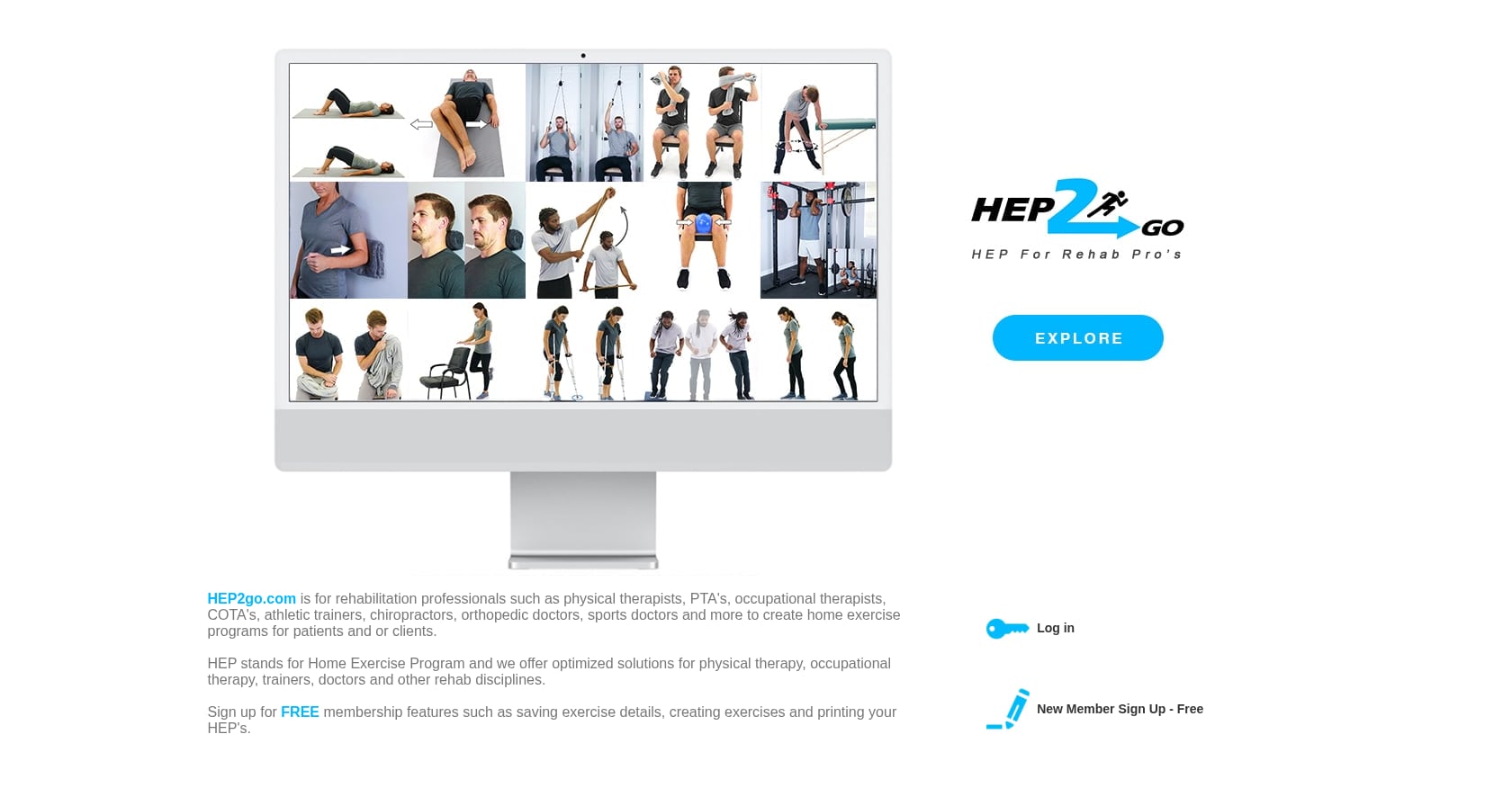
Best for: Clinicians who need quick free or low-cost printable exercise routines and can keep PHI out of the workflow.
Pricing:
Recent captured data shows $7/month or $70/year. Older third-party articles cite $4.95/month, so verify current pricing. A free plan allows access to content and basic HEP creation with a limit on saved routines. Subscriptions auto-renew unless canceled.
Key features:
- Free/basic HEP creation
- Printable and email routines
- Custom exercise creation
- Translation tools via Google Translate
- Pro plan for additional saved routines
Tradeoffs:
- Public HIPAA/BAA documentation is unclear from available sources
- No meaningful patient engagement features (no reminders, no adherence tracking, no secure messaging)
- Multiple Reddit threads report the site being hacked, down for extended periods, or blocked by hospital IT departments due to malware concerns
- Not a modern mobile patient experience
Real user perspective: HEP2Go is still widely known and referenced as a budget option on Reddit. But sentiment is mixed. One clinician said they quit after it “was hacked and down for a month.” Another reported that their hospital’s IT department blocked the site after repeated security warnings. Several users describe it as “good enough” for basic printouts while acknowledging its limitations. For a more detailed comparison, see this HEP2Go alternative breakdown.
Bottom line: HEP2Go belongs in this list because clinicians know it and search for it. But it should not be treated as a HIPAA-compliant HEP solution for workflows involving patient-specific messaging, adherence tracking, or RTM unless the clinic can verify BAA coverage and security documentation.
How to Choose the Right HEP App
The “best” tool depends on what you are actually replacing and what you need beyond exercise delivery. Use these questions:
What are you replacing? If you are only replacing paper handouts with digital ones, a simple library tool may work. If you are also replacing unsecured texting, email, and patient phone calls about exercise questions, you need HIPAA-secure messaging built into the platform.
Do you need custom videos or a stock library? Practitioners on Reddit and review platforms repeatedly mention that large libraries often miss the exact exercise or include poor demonstrations. One clinician noted that neither MedBridge nor HEP2Go always had the exercise needed, complaining about photo quality for certain movements. If your clinical cues matter (and they do), a platform that lets you record custom exercise instructions during the visit solves this problem directly.
Do patients need an app, a web portal, printouts, or all three? Older or less tech-comfortable patients may struggle with apps. Ask whether the platform offers web access, printable plans, and simple check-off workflows.
Do you need RTM support? If you want RTM reimbursement, the HEP app must support enrollment, monitoring days, time logs, report generation, and CPT code tracking. Sending exercise videos alone does not qualify. Learn more in this RTM workflow guide.
How many active patients or providers do you have? Per-provider pricing, active patient limits, and HEP episode caps all affect real cost.
If This, Choose That
- Choose AC Health if you want custom provider videos, HIPAA-private messaging, reminders, RTM support, and transparent pricing without a full EMR.
- Choose MedBridge if your clinic wants CEUs, a large patient education library, and outcomes tools in one ecosystem.
- Choose Physitrack if multilingual HEPs, international scale, telehealth add-ons, and ISO certifications matter.
- Choose PT Everywhere if you want HEP inside an all-in-one scheduling, billing, documentation, and portal platform.
- Choose Exercise Pro Live if you want an affordable HEP library with video and print delivery without an EMR commitment.
- Consider WebPT/Keet if you are already in the WebPT/Net Health ecosystem and need outcomes, MIPS, and enterprise reporting.
- Use HEP2Go cautiously if you only need free printable routines and can avoid any PHI-heavy workflows.
Pricing Traps and Hidden Costs
The lowest advertised price is rarely the real price. Here is where clinics get surprised:
HEP episode caps and overages. MedBridge’s Care Essentials plan caps HEP programs at 100 per seat per year. Every program beyond that costs $1.50. A busy outpatient clinic can burn through that allocation fast.
RTM per-patient charges. Physitrack’s RTM bundle adds $8 per active user in any month where a patient is actively monitored. That cost scales with your RTM patient panel.
Feature gates by plan tier. PT Everywhere’s Starter plan caps visits at 20 per month and excludes SMS, telehealth, and fax. Moving to Pro more than quadruples the base price.
Additional provider seats. PT Everywhere charges $75/month per additional therapist for small teams. Even Exercise Pro Live’s group pricing shifts with team size.
Quote-based opacity. WebPT does not publish pricing. You cannot compare it against transparent-price competitors without a sales call.
White-label and add-on fees. Branded apps, telehealth minutes, RCM services, and premium integrations all add cost. AC Health’s white-label option is $400 upfront plus $150/month, which is transparent but still an additional line item.
Free tools that cost you in other ways. HEP2Go is cheap, but if it lacks secure messaging, adherence tracking, BAA documentation, or reliable uptime, the clinic absorbs those risks.
Before buying, count your patients, providers, HEP episodes, RTM patients, SMS needs, and reporting requirements. Then calculate the actual monthly cost, not the starting price.
A Note on RTM and HEP Software
Remote Therapeutic Monitoring is adjacent to HEP but not the same thing. A HEP app delivers exercises. RTM software must also support documentation and billing workflows around CPT codes like 98975, 98977, 98980, and 98981.
CMS’s 2026 therapy services update added new RTM-related codes (98979, 98984, and 98985) and revised descriptors for existing codes. This is a moving target.
Community discussions in PT forums show that RTM interest is real, but execution is messy. Clinicians worry about patient logging, co-pays, payer adoption, and keeping up with rule changes. One 2026 Reddit thread noted that patients often sign up for RTM but forget to log their HEP activity. Others discussed confusion around coding requirements.
RTM can create revenue, but only if the clinic can operationalize enrollment, patient engagement, monitoring documentation, time tracking, and payer rules. Do not choose a HEP app solely because it mentions RTM. Verify the actual RTM billing workflow before counting on reimbursement.
Library Size Is Not the Same as Clinical Fit
One pattern across Reddit threads, Capterra reviews, and practitioner forums: clinicians care less about having 15,000 exercises and more about finding the exact one they need with the right cues.
MedBridge users praise the library but some describe exercises as “cookie cutter” for certain populations. Exercise Pro Live users report missing exercises and inconsistent naming. One Reddit clinician said they could not find the right exercise on either MedBridge or HEP2Go and complained about photo quality.
The strongest patient engagement strategies are built around personalization, not volume. A good HEP is not the closest stock video. It is the version your patient understands, with the cues you actually gave them during the visit.
This is where custom video recording becomes a clinical advantage, not just a feature checkbox.
Patient-Side UX Determines Whether Your Data Is Real
Providers may buy the software, but patients determine whether it works. When evaluating any HIPAA-compliant HEP app, ask these patient-focused questions:
- How many taps does it take to open the exercise plan?
- Can patients mark completion quickly, or does every exercise require opening and loading individually?
- Are reminders easy to set and customize?
- Can patients message the provider from the same place they view exercises?
- Does the plan work on both web and mobile?
- Can older or less tech-comfortable patients navigate it?
PT Everywhere’s App Store reviews include a patient complaint that checking off exercises required opening each one separately and was slow on poor internet. RTM-related Reddit threads show clinicians worrying that patients forget to log activity entirely. If the patient experience creates friction, your adherence data and RTM logs will be unreliable.
Ready to Choose?
If your clinic wants a HIPAA-compliant HEP platform built around personalized provider videos, secure messaging, reminders, reporting, and RTM support, without paying for a full EMR or CE library, start with AC Health’s free plan or compare pricing tiers to find the right fit.
Have questions about HIPAA workflows, RTM setup, or white-label options? Contact the AC Health team directly.
FAQ
What is a HIPAA-compliant HEP app?
A HIPAA-compliant HEP app is home exercise program software that protects patient health information throughout the entire workflow, including exercise assignments, patient messages, adherence logs, photos, videos, and reports. It should be backed by a signed Business Associate Agreement, use encryption, provide access controls, and keep PHI out of unsecured channels like personal text messages or consumer email.
Does HIPAA require a BAA for HEP software?
Yes, if the HEP software creates, receives, maintains, or transmits PHI on behalf of a covered entity. HHS guidance on cloud computing states that a BAA must be in place before ePHI is stored or processed through a third-party service. A marketing claim of “HIPAA compliant” without a signed BAA is not sufficient.
Is HEP2Go HIPAA compliant?
Based on publicly available sources, HEP2Go does not prominently display BAA documentation or detailed HIPAA compliance information. Multiple Reddit users have reported security incidents, extended outages, and hospital IT departments blocking the site. Clinics should verify BAA availability directly with HEP2Go before using it for any workflow involving patient-specific health information.
Can I text HEPs to patients?
Standard SMS is not HIPAA compliant because messages are not encrypted and can be intercepted or stored on carrier servers. HHS telehealth guidance recommends using platforms with secure communications and data storage. A HIPAA-compliant HEP app with built-in messaging keeps exercise plans and patient questions inside a protected channel.
What is the best HIPAA-compliant HEP app for small PT clinics?
AC Health is the strongest fit for small physical therapy clinics because it offers custom clinician-recorded video HEPs, HIPAA-private messaging, behavior-change reminders, RTM support, and transparent pricing starting with a free tier for up to 5 active patients. It does not require buying into a CEU library or a full EMR replacement.
Which HEP software supports RTM billing?
AC Health supports RTM for CPT codes 98975, 98977, 98980, and 98981 with automated 16-day updates and one-click report generation. MedBridge offers RTM in its Care Elite tier at $10 per program. Physitrack offers an RTM bundle at $30/user/month plus $8 per active RTM patient. WebPT/Keet also positions around RTM. CMS added new RTM codes for 2026, so verify which codes each platform currently supports.
Does a bigger exercise library improve patient adherence?
Not necessarily. Research shows that the strongest predictors of home exercise adherence are motivation, self-efficacy, and social support, not library size. A personalized video showing exactly what the clinician demonstrated, paired with reminders and the ability to ask questions securely, is more likely to drive follow-through than browsing through thousands of stock videos.
Is MedBridge or Physitrack better for HEP?
It depends on what you prioritize. MedBridge is better if you also want CEUs, patient education content, and outcomes tools in a single ecosystem. Physitrack is better for multilingual populations, international practices, and clinics that want ISO security certifications and a telehealth add-on. Neither is built around custom clinician-recorded video the way AC Health is, and both have add-on costs that can exceed their advertised starting prices.
{ “@context”: “https://schema.org”, “@type”: “FAQPage”, “@id”: “#faq”, “mainEntity”: [ { “@type”: “Question”, “@id”: “#faq-question-1”, “name”: “What is a HIPAA-compliant HEP app?”, “acceptedAnswer”: { “@type”: “Answer”, “text”: “A HIPAA-compliant HEP app is home exercise program software that protects patient health information throughout the entire workflow, including exercise assignments, patient messages, adherence logs, photos, videos, and reports. It should be backed by a signed Business Associate Agreement, use encryption, provide access controls, and keep PHI out of unsecured channels like personal text messages or consumer email.” } }, { “@type”: “Question”, “@id”: “#faq-question-2”, “name”: “Does HIPAA require a BAA for HEP software?”, “acceptedAnswer”: { “@type”: “Answer”, “text”: “Yes, if the HEP software creates, receives, maintains, or transmits PHI on behalf of a covered entity. HHS guidance on cloud computing states that a [BAA must be in place](https://www.hhs.gov/hipaa/for-professionals/special-topics/health-information-technology/cloud-computing/index.html) before ePHI is stored or processed through a third-party service. A marketing claim of \”HIPAA compliant\” without a signed BAA is not sufficient.” } }, { “@type”: “Question”, “@id”: “#faq-question-3”, “name”: “Is HEP2Go HIPAA compliant?”, “acceptedAnswer”: { “@type”: “Answer”, “text”: “Based on publicly available sources, HEP2Go does not prominently display BAA documentation or detailed HIPAA compliance information. Multiple Reddit users have reported security incidents, extended outages, and hospital IT departments blocking the site. Clinics should verify BAA availability directly with HEP2Go before using it for any workflow involving patient-specific health information.” } }, { “@type”: “Question”, “@id”: “#faq-question-4”, “name”: “Can I text HEPs to patients?”, “acceptedAnswer”: { “@type”: “Answer”, “text”: “Standard SMS is not HIPAA compliant because messages are not encrypted and can be intercepted or stored on carrier servers. HHS telehealth guidance recommends using platforms with [secure communications and data storage](https://telehealth.hhs.gov/providers/best-practice-guides/privacy-and-security-telehealth/privacy-laws-and-policy-guidance). A HIPAA-compliant HEP app with built-in messaging keeps exercise plans and patient questions inside a protected channel.” } }, { “@type”: “Question”, “@id”: “#faq-question-5”, “name”: “What is the best HIPAA-compliant HEP app for small PT clinics?”, “acceptedAnswer”: { “@type”: “Answer”, “text”: “AC Health is the strongest fit for small physical therapy clinics because it offers custom clinician-recorded video HEPs, HIPAA-private messaging, behavior-change reminders, RTM support, and transparent pricing starting with a free tier for up to 5 active patients. It does not require buying into a CEU library or a full EMR replacement.” } }, { “@type”: “Question”, “@id”: “#faq-question-6”, “name”: “Which HEP software supports RTM billing?”, “acceptedAnswer”: { “@type”: “Answer”, “text”: “AC Health supports RTM for CPT codes 98975, 98977, 98980, and 98981 with automated 16-day updates and one-click report generation. MedBridge offers RTM in its Care Elite tier at $10 per program. Physitrack offers an RTM bundle at $30/user/month plus $8 per active RTM patient. WebPT/Keet also positions around RTM. CMS added new RTM codes for 2026, so verify which codes each platform currently supports.” } }, { “@type”: “Question”, “@id”: “#faq-question-7”, “name”: “Does a bigger exercise library improve patient adherence?”, “acceptedAnswer”: { “@type”: “Answer”, “text”: “Not necessarily. Research shows that the strongest predictors of home exercise adherence are [motivation, self-efficacy, and social support](https://pubmed.ncbi.nlm.nih.gov/27097761/), not library size. A personalized video showing exactly what the clinician demonstrated, paired with reminders and the ability to ask questions securely, is more likely to drive follow-through than browsing through thousands of stock videos.” } }, { “@type”: “Question”, “@id”: “#faq-question-8”, “name”: “Is MedBridge or Physitrack better for HEP?”, “acceptedAnswer”: { “@type”: “Answer”, “text”: “It depends on what you prioritize. MedBridge is better if you also want CEUs, patient education content, and outcomes tools in a single ecosystem. Physitrack is better for multilingual populations, international practices, and clinics that want ISO security certifications and a telehealth add-on. Neither is built around custom clinician-recorded video the way AC Health is, and both have add-on costs that can exceed their advertised starting prices.” } } ] }