TL;DR
The best HIPAA compliant app for therapists depends on your workflow. Rehab clinicians who prescribe home programs should start with a care-plan app like AC Health. Mental health therapists need a full EHR like SimplePractice, TherapyNotes, or Jane. For secure video visits alone, Doxy.me works at a free tier. For phone and texting boundaries, Spruce or iPlum keep client communication off personal devices.
Why Most “HIPAA App” Lists Get It Wrong
Therapists don’t need another generic software roundup. They need to know which app actually protects patient data in the specific workflow they use every day, whether that’s sending home exercises, messaging clients, running telehealth visits, or filing insurance claims.
The problem with most HIPAA compliant apps for therapists lists is a lazy assumption: that every therapist has the same needs. A physical therapist prescribing home exercise programs has almost nothing in common, software-wise, with a licensed counselor running insurance-heavy psychotherapy sessions. Treating them identically leads to bad recommendations.
This guide organizes HIPAA compliant apps for therapists into five workflow categories so you can find the right tool for your actual practice.
Compare AC Health’s pricing tiers to see which plan fits your caseload.
What Actually Makes an App HIPAA Compliant for Therapists?
No app magically makes your practice HIPAA compliant by itself. The HIPAA Security Rule requires covered entities to protect the confidentiality, integrity, and availability of electronic protected health information (ePHI) through administrative, physical, and technical safeguards. An app is one piece of that puzzle. The rest falls on you: risk analysis, access controls, staff training, device security, and documentation.
Here is what actually matters when choosing software.
Business Associate Agreements are non-negotiable
If a vendor handles PHI on behalf of your practice, you need a BAA before entering any patient data. HHS guidance is direct: an app developer that provides patient messaging, remote counseling, exercise monitoring, or EHR access on behalf of a covered entity qualifies as a business associate. For a deeper breakdown of what BAAs cover and when you need one, this BAA and HIPAA guide walks through the details.
Consumer apps are not clinical tools
HIPAA generally does not protect data that individuals download into consumer mobile apps for personal use. The protection applies when the app is provided by a covered entity or its business associate. That distinction matters: sending a patient exercises through a consumer fitness app is not the same as using a clinical platform backed by a BAA.
Pandemic telehealth leniency is over
During COVID-19, HHS exercised enforcement discretion for telehealth using non-public-facing tools like FaceTime. That discretion expired on May 11, 2023. Therapists still using consumer video tools without a BAA are taking on real risk.
Secure messaging is not the same as SMS
A HIPAA compliant app might offer secure in-app messaging but also send appointment reminders via standard SMS. The question to ask: is PHI in the SMS body, or is SMS only a notification prompting the patient to log into a secure portal?
Practitioners on Reddit consistently recommend keeping clinical content inside secure channels and limiting SMS to logistics like “running late” or appointment confirmations. For practical policy guidance, this resource covers preventing PHI leaks through SMS.
Breaches are not theoretical
A 2025 summary of healthcare breaches reported to the HHS OCR portal found that large breaches affected more than 35 million individuals, and that figure only includes incidents affecting 500 or more people. Routing patient information through personal texts, Gmail, or random consumer apps is a gamble therapists can avoid.
At-a-Glance Comparison: HIPAA-Compliant Apps for Therapists
| App | Best for | Starting price | Core workflow | BAA? | Key tradeoff |
|---|---|---|---|---|---|
| AC Health | Rehab/allied-health care plans and HEPs | Free (up to 5 patients); paid from $14/mo | Custom video care plans, HIPAA messaging, RTM | Yes | Not a full mental-health EHR |
| SimplePractice | Mental-health all-in-one EHR | $49/mo | EHR, scheduling, telehealth, billing, portal | Yes | Costs rise with add-ons and scaling |
| TherapyNotes | Insurance-heavy behavioral health | $69/mo solo | EHR, notes, billing, basic telehealth | Yes | Less flexible; eRx/AI/telehealth are add-ons |
| Jane | Multidisciplinary clinics | $54/mo | Scheduling, charting, telehealth, portal | Yes | Insurance billing and AI are add-ons |
| Ensora / TheraNest | Budget counseling practices | $29/therapist/mo | EHR, scheduling, notes, telehealth on higher tiers | Yes | Mixed post-acquisition community feedback |
| Doxy.me | Simple telehealth | Free; paid from $35/mo | Video visits, waiting room | Yes | Not an EHR or messaging hub |
| Spruce Health | Secure phone/text/fax/team inbox | $24/user/mo | Business phone, messaging, fax, video | Yes | Per-user pricing for all staff |
| iPlum | Low-cost HIPAA business line | $14.99/user/mo (annual) | Phone, secure texting, voicemail | Yes (Professional+) | Must select Professional plan for HIPAA |
| Physitrack | Library-based HEP for rehab | $18.99/practitioner/mo | Exercise library, patient app, tracking | Yes | Stock library may not match clinician cueing |
| MedBridge | CE + HEP + RTM for rehab orgs | ~$329/seat/year | CE, HEP, patient app, RTM tiers | Yes | Annual seat pricing; HEP episode limits on lower tiers |
Best HIPAA-Compliant Apps for Therapists: The Full Breakdown
1. AC Health
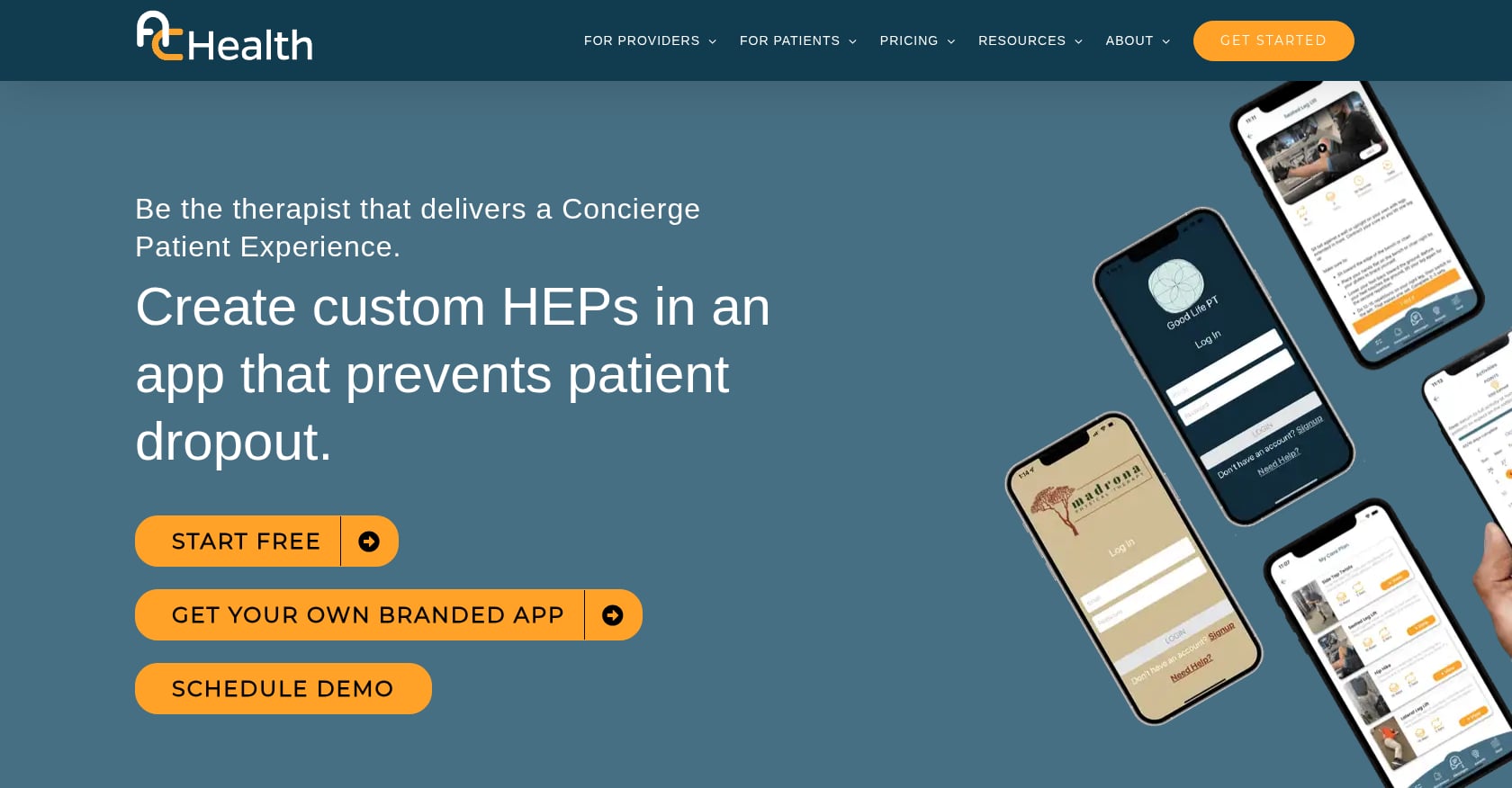
Best for: Physical therapists, occupational therapists, speech-language pathologists, chiropractors, athletic trainers, and other rehab clinicians who prescribe personalized home programs, exercises, or between-session care.
Pricing:
- Free: $0/mo, up to 5 active patients
- Basic: $14/mo, 6 to 15 active patients
- Professional: $29/mo, 16 to 30 active patients (adds printable care plans)
- Unlimited: $45/mo, 31+ active patients (adds Remote Therapeutic Monitoring)
- Clinic: $60/mo for 2+ locations, 3 unlimited channels, shareable clinic libraries
- Branded app: $400 setup + $150/mo for a single user/login
Key features:
- One-tap custom video and exercise plans created during the visit
- HIPAA-private video, photo, and text messaging
- Behavior-change prompts and personalized patient reminders
- Patient progress, exercise history, and conversation history in one workspace
- RTM support for CPT codes 98975, 98977, 98980, and 98981
- Customizable reporting aligned to clinic KPIs
- Optional white-label branded app
- Knowledge Tracks for post-discharge education and subscription revenue
Tradeoffs:
- Not a full behavioral-health EHR for psychotherapy notes, insurance billing, or eRx
- Provider-created content is a strength, but clinics wanting a massive stock library from day one may prefer library-first platforms
- Smaller vendor than SimplePractice, TherapyNotes, or MedBridge
- EMR integrations are not a highlighted feature
AC Health reports a 91 patient NPS and a 4.9 overall rating on Capterra from 10 reviews. Case studies describe clinics seeing better compliance, fewer drop-offs, significant time savings, and increased referrals. See real clinic examples for specifics.
Bottom line: Choose AC Health if your practice’s biggest HIPAA gap is getting patients to understand and follow their exact plan. For rehab therapists, this is the strongest fit because it combines personalized care delivery with protected communication in a single app, not just another note-taking system.
Schedule a free demo to see AC Health in your workflow.
2. SimplePractice
Best for: Solo and small mental-health practices that want scheduling, notes, client portal, telehealth, billing, and payments in one platform.
Pricing:
- Starter: $49/mo
- Essential: $79/mo
- Plus: $99/mo
- Additional clinicians on Plus: $74/mo (2 to 5), $72/mo (6 to 15), $69/mo (16+)
- ePrescribe add-on: $49/mo per clinician + $89 one-time setup
- Note Taker (AI): $35/mo per clinician
Pricing is listed on SimplePractice’s pricing page. Secure messaging is only available on Essential and Plus, not Starter.
Key features:
- HIPAA-compliant telehealth with unlimited session length, waiting rooms, and screen sharing
- Secure messaging for clients, contacts, and team members on Essential and Plus
- Insurance billing, analytics, customizable notes, and Wiley Treatment Planners
- Online appointment requests and client portal
Tradeoffs:
- Costs escalate quickly with add-ons, especially eRx and AI notes
- No eFax and no public-facing API
- Insurance pricing is changing: current per-claim rates apply through September 30, 2026, with new rates starting October 1, 2026
- AI note-taking raises questions about transcript retention and client trust
SimplePractice holds a 4.6/5 rating from 2,827 Capterra reviews. Users praise the feature range but raise affordability concerns after price increases. Practitioners on Reddit frequently describe it as the “obvious choice” that gets expensive as a practice grows. One recent thread called pricing “out of control” after changes to claim submission and Insurance Navigator. A LinkedIn practitioner post criticized the platform’s AI transcript-retention defaults, urging therapists to check what happens to session data before enabling the feature.
Bottom line: The most recognized all-in-one mental-health EHR, but pricing adds up. Best for therapists willing to pay for convenience and familiar workflows.
3. TherapyNotes

Best for: Insurance-heavy behavioral health practices that prioritize documentation, claims workflows, and predictable support over cutting-edge design.
Pricing:
- Solo: $69/mo
- Group: $79/mo (first clinician) + $50/mo per additional clinician
- Optional per-use fees: $0.14/claim, $0.14/eligibility check, $0.14/text or voice reminder, $1/mailed paper claim
- Premium Telehealth: $15/mo per clinician
- ePrescribe: $65/mo per prescriber
- TherapyFuel AI: $40/mo per clinician
All pricing is listed on TherapyNotes’ support documentation.
Key features:
- Behavioral-health EHR with structured note templates
- Insurance billing, eligibility checks, ERA, and claims
- Client portal with secure messaging
- Basic telehealth included; premium adds HD video, screen sharing, and up to 16 participants
- 24/7 phone and email support
Tradeoffs:
- More rigid interface with less flexibility for customizable forms or modern UX
- Per-item fees for claims, reminders, and eligibility add up across a busy caseload
- Not designed for rehab or HEP workflows
TherapyNotes carries a 4.7/5 Capterra rating from 969 reviews. Reddit users consistently describe it as solid for Medicaid and insurance-heavy practices, though less client-friendly than SimplePractice. PMHNP community feedback notes that prescribers’ real monthly cost climbs substantially once eRx, premium telehealth, and AI are layered on.
Bottom line: Best for behavioral health clinicians who value structured billing and support over design flexibility.
4. Jane
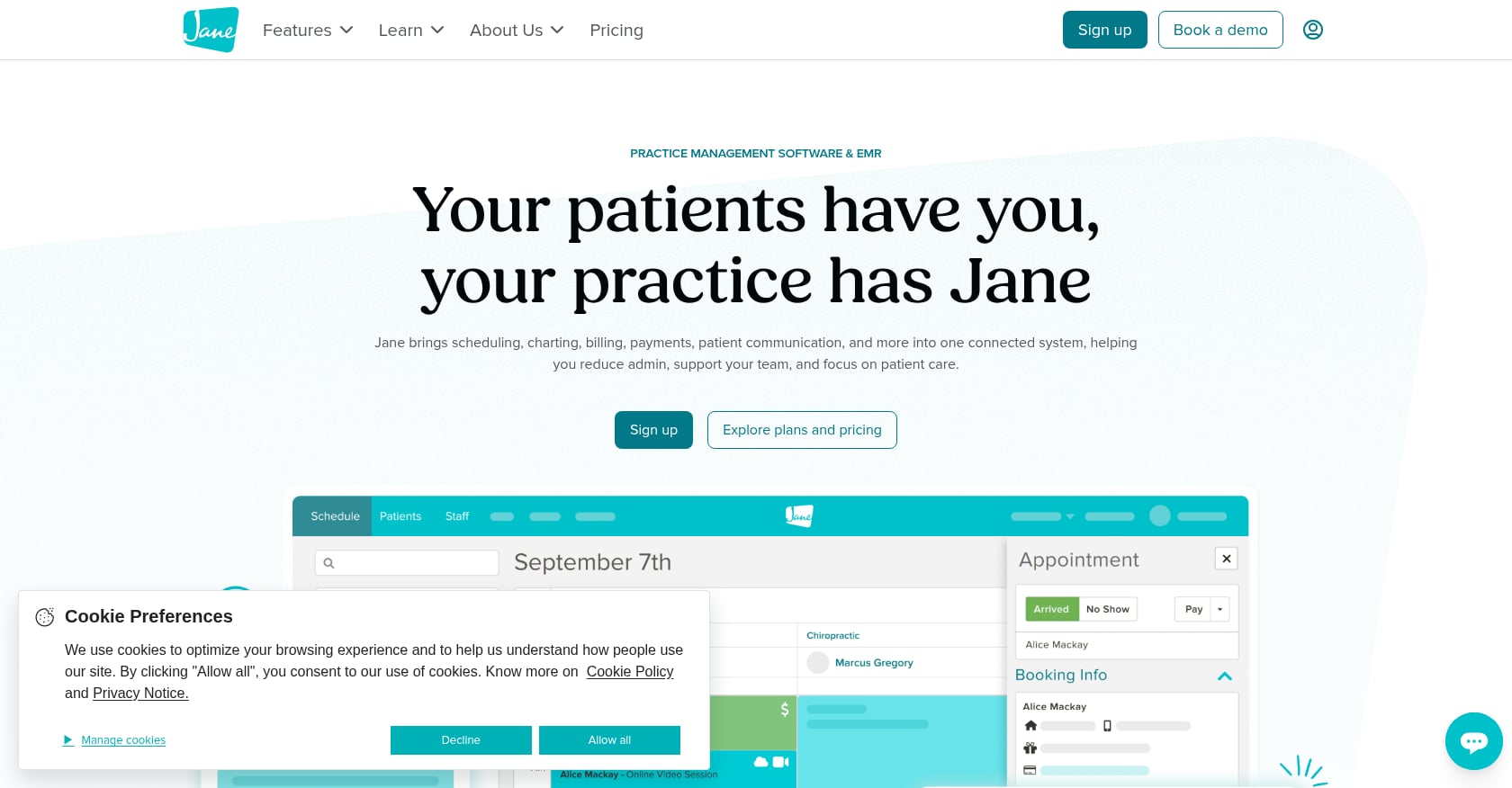
Best for: Multidisciplinary clinics (counseling, PT, chiro, massage, wellness) that want polished scheduling, charting, and client-facing workflows in one system.
Pricing:
- Balance: $54/mo
- Practice: $79/mo
- Thrive: $99/mo
- Insurance Billing add-on: $20/mo + $5/mo per license
- AI Scribe: $15/mo per practitioner
- Group Telehealth: $15/mo per practitioner
- Card processing: 2.85% + $0.25 (online), 2.6% + $0.10 (in-person)
Pricing details come from Jane’s pricing page. Admin and support staff who don’t book appointments under their own profile are free.
Key features:
- Secure client portal, intake forms, outcome measure surveys, and treatment plans
- Telehealth, secure messaging, email confirmations, and SMS reminders
- Chart template library and customizable documentation
- 2-step verification, 256-bit encryption, SOC 2-audited, HIPAA/PIPEDA/GDPR compliance
Tradeoffs:
- Insurance billing adds cost and may not suit every plan configuration
- Some users report documentation limitations and telehealth reliability concerns
- Less specialized than TherapyNotes for behavioral health or AC Health for rehab care plans
Jane has a 4.8/5 rating from 534 Capterra reviews. Reddit users frequently recommend it as a SimplePractice alternative, with one therapist calling it “amazing” for all-in-one booking, video, billing, receipts, and notes. Jane is actively expanding into U.S. behavioral health, making it increasingly relevant for cross-discipline clinics.
Bottom line: Best for practices that span multiple disciplines and want a polished operating system without cobbling together separate tools.
5. Ensora Mental Health (TheraNest)
Best for: Solo therapists and small counseling practices that want EHR and practice management at a lower starting price.
Pricing:
- Essentials: $29/therapist/mo ($27/mo on annual billing)
- Advanced: $59/therapist/mo ($54/mo annual)
- Premier: $89/therapist/mo ($82/mo annual)
- Annual AMA CPT License Fee: $19.50 per therapist
- 21-day Premier trial, no credit card required
Pricing is listed on Ensora’s TheraNest pricing page.
Key features:
- Scheduling, secure client portal, calendar sync, and notes
- Secure messaging and unlimited telehealth on Advanced and above
- Insurance billing automation, Wiley Practice Planner, and credentialing on Premier
- MFA and HIPAA-compliant infrastructure
Tradeoffs:
- Essentials tier lacks secure messaging and unlimited telehealth
- Community feedback on the Ensora transition is mixed, with some users reporting support and workflow problems post-acquisition
- The annual CPT license fee is easy to miss on first glance
TheraNest holds a 4.4/5 rating from 1,052 Capterra reviews. A 2026 reviewer noted it had “finally smoothed out” after the Ensora acquisition, while a Reddit thread from the same period described persistent problems. Demo carefully and talk to current users before committing.
Bottom line: The most budget-friendly EHR option for counseling practices. Worth the extra due diligence on support quality and post-acquisition stability.
6. Doxy.me

Best for: Therapists who need a simple, HIPAA-compliant video platform without buying an entire EHR.
Pricing:
- Free plan available
- Professional: $35/mo
- Clinic: $50/mo
- Enterprise: custom pricing
Key features:
- Unlimited video calls, waiting room, in-session chat, and screen sharing (paid tiers)
- Virtual backgrounds, photo capture, file transfer, and picture-in-picture
- Group calls up to 25 participants on paid tiers
- BAA included (individual providers on Free/Professional; multi-provider practices should request a Clinic BAA)
Tradeoffs:
- Not an EHR, messaging hub, billing platform, or care-plan app
- Free tier limits screen sharing and video quality
- Some users report mobile glitches, so test with your actual client population before relying on it
Doxy.me has a 4.6/5 rating from 1,227 Capterra reviews and a 4.8/5 value-for-money score. Practitioners on Reddit regularly recommend it as a free HIPAA telehealth backup, often pairing it with an EHR that has unreliable built-in video. One therapist noted the paid version is worth it for whiteboard and multi-participant sessions.
Bottom line: The go-to option for therapists who need secure video and nothing else. Pair it with an EHR for a lightweight, affordable stack.
7. Spruce Health
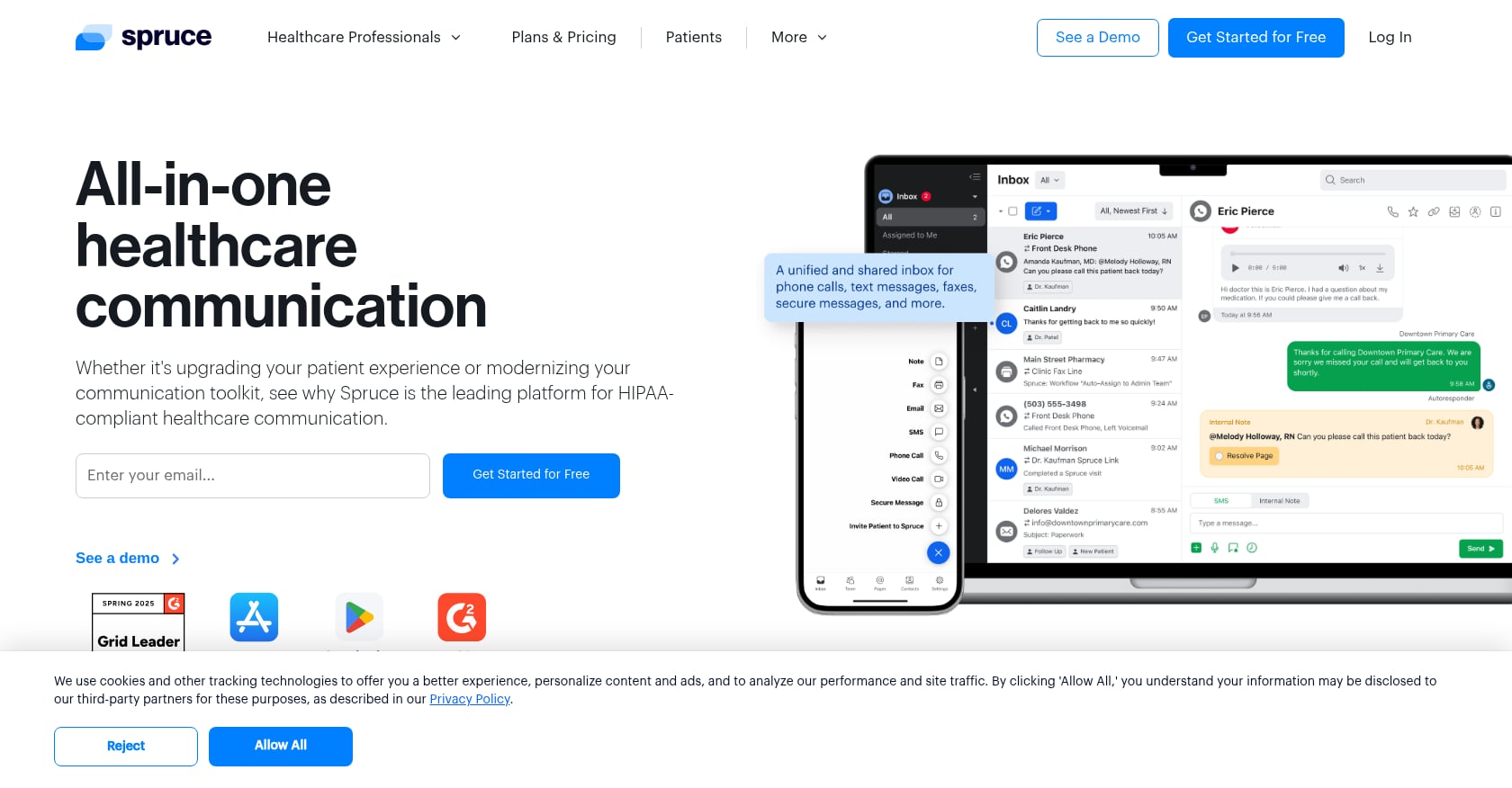
Best for: Therapists and practices that need a HIPAA-grade business phone number, secure messaging, fax, voicemail, shared inbox, and team routing.
Pricing:
- Basic: $24/user/mo
- Communicator: $49/user/mo
- 14-day free trial, no credit card required
- One-time $19.50 SMS registration fee
- Per-user pricing applies to every teammate, including non-clinical staff
Key features:
- Business phone number, SMS texting, secure app-based messaging, and eFax
- Video telemedicine, voicemail transcription, and call recording on higher tiers
- Team chat, shared inbox, auto-replies, and customizable routing
- BAA included on all trials and paid plans
- Mobile, desktop, and web access
Tradeoffs:
- Not an EHR or care-plan app
- Per-user pricing adds up if every admin and assistant needs access
- Secure app-based messaging is different from ordinary SMS; practices need clear policies defining what goes where
Practitioners on Reddit repeatedly cite Spruce as their preferred tool for keeping client calls and texts off personal devices. One user described the monthly cost as a “wonderful investment.” Spruce is commonly paired with a separate EHR or Google Workspace with a BAA, reflecting the reality that many therapists build a stack rather than relying on a single platform.
Bottom line: The best secure communication layer for therapists who want professional phone and text boundaries without switching EHRs.
8. iPlum
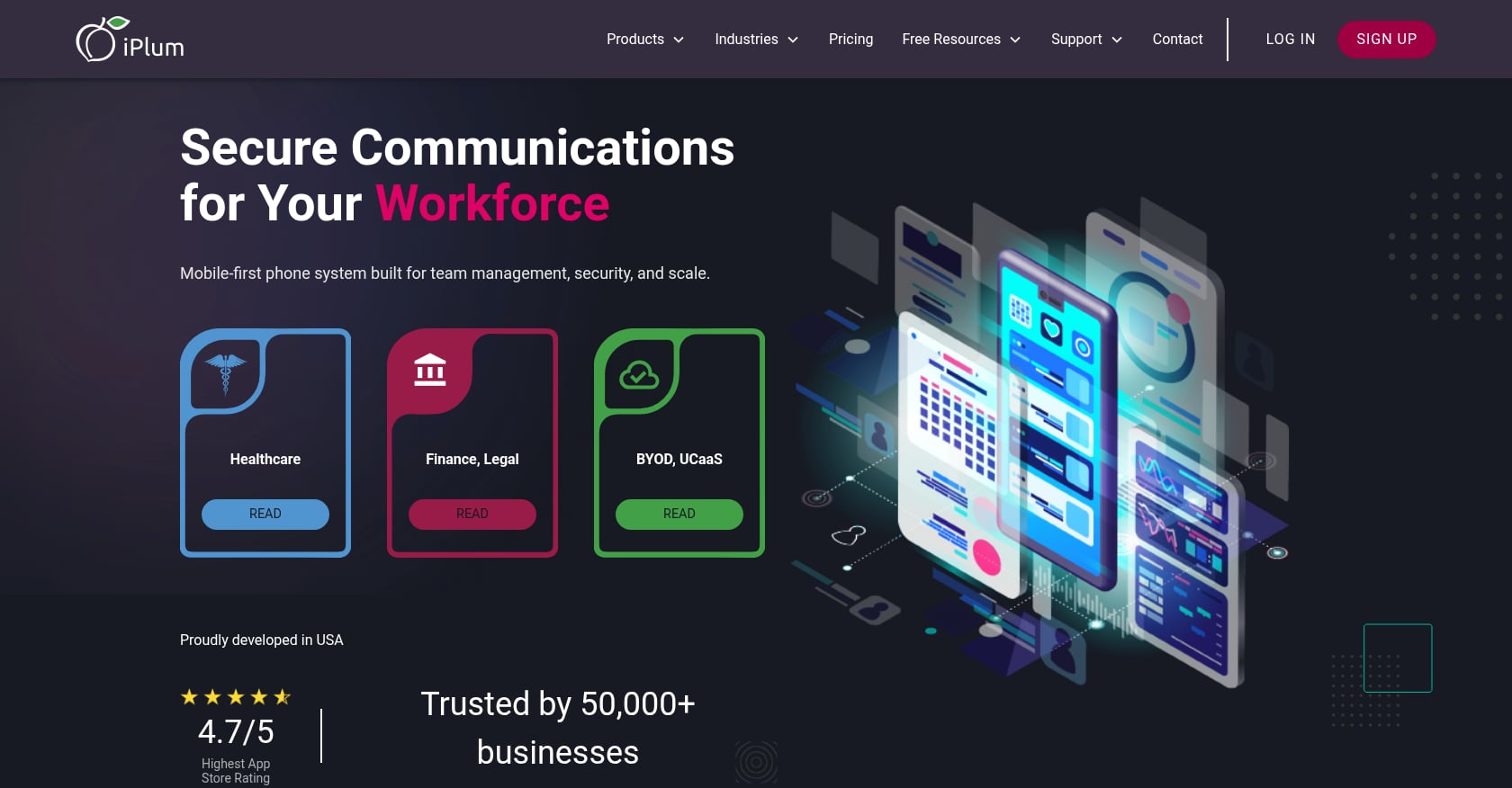
Best for: Solo therapists who need a separate HIPAA business line for calling, secure texting, and voicemail at the lowest possible price.
Pricing:
- Standard: $8.99/user/mo (annual) or $13.99 (monthly), no HIPAA/BAA
- Professional: $14.99/user/mo (annual) or $20.99 (monthly), includes HIPAA and BAA
- Enterprise: $25.99/user/mo (annual) or $30.99 (monthly)
- One-time $20 TCR registration fee for U.S. outbound SMS
Key features:
- U.S./Canada phone number, calling, texting, voicemail, and spam blocking
- Secure encrypted texting, archiving, and app-less online access on Professional
- Phone tree, business hours, auto-replies, and group/broadcast text
- iOS and Android apps
Tradeoffs:
- HIPAA compliance and BAA require the Professional plan, not Standard
- Best for phone and text only, not a full EHR, telehealth platform, or care-plan app
- Therapists still need written communication policies defining what’s appropriate for SMS versus secure messaging
Reddit therapists frequently recommend iPlum for a HIPAA-compliant business line, citing the roughly $15/month annual pricing as reasonable. A recurring caution in community threads: even with a secure texting tool, regular text should be limited to logistics. Clinical information belongs in a protected system.
Bottom line: The most affordable way to separate personal and professional phone communication while maintaining HIPAA coverage.
9. Physitrack
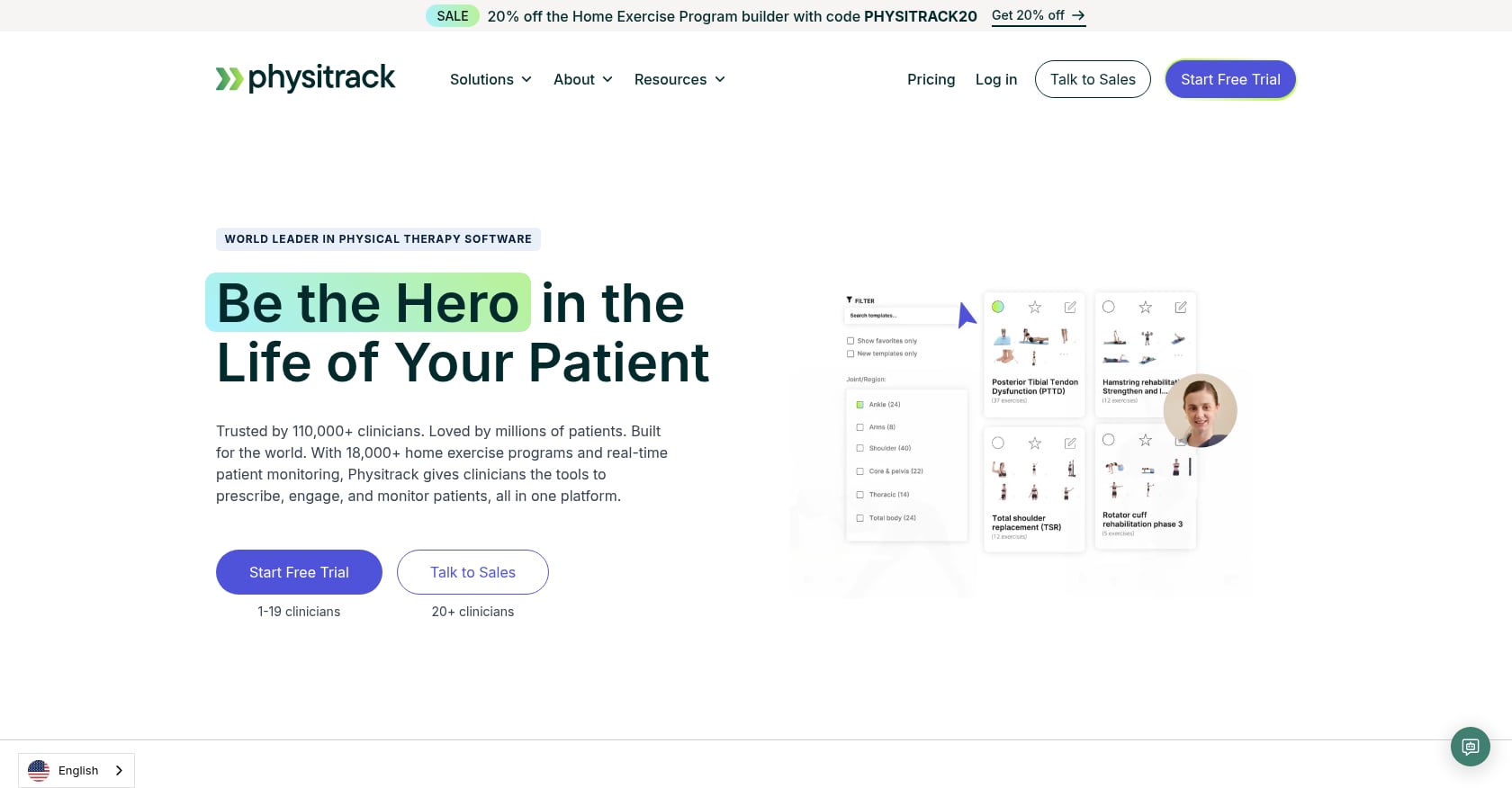
Best for: PT, OT, and rehab clinics that want a large ready-made exercise library, patient tracking, and an out-of-the-box home exercise program platform.
Pricing:
- $18.99/practitioner/mo (monthly)
- $227.88/practitioner/year (annual)
- Enterprise plans for 20+ practitioners with EMR integrations, by quote
- Complimentary two-week trial
Key features:
- 18,000+ exercise library
- Free patient engagement app with progress tracking
- Telehealth system trial
- RTM support (requires HEP subscription)
- Data encrypted and backed up
Tradeoffs:
- Stock library exercises may not match a clinician’s exact cueing or patient-specific modifications
- Public third-party review volume is lower than EHR competitors
- Enterprise integrations and EMR access require a custom quote
A 2026 Capterra reviewer praised navigation and exercise options but flagged that some exercise images showed unsafe support examples for certain populations. A Reddit user noted Physitrack provided what they needed for RTM reimbursement, though results vary. For a look at how library-based HEP tools compare to personalized care-plan platforms, this HEP platform comparison covers the key distinctions.
Bottom line: Strong choice for clinics that prefer a massive pre-built library over creating custom video content. Compare it to AC Health’s personalization-first approach to decide which model fits your clinical style.
10. MedBridge
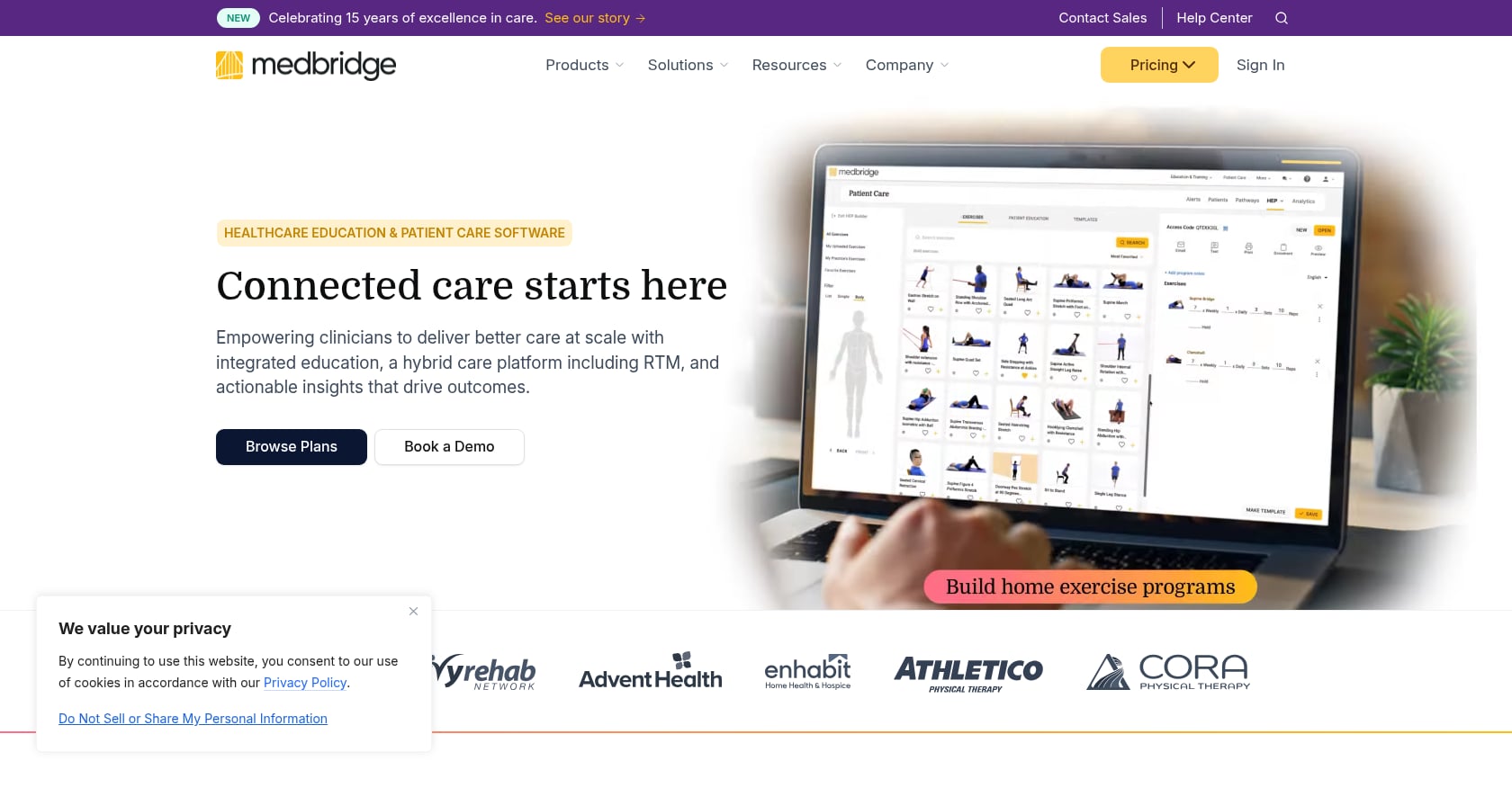
Best for: Rehab organizations that want continuing education, a large HEP library, patient education, and RTM options from a single vendor.
Pricing:
- Individual clinician plans: approximately $325/year for Education or Premium
- Small business Care Essentials: $329/seat/year (100 HEP episodes/seat/year pooled, $1.50/extra episode)
- Care Elite: $329/seat/year with unlimited HEP episodes and RTM/guided care pathways
- Verify current pricing directly, as tier details may have changed
Key features:
- 8,000+ exercise and template library
- MedBridge GO patient mobile app
- Patient and family education content
- Adherence tracking, reminders, and patient-provider messaging (plan-dependent)
- Spanish translation and EMR documentation support
- Continuing education courses for clinicians
Tradeoffs:
- Annual seat pricing and HEP episode economics require careful math
- CE bundling adds cost if your team doesn’t need it
- Stock videos can be “almost right” but may not capture a specific clinician’s cueing
- Some Reddit PTs report renewal price increases and new usage restrictions
MedBridge is widely used in PT. Reddit sentiment is generally positive on video quality and app experience, but a 2026 thread raised concerns about renewal pricing. On the patient side, a Reddit post about MedBridge GO described frustration with the app requiring explanations every time an exercise day was skipped, illustrating how patient-facing UX affects adherence data. Research shows that reducing admin time is a top priority for therapists, and the right tool should save time for both clinician and patient.
Bottom line: Best for rehab organizations that want CE and HEP from the same vendor. Solo clinicians or small clinics may find the per-seat economics hard to justify compared to lighter alternatives.
How to Choose the Right HIPAA-Compliant App
Most HIPAA compliant apps for therapists fall into five workflow categories. The right app depends on which category represents your biggest gap, not which brand has the most name recognition.
| Workflow need | What the app must do | Best-fit category |
|---|---|---|
| Home programs and care plans | Assign videos, exercises, reminders, check-ins, progress tracking | Care-plan / HEP app |
| Notes, scheduling, billing, records | Charting, claims, reminders, portal, superbills | EHR / practice management |
| Video visits | Secure video, waiting room, patient links | Telehealth platform |
| Client texting, calling, fax | Business number, secure messaging, voicemail, team inbox | Communications platform |
| Clinic scaling | Permissions, audit logs, reporting, shared libraries | Enterprise or clinic tier |
If you prescribe exercises or home programs
This applies to most physical therapists, OTs, SLPs, chiropractors, and athletic trainers. Your primary HIPAA concern isn’t just notes and billing. It’s the channel between you and the patient where care plans, custom videos, messages, and progress data flow.
A full EHR that lacks a protected care-plan delivery system leaves a gap. Most therapists fill it with text messages, email, or consumer apps, all of which put PHI at risk. AC Health was built for this exact problem: custom video capture, HIPAA-private messaging, behavior-change reminders, and RTM reporting in a single provider-to-patient channel.
If you need full EHR and billing
Mental health therapists who run insurance billing, psychotherapy documentation, scheduling, and client portals should choose an EHR first. SimplePractice, TherapyNotes, Jane, and TheraNest each have strengths covered earlier in this article.
If you only need video
Doxy.me provides HIPAA-compliant telehealth with a BAA at a free tier. It works as a backup even if your EHR includes built-in video that occasionally glitches.
If clients text or call you
Every therapist who gives clients a personal number should consider Spruce or iPlum. Both offer BAA-covered business lines that keep PHI out of personal messaging apps.
If you use AI notes
AI documentation tools are now built into multiple HIPAA compliant apps for therapists, with add-on prices ranging from $15 to $40 per clinician per month. Before turning any of them on, ask:
- Is audio recorded? When is it deleted?
- Are transcripts retained or used to train the AI?
- Is the feature opt-in or opt-out by default?
- How do you document client consent?
- Can you disable transcript retention at the account level?
A LinkedIn practitioner post criticized one major EHR’s AI transcript-retention defaults, urging therapists to review their settings before assuming privacy was automatic. Whether or not that specific critique applies to your platform, the questions are worth asking every time.
The Real Cost Problem
Starting prices are misleading for HIPAA compliant apps for therapists. The actual monthly cost depends on layers most comparison articles ignore.
Real monthly cost = base plan + extra clinicians + telehealth add-ons + secure messaging tier + claims fees + eligibility checks + reminder fees + SMS registration + AI notes + eRx + HEP episodes + payment processing + onboarding
Some examples of how this plays out:
- SimplePractice Starter ($49/mo) lacks secure messaging. Moving to Essential ($79/mo) and adding ePrescribe ($49/mo) and AI notes ($35/mo) brings a solo prescriber to $163/mo before claims fees.
- TherapyNotes Solo ($69/mo) looks simple, but claims at $0.14 each plus reminders at $0.14 each plus premium telehealth ($15/mo) plus eRx ($65/mo) can double the cost for a busy prescriber.
- MedBridge Care Essentials caps HEP episodes at 100/seat/year, with overages at $1.50/episode. A therapist assigning 4 programs per day would blow through that allocation fast.
This is not a reason to avoid any of these platforms. It is a reason to ask every vendor for a realistic total before committing.
One App or a Stack?
Many therapists don’t need one giant platform. They need the right combination.
Practitioners on Reddit commonly describe building stacks: an EHR for notes and billing, Spruce or iPlum for phone and text, Doxy.me for backup video, and a separate tool for home programs. This isn’t a failure of the software market. It reflects the reality that no single product does everything well.
Practical stack combinations:
Rehab solo clinician: AC Health for care plans and HIPAA messaging, plus a lightweight EHR or accounting tool for notes and billing.
Mental-health solo practice: SimplePractice or TherapyNotes for EHR, plus Spruce or iPlum if phone boundaries matter.
Telehealth-heavy clinician: EHR with built-in video, plus Doxy.me as a backup for connection issues.
Rehab organization: AC Health, Physitrack, or MedBridge depending on whether personalization, library size, RTM economics, or CE bundling drives the decision. For practices with multiple locations, shared libraries, consistent care plans, and centralized reporting become essential.
The key question isn’t “which app does the most?” It’s “which app protects PHI in the specific workflow where your practice is currently exposed?”
Frequently Asked Questions
Can therapists text clients under HIPAA?
Yes, but PHI should stay protected. Use secure in-app messaging for clinical content, document consent and communication boundaries, and limit standard SMS to logistics like scheduling confirmations. HIPAA does not ban texting outright. It requires that ePHI be safeguarded during transmission. HHS guidance on mobile devices and HIPAA provides additional context.
Do therapists need a BAA with their app vendor?
If the vendor creates, receives, maintains, or transmits PHI on behalf of your practice, yes. HHS explicitly lists app developers that provide patient messaging, remote counseling, and exercise monitoring as business associate examples.
Is Zoom or FaceTime HIPAA compliant for therapy?
Neither is automatically compliant. Zoom offers a healthcare plan with a BAA, but the standard consumer version does not qualify. FaceTime does not offer a BAA. Since pandemic enforcement discretion ended in May 2023, therapists should use telehealth tools where the vendor signs a BAA and meets HIPAA technical safeguards.
What is the cheapest HIPAA-compliant app for therapists?
It depends on the workflow. Doxy.me has a free telehealth plan. AC Health offers a free tier for up to 5 active patients. iPlum’s HIPAA-capable Professional plan starts at $14.99/user/month on annual billing. TheraNest starts at $29/therapist/month for EHR basics. “Cheapest” only matters if the app covers the specific workflow where PHI is at risk.
What is the best HIPAA-compliant app for physical therapists?
AC Health for personalized custom video care plans and HIPAA messaging. Physitrack for a large library-based HEP approach. MedBridge for CE plus HEP plus RTM bundled together. The best choice depends on whether your practice prioritizes personalized content, stock libraries, or continuing education integration.
What is the best HIPAA-compliant app for mental-health therapists?
SimplePractice for all-in-one convenience, TherapyNotes for insurance and billing depth, Jane for multidisciplinary practices, and TheraNest for the lowest starting price. All four offer BAAs, secure messaging, telehealth, and client portals at various tiers.
Are AI therapy notes HIPAA compliant?
The question to ask is whether the AI vendor is covered by your BAA, what data is retained after the session, whether transcripts are used to improve models, and whether the feature can be fully disabled. AI scribes are increasingly common in therapy software, but transcript retention and patient trust remain active concerns among practitioners and should be evaluated before enabling any AI documentation tool.
Should therapists use one platform or build a stack?
It depends on practice type and budget. Solo mental-health therapists often do well with a single all-in-one EHR. Rehab clinicians frequently pair a care-plan app with a separate EHR and communication tool. The deciding factor is whether a single platform genuinely covers every workflow where PHI moves, or whether gaps force you back to unprotected channels like personal text and email.
{ “@context”: “https://schema.org”, “@type”: “FAQPage”, “@id”: “#faq”, “mainEntity”: [ { “@type”: “Question”, “@id”: “#faq-question-1”, “name”: “Can therapists text clients under HIPAA?”, “acceptedAnswer”: { “@type”: “Answer”, “text”: “Yes, but PHI should stay protected. Use secure in-app messaging for clinical content, document consent and communication boundaries, and limit standard SMS to logistics like scheduling confirmations. HIPAA does not ban texting outright. It requires that ePHI be safeguarded during transmission. HHS guidance on [mobile devices and HIPAA](https://www.hhs.gov/hipaa/for-professionals/privacy/guidance/cell-phone-hipaa/index.html) provides additional context.” } }, { “@type”: “Question”, “@id”: “#faq-question-2”, “name”: “Do therapists need a BAA with their app vendor?”, “acceptedAnswer”: { “@type”: “Answer”, “text”: “If the vendor creates, receives, maintains, or transmits PHI on behalf of your practice, yes. HHS explicitly lists app developers that provide patient messaging, remote counseling, and exercise monitoring as business associate examples.” } }, { “@type”: “Question”, “@id”: “#faq-question-3”, “name”: “Is Zoom or FaceTime HIPAA compliant for therapy?”, “acceptedAnswer”: { “@type”: “Answer”, “text”: “Neither is automatically compliant. Zoom offers a healthcare plan with a BAA, but the standard consumer version does not qualify. FaceTime does not offer a BAA. Since pandemic enforcement discretion ended in May 2023, therapists should use telehealth tools where the vendor signs a BAA and meets HIPAA technical safeguards.” } }, { “@type”: “Question”, “@id”: “#faq-question-4”, “name”: “What is the cheapest HIPAA-compliant app for therapists?”, “acceptedAnswer”: { “@type”: “Answer”, “text”: “It depends on the workflow. Doxy.me has a free telehealth plan. AC Health offers a free tier for up to 5 active patients. iPlum’s HIPAA-capable Professional plan starts at $14.99/user/month on annual billing. TheraNest starts at $29/therapist/month for EHR basics. \”Cheapest\” only matters if the app covers the specific workflow where PHI is at risk.” } }, { “@type”: “Question”, “@id”: “#faq-question-5”, “name”: “What is the best HIPAA-compliant app for physical therapists?”, “acceptedAnswer”: { “@type”: “Answer”, “text”: “AC Health for personalized custom video care plans and HIPAA messaging. Physitrack for a large library-based HEP approach. MedBridge for CE plus HEP plus RTM bundled together. The best choice depends on whether your practice prioritizes personalized content, stock libraries, or continuing education integration.” } }, { “@type”: “Question”, “@id”: “#faq-question-6”, “name”: “What is the best HIPAA-compliant app for mental-health therapists?”, “acceptedAnswer”: { “@type”: “Answer”, “text”: “SimplePractice for all-in-one convenience, TherapyNotes for insurance and billing depth, Jane for multidisciplinary practices, and TheraNest for the lowest starting price. All four offer BAAs, secure messaging, telehealth, and client portals at various tiers.” } }, { “@type”: “Question”, “@id”: “#faq-question-7”, “name”: “Are AI therapy notes HIPAA compliant?”, “acceptedAnswer”: { “@type”: “Answer”, “text”: “The question to ask is whether the AI vendor is covered by your BAA, what data is retained after the session, whether transcripts are used to improve models, and whether the feature can be fully disabled. AI scribes are increasingly common in therapy software, but transcript retention and patient trust remain active concerns among practitioners and should be evaluated before enabling any AI documentation tool.” } }, { “@type”: “Question”, “@id”: “#faq-question-8”, “name”: “Should therapists use one platform or build a stack?”, “acceptedAnswer”: { “@type”: “Answer”, “text”: “It depends on practice type and budget. Solo mental-health therapists often do well with a single all-in-one EHR. Rehab clinicians frequently pair a care-plan app with a separate EHR and communication tool. The deciding factor is whether a single platform genuinely covers every workflow where PHI moves, or whether gaps force you back to unprotected channels like personal text and email.” } } ] }