Best Free Home Exercise Program Apps for Clinicians
TL;DR
Most “free home exercise program apps” are not truly free for the clinician. Some offer a free patient download while the provider pays, others give trials that expire in two weeks, and a few provide permanent free plans with real limits. For a genuinely free provider plan with personalized video HEPs, AC Health offers up to 5 active patients at no cost. For free printable HEPs without engagement features, HEP2Go is the standard budget pick.
Searching for a free home exercise program app as a PT, OT, SLP, or chiropractor turns up a confusing mix of results. Some tools are free for patients but paid for providers. Others offer temporary trials. A handful are actually free for the clinician, though usually with caps on patients or features.
The distinction matters more than most comparison articles admit. A free printable HEP builder and a free clinical engagement platform solve very different problems. This guide breaks down what “free” actually means across eight HEP tools, compares their features honestly, and helps you decide which one fits your workflow, caseload, and growth plans.
Compare AC Health’s free and paid plans.
At-a-Glance Comparison
| App | Free Availability | Starting Price | Best For | Key Differentiator | Main Tradeoff |
|---|---|---|---|---|---|
| AC Health | Free provider plan, up to 5 active patients | $0/mo (paid from $14/mo) | Solo clinicians wanting personalized video HEPs | Custom clinician-created video/photo care plans, HIPAA messaging, RTM path | Requires provider-created content; smaller vendor |
| HEP2Go | Free provider plan | $0/mo (Pro $7/mo) | Quick free printable HEPs | Free access to thousands of exercises, printable programs | 2 saved routines on free; limited tracking |
| MedBridge GO | Free patient app; provider paid | $329/seat/year | HEP + patient education + CEUs | 8,000+ exercises, education library, gamification | Provider subscription required; episode limits |
| Physitrack / PhysiApp | Free patient app; provider paid | ~$19-24/practitioner/mo | Large library, outcomes, telehealth, RTM | 15,000+ exercises, progress tracking, telehealth | Not free for clinicians; pricing varies |
| SimpleSet | 14-day trial; students free | $14.99/mo (solo) | Clean, fast HEP builder | Unlimited programs, full content customization | No permanent free clinic plan |
| Rehab Guru | 30-day trial | £10/mo | UK/international rehab teams | 6,000+ exercises, modular, custom branding | GBP pricing; U.S. RTM/HIPAA needs verification |
| PT Wired / Prompt Engage | No free trial listed | Contact vendor | Branded clinic apps with RTM | Fully branded patient app, RTM tracking | Poor price transparency |
| WebPT HEP / StriveHub | Included in WebPT plans | Quote-based | Clinics already using WebPT | HEP integrated into WebPT EMR workflow | Not standalone; low patient app ratings |
What “Free” Really Means in HEP Apps
The word “free” gets stretched in this category. Before picking a free home exercise program app, know which type of “free” you are getting.
| Label | What It Means | Example |
|---|---|---|
| Free provider plan | Clinician uses the platform without paying, usually with patient or feature limits | AC Health (5 active patients), HEP2Go (2 saved routines) |
| Free patient app | Patient downloads for free; provider pays for the clinician platform | PhysiApp, MedBridge GO |
| Free trial | Temporary test access, typically 14-30 days | SimpleSet, Rehab Guru, Physitrack |
| Free student plan | Free for students, not for working clinics | SimpleSet |
| Free consumer app | General workout app, not designed for prescribed clinical rehab | Consumer fitness apps |
The practical difference is significant. A “free patient app” means the clinic still pays hundreds or thousands per year. A “free provider plan” means the clinician can actually use the tool without a credit card, though usually with caps on patients, features, or saved content.
The 8 Best Free and Low-Cost Home Exercise Program Apps
1. AC Health
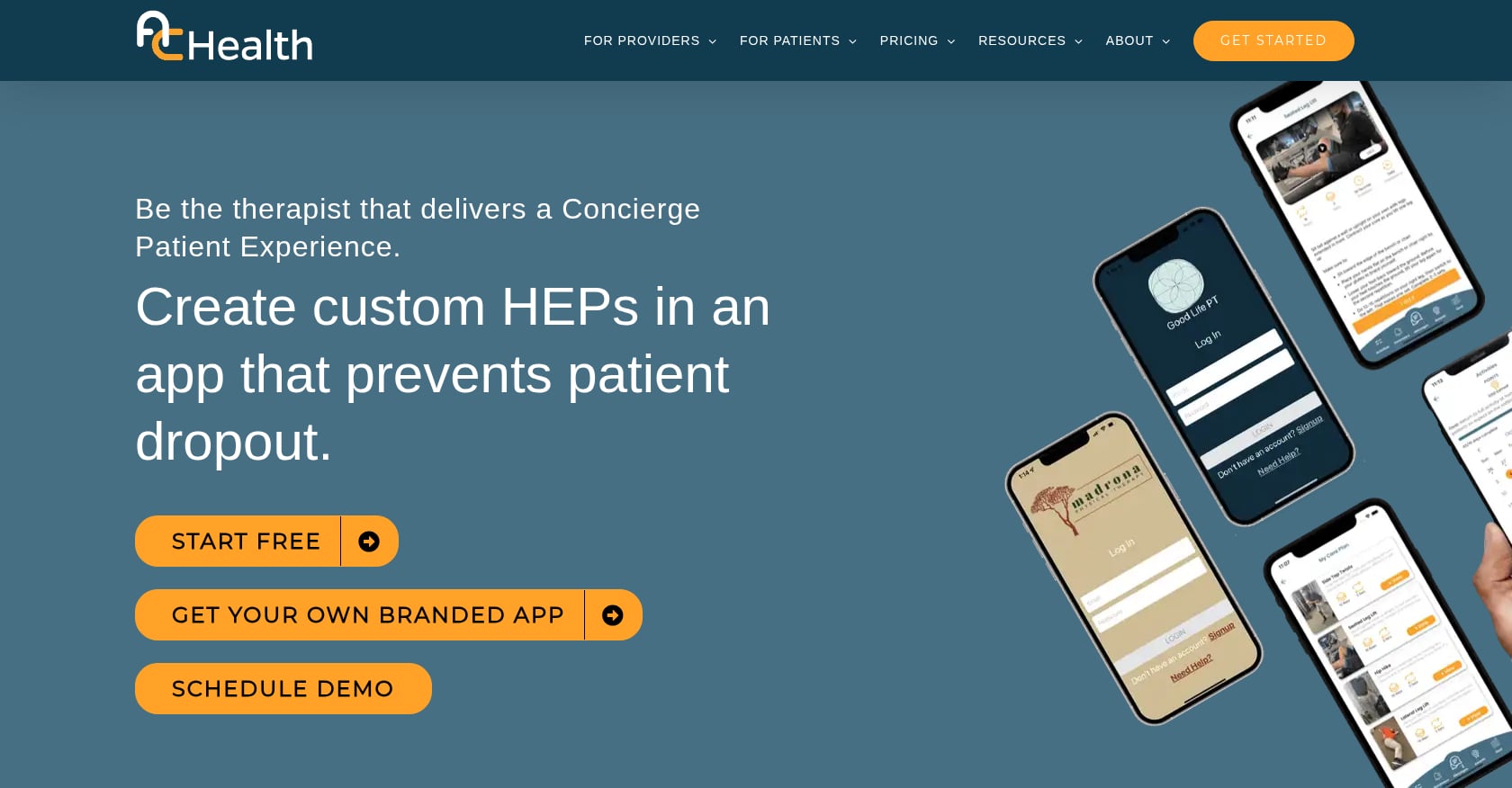
Best for: Solo clinicians, mobile providers, and small clinics that want personalized video HEPs with a real free starting point and room to grow.
Free status: Permanent free plan for up to 5 active patients.
Pricing:
- Free: $0/mo, up to 5 active patients
- Basic: $14/mo, 6-15 active patients
- Professional: $29/mo, 16-30 active patients, adds printable care plans
- Unlimited: $45/mo, 31+ active patients, adds Remote Therapeutic Monitoring
- Clinic: $60/mo, 2+ locations, shareable clinic libraries
- White-label branded app: $400 setup + $150/mo
Key features:
- One-tap custom video creation during the visit
- HIPAA-private video, photo, and text messaging
- Behavior-change prompts and personalized reminders
- All-in-one patient workspace (exercise history, current plan, progress, conversations)
- Customizable reporting for provider and patient activity
- RTM support for CPT codes 98975, 98977, 98980, 98981
- Knowledge Tracks for post-discharge content subscriptions
- Optional white-label app with branded iOS, Android, and web portals
- Provider libraries and printable care plans on higher tiers
- Free educator program for PT/OT/SLP students
What users say:
AC Health reports a 91/100 patient NPS. On Capterra, the platform holds a 4.9 overall rating from 10 reviews, with praise for mobile capture, customization, and responsive support. Site case studies cite better compliance, fewer drop-offs, time savings, and increased referrals. The Android listing shows 4.2/5 from 8 reviews, while iOS shows 3.0/5 from 19 ratings with developer replies addressing reported issues.
Tradeoffs:
- No CEU library (unlike MedBridge)
- Personalization-first workflow means clinicians need to record or build custom content
- EMR integrations are not prominently advertised
- App-store feedback mentions occasional sign-outs or glitches
- Smaller vendor scale compared to large incumbents
Bottom line: AC Health is the strongest free home exercise program app for clinicians who want more than a printable handout. The free plan gives you a working clinical workflow, and the upgrade path is transparent. If you capture exercise videos during the visit, patients get your exact cues rather than a generic library video.
Schedule a free demo to see the platform in action.
2. HEP2Go
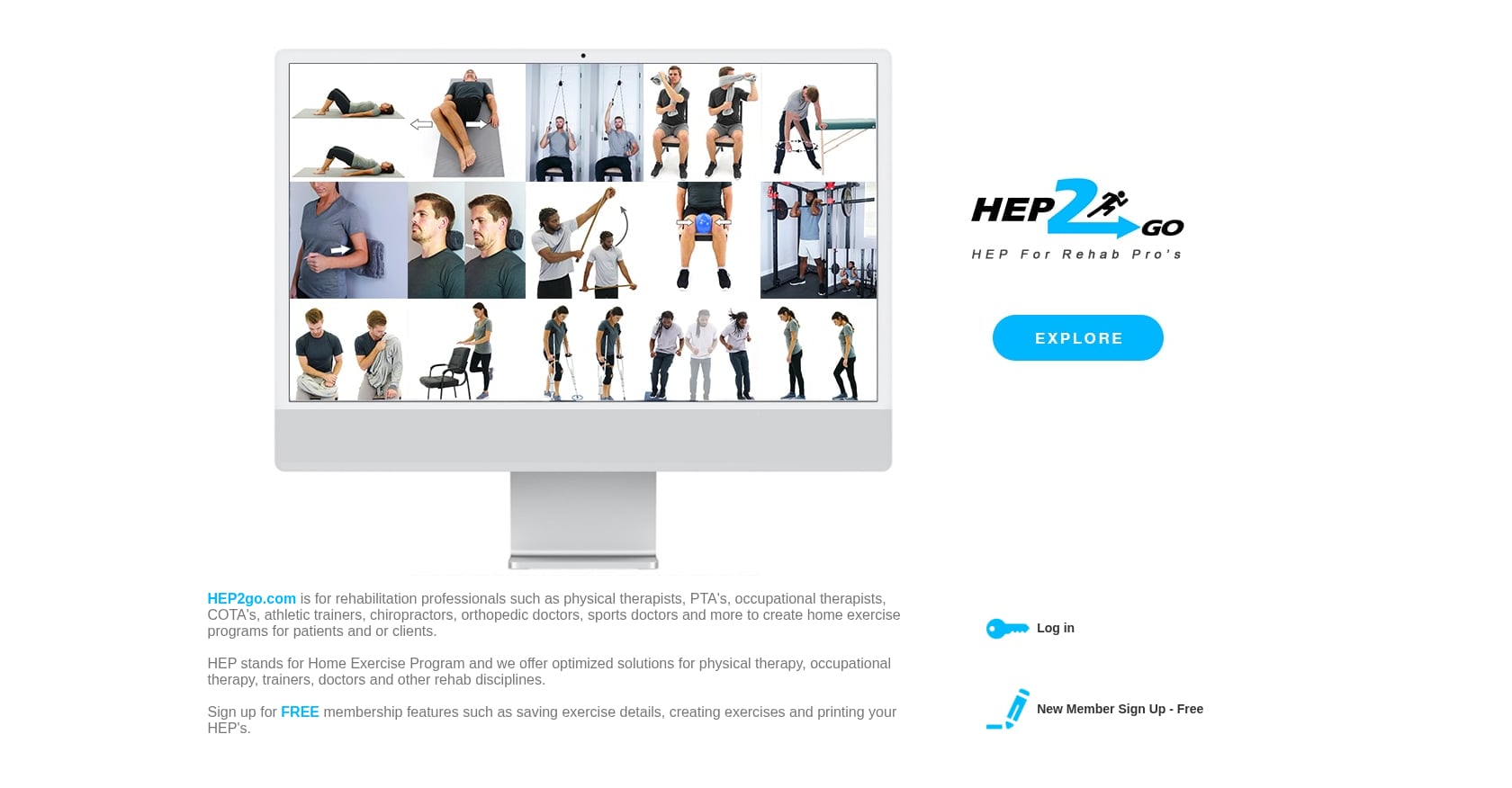
Best for: Students, new grads, and clinicians who need a quick free printable HEP without advanced tracking or messaging.
Free status: Free provider plan with limits.
Pricing:
- Free: $0/mo, access to exercise library, printable HEPs, 2 saved routines
- Pro: $7/mo or $70/year, adds unlimited routines, QR/email/SMS delivery, branding, mobile web viewer, Google Translate
Key features:
- Thousands of therapeutic exercises
- Custom exercise creation
- Printable PDF HEPs
- QR code, email, and SMS delivery (Pro)
- Mobile web viewer (Pro)
- Company logo branding (Pro)
- Google Translate (Pro)
What users say:
Practitioners on Reddit consistently mention HEP2Go when the requirement is “free.” One r/physicaltherapy thread called the free version imperfect but workable. Others note that search can require sifting through duplicates, and the free routine limit is a constraint. One clinician said they often choose the closest exercise and rewrite instructions.
A patient perspective from Reddit is telling: a rehab patient recovering from meniscus surgery described black-and-white printouts as inaccessible and unhelpful once they left the clinic, feeling on their own to track progress and look up proper form.
Tradeoffs:
- Free plan limited to 2 saved routines
- No native patient app with tracking or adherence logging
- No secure two-way messaging
- No RTM reporting or adherence analytics
- Search friction and duplicate exercises reported by users
Bottom line: HEP2Go earns its reputation as the go-to free printable HEP builder. It does that job well. But if patient adherence, secure messaging, or progress tracking matter to your workflow, it is not the right tool. For a deeper look, see this AC Health vs HEP2Go breakdown.
3. MedBridge GO / MedBridge
Best for: Clinics that want HEP software inside a broader education ecosystem with CEUs, patient education content, and professionally produced exercise videos.
Free status: Patient app is free after the provider assigns an access code. Provider platform is paid.
Pricing:
- Care Essentials: $329/seat/year with 100 HEP episodes per seat, pooled organization-wide
- Extra HEP episodes: $1.50 each, billed monthly
- Care Elite: unlimited HEP episodes (verify terms with vendor)
Key features:
- 8,000+ exercises and templates
- MedBridge GO patient app (iOS and Android)
- Patient education library
- Spanish translation
- Patient-provider messaging
- Adherence tracking with reminders and notifications
- Gamification and incentives
- On-demand CEU course library on relevant plans
What users say:
MedBridge GO holds a 4.9 rating with 45.2K reviews on Google Play and over 1M downloads. On Capterra, MedBridge sits at 4.5 from 37 reviews, with praise for intuitive HEP creation and visual engagement. One reviewer flagged that duration edits sometimes display incorrectly for patients, creating wrong stretch or repetition timing.
On Reddit, a patient said they liked that MedBridge GO kept tailored reps and sets available long after discharge, calling it like a follow-along class. Another patient said reducing exercise frequency caused the app to prompt skip explanations repeatedly, which became annoying. This is a good reminder that engagement features need tuning, or they create app fatigue instead of adherence.
Tradeoffs:
- Not free for providers; subscription is required
- Episode limits on the lower tier can add up for busy clinics
- Timer and logging UX frustrations reported by some users
- Best fit when CEUs and patient education matter, not for quick custom video capture
- Patients need a provider-issued access code
Bottom line: MedBridge GO is one of the most polished patient-facing apps in the category. But calling it a free home exercise program app is misleading. It is free for patients, paid for clinics. If your practice values a deep education library alongside HEPs, it is a strong choice.
4. Physitrack / PhysiApp
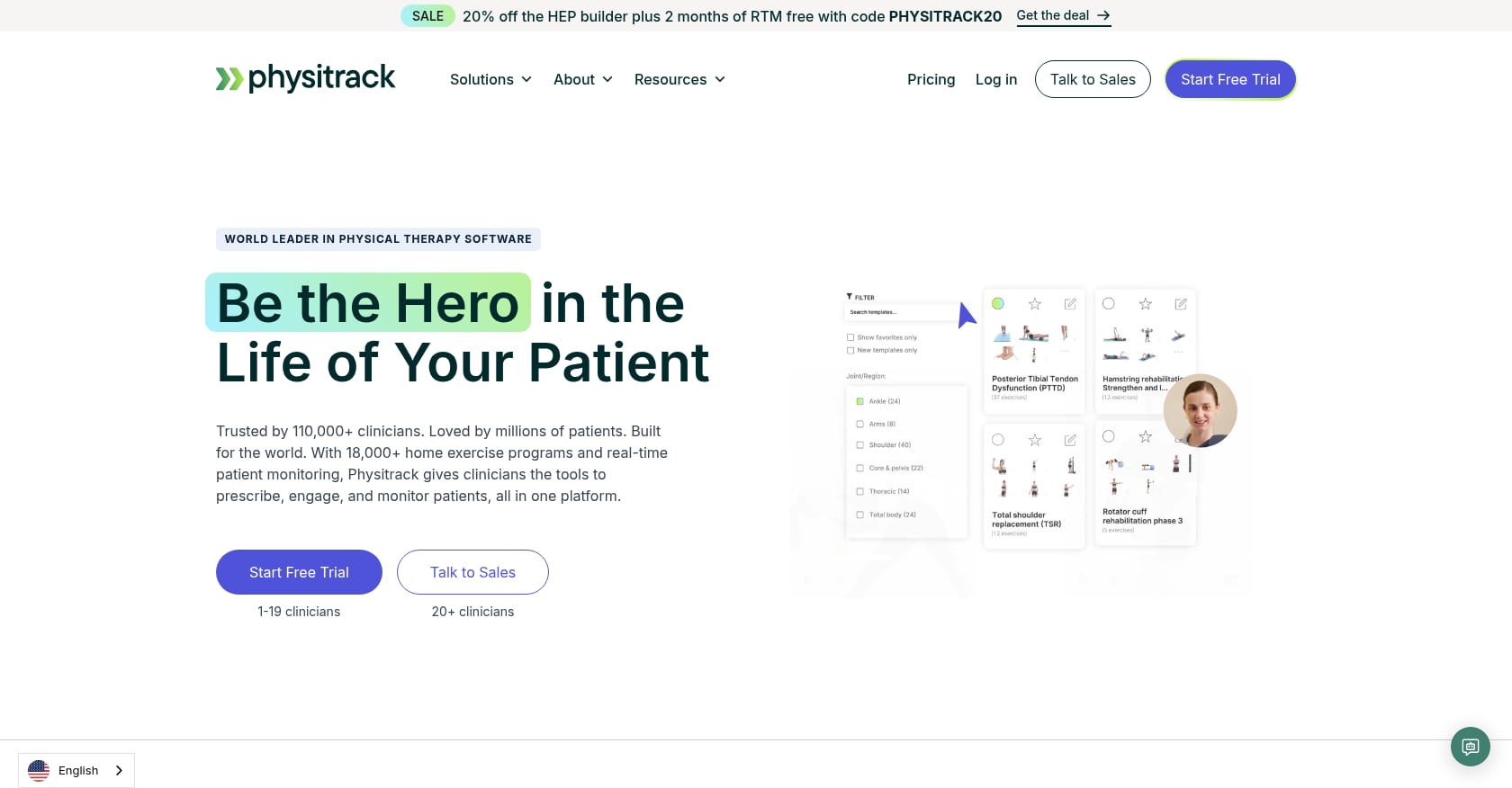
Best for: Clinics that need a large exercise library, patient outcome tracking, telehealth, and RTM options, and are willing to pay for the clinician platform.
Free status: PhysiApp is free for patients. Clinician platform is paid.
Pricing:
- U.S. HEP-only: listed at $23.99/practitioner/month on the support page, though the public pricing page shows $18.99/practitioner/month
- HEP + RTM + CEU bundle: $30/user/month plus an $8 active-user charge when monitoring an RTM patient
- 14-day trial included
Pricing discrepancies exist between Physitrack’s own pages, so verify at checkout.
Key features:
- Free PhysiApp for patients (iOS, Android, web)
- 15,000-18,000+ exercise videos
- Patient progress tracking (completion, pain, discomfort)
- 60 free Telehealth Pro minutes per account
- RTM bundle for U.S. customers
- Multilingual support
- Outcome measures
What users say:
PhysiApp holds a 4.9 rating with 32.1K reviews on Google Play. On Capterra, Physitrack has 4.5 from 2 reviews, with one praising support and customization while flagging that some stock images show an unsafe flimsy chair for balance exercises.
Reddit sentiment is mixed but useful. One practitioner said Physitrack worked well for RTM reimbursement and gave their clinic exercises, outcome measures, and messaging in one place. Others in sports and S&C settings complained that the exercise library skews too rehab-specific for athletic programming.
Tradeoffs:
- Not free for clinicians
- Pricing varies between official sources
- Library-first approach may not replace clinician-recorded cues for nuanced cases
- Patient experience depends on whether the clinician actively reviews feedback
- Some patient-facing reviews mention bugs or slow UX
Bottom line: Physitrack is a solid established platform for clinics that want outcomes tracking, telehealth, and a free patient app. It is not the answer for clinicians who need a free provider account. And a library of 15,000+ exercises still may not capture the exact modification you demonstrated in the visit.
5. SimpleSet
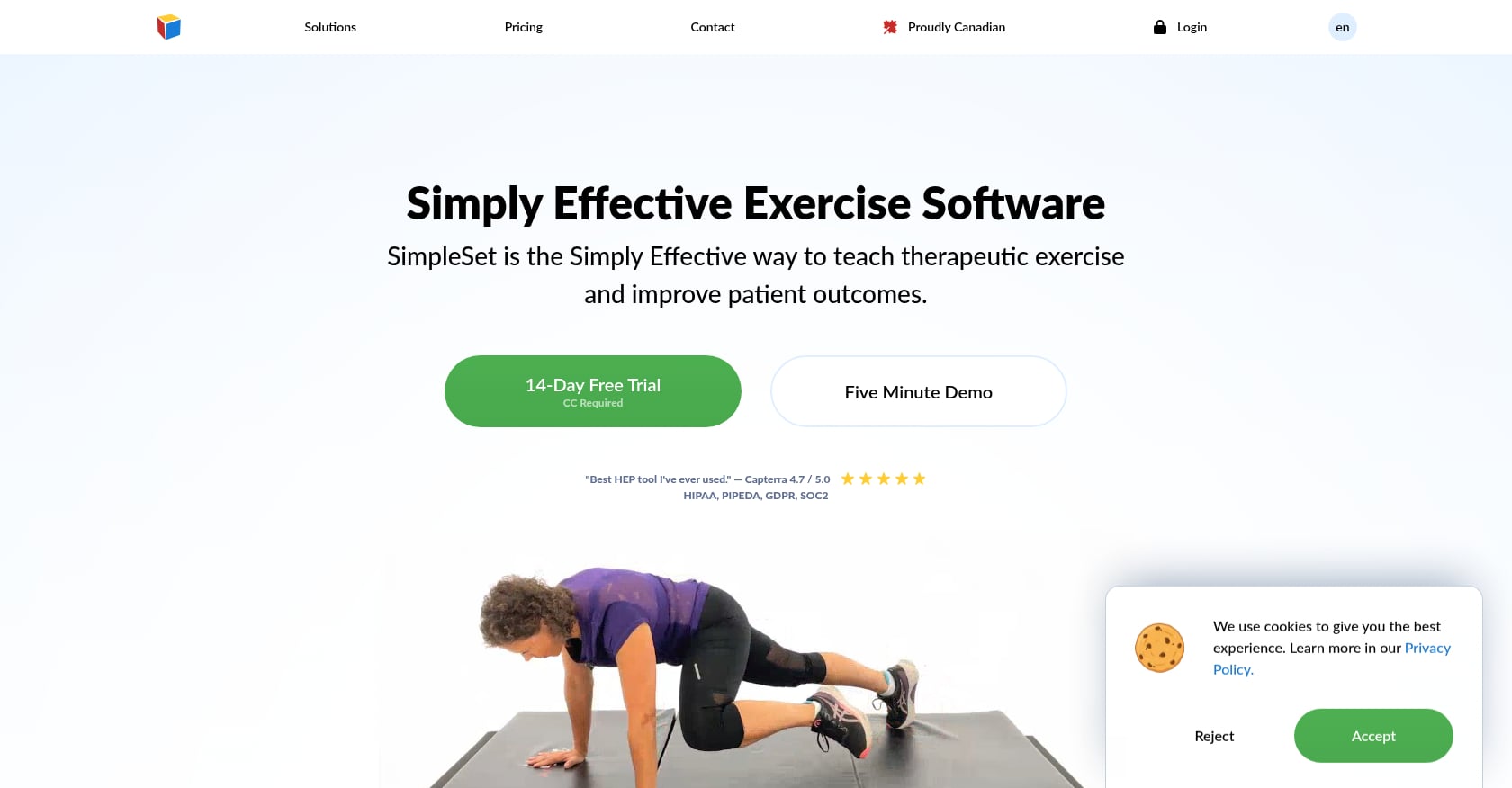
Best for: Clinicians who want a clean, fast HEP builder with outcome tracking and a simple subscription.
Free status: 14-day free trial. Students get free access.
Pricing:
- Solo: $14.99/mo
- Clinic: $12.49/clinician/month
- 14-day trial for all plans
- Free for students
Key features:
- Unlimited exercises and exercise programs
- Outcome measures and tracking
- Patient education
- Full content customization
- Team collaboration on clinic plans
- Simple, intuitive interface
What users say:
SimpleSet holds a 4.7 rating from 144 reviews on Capterra. Reviewers praise its ease of use, exercise search, and quick program creation. One said they could design programs, email them directly, and use telehealth. Another said it helped them spend less time building programs and more time treating.
On Reddit, a physiotherapy practitioner described SimpleSet as a known tool for creating PDF programs that are easy to send, while another called it the best program they knew after their company switched away.
Tradeoffs:
- No permanent free clinic plan
- Trial and student-free option only
- Less obviously built around U.S. RTM billing than RTM-first competitors
- Strong for program creation, lighter on compliance and branding
Bottom line: SimpleSet earns its name. It does one thing well: fast, clean HEP creation. If you want a polished builder and can pay a modest monthly fee, it delivers. It is not the strongest match for clinicians who strictly need a forever-free tool.
6. Rehab Guru
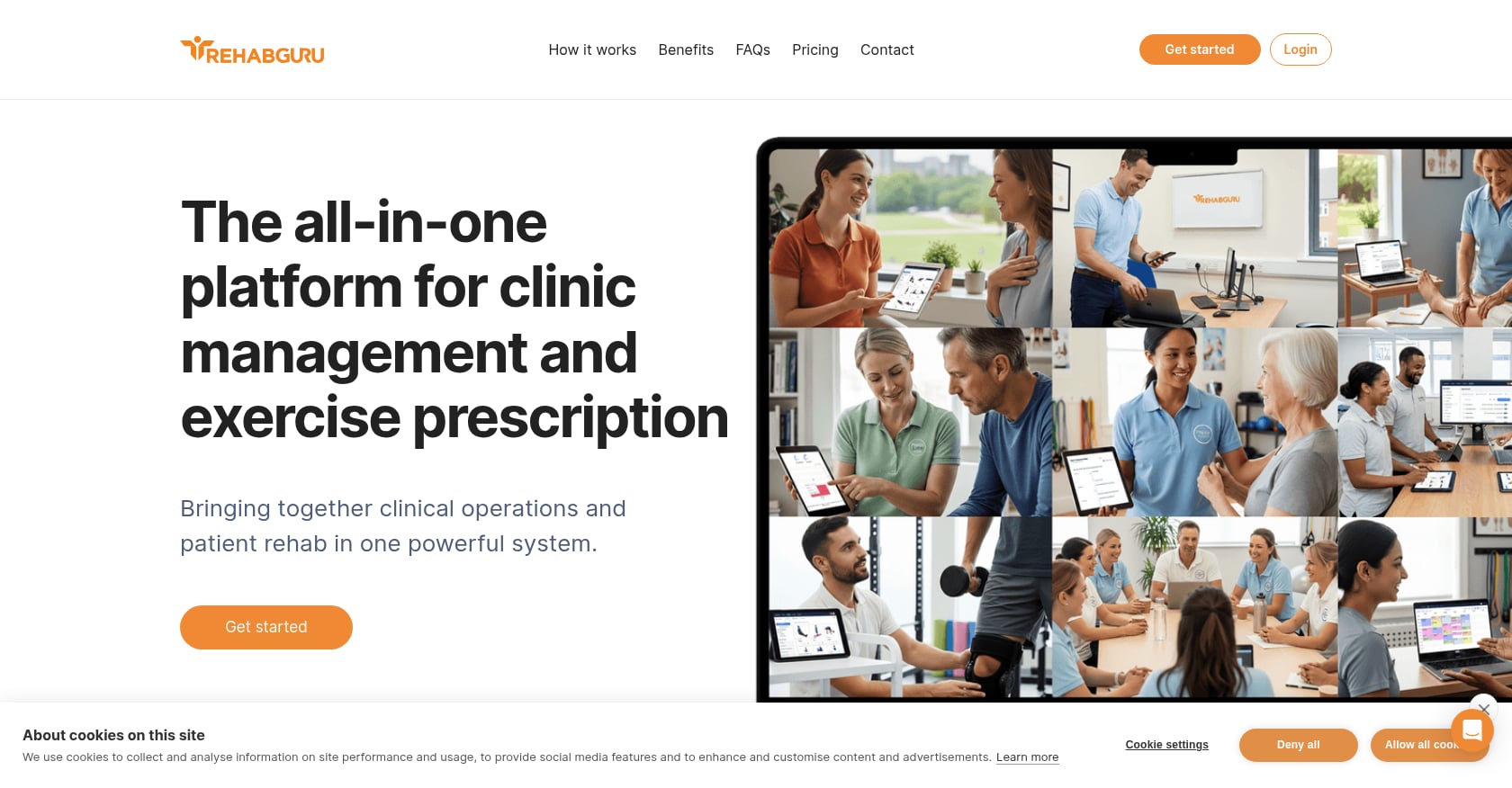
Best for: UK and international rehab teams wanting modular exercise prescription with a client app at a low monthly cost.
Free status: 30-day free trial. Patient app included on paid plans.
Pricing:
- Basic: £10/month
- Optional modules (appointments, treatment notes): £5/month each
- Annual billing saves two months
- No per-patient charges or patient-count caps
Key features:
- 6,000+ exercises with HD video and images
- Exercise creation and PDF export
- Unlimited clients, programmes, and templates
- Remote monitoring and outcome tracking
- Client portal and free client apps
- Custom branding
- Evidence-based template library
What users say:
An App Store reviewer said Rehab Guru works well for physical therapy exercise prescription and tracking across phone, tablet, and PC. The Google Play listing describes the client app as offering HD video, step-by-step guidance, and audio narration.
Tradeoffs:
- GBP pricing and UK orientation may feel less natural for American clinics
- U.S. RTM and HIPAA compliance should be verified before relying on it for billing
- Modular pricing requires careful configuration
- Built for clinician-prescribed programs, not patient self-service
Bottom line: Rehab Guru is a credible low-cost option, particularly for international clinics. For U.S. practices, double-check compliance and RTM positioning before committing.
7. PT Wired / Prompt Engage

Best for: Clinics that want a fully branded patient app with RTM workflows, messaging, and engagement marketing features.
Free status: No free trial listed on review sites. Contact vendor for pricing.
Pricing: Contact vendor. No public pricing available.
Key features:
- Fully branded mobile app with clinic logo
- HEP videos
- Patient-provider messaging
- Marketing content delivery
- RTM billing requirement tracking
- Automatic notification when requirements are met
- Web, Android, and iOS deployment
What users say:
PT Wired holds a 4.9 rating from 16 reviews on Capterra. Positive reviews mention compliance tracking, patient engagement, and professional video quality. One negative review stands out: a PT said setup and support were strong, but they would not recommend it for HEP-only use because it was much more expensive than their previous system and exercises were harder to find.
On Reddit, a practitioner said their clinic used PT Wired for HEP and RTM, loved it, and liked that the app used their own logo.
Tradeoffs:
- Poor price transparency
- Likely expensive for HEP-only use
- Annual contracts reported by reviewers
- Overkill if you only need a simple HEP builder
- May have been rebranded into Prompt Engage; verify current naming
Bottom line: PT Wired is not the budget answer. It belongs on this list because some clinics want their home exercise program app to double as a branded engagement and RTM tool. If you only need free HEP delivery, it is overbuilt for the job.
8. WebPT HEP / StriveHub

Best for: Practices already committed to the WebPT EMR ecosystem.
Free status: HEP and patient portal included in WebPT care plans. Not available as a standalone free app.
Pricing: Quote-based. Can be structured per provider per month or per visit.
Key features:
- HEP with professional videos and customizable instructions
- Multi-phase templates
- Patient chat within HEP software
- StriveHub patient app
- Access from internet-enabled devices
- Part of the broader WebPT EMR suite
What users say:
WebPT holds a 4.4 from 162 reviews on G2, with praise for scheduling and documentation. StriveHub, the patient-facing app, holds just a 1.9 rating from 256 reviews on Google Play. Complaints include navigation issues, slow performance, and workflow frustrations.
On Reddit, WebPT sentiment is notably mixed, with complaints about outages, slow performance, and HEP portal bugs. These are anecdotal but consistent enough to warrant piloting the patient-facing workflow before committing.
Tradeoffs:
- Not a standalone free home exercise program app
- Quote-only pricing makes comparison harder
- Patient app rating (1.9 on Google Play) is significantly weaker than competitors
- May be overbuilt for solo providers who only need HEP delivery
Bottom line: WebPT HEP matters because many clinics already run WebPT. If that is your EMR, adding HEP inside the same system makes sense. If you are shopping for a standalone free HEP app, this is not it.
How to Choose the Right HEP App
The best home exercise program app is not the one with the biggest exercise library. It is the one that keeps the patient connected to the plan between visits. Think of it as an adherence loop with eight steps:
- Create – Can the clinician build the plan quickly during or right after the visit?
- Personalize – Can it include custom video, photos, and clinician-specific cues?
- Deliver – Can patients access it easily on their phone, browser, or in print?
- Remind – Are reminders useful without being annoying?
- Track – Can patients log completion, pain, difficulty, or feedback?
- Message – Can questions stay in a secure channel instead of personal texts?
- Report – Can the clinic use the data for documentation, outcomes, or RTM?
- Scale – Can the workflow grow from solo clinician to a multi-location team?
A 2022 systematic review of 10 randomized controlled trials (1,117 participants) found that digital interventions can improve adherence to prescribed home exercise programs in the short term, though longer-term effects remain less certain. The same review notes that HEP adherence has been reported as low as 50%, with barriers including time constraints, low self-efficacy, and stopping after early improvement.
Separate research on reminder systems in physical therapy concluded that reminders (SMS, phone calls, emails, in-app notifications) may improve exercise adherence. This supports choosing an app that includes behavior prompts, not just exercise delivery. For practical strategies beyond software, see these tips to increase patient engagement.
A practitioner on LinkedIn made the point well: HEP compliance suffers because the home experience often looks nothing like the clinic experience. In the clinic, patients get the therapist’s voice, cues, and demonstration. At home, they get a PDF. The best HEP app should preserve the clinician’s intent, not just deliver exercise names.
Library-First vs. Custom-Video HEP Apps
Most comparisons rank HEP apps by library size. That metric is overrated for many clinical scenarios.
Library-first platforms (MedBridge, Physitrack, SimpleSet, Rehab Guru, WebPT) give you fast search, professionally produced videos, and broad coverage. The weakness: the stock video may be “almost right” but not exactly what you demonstrated. Practitioners on Reddit confirm this frustration. One PT said both MedBridge and HEP2Go sometimes lack the exact exercise needed, and modifications or progressions are hard to find quickly.
Custom-video platforms (AC Health, and to some extent PT Wired) let the clinician record their own cues, setup, and modifications. The patient sees exactly what happened in the visit. The tradeoff: the clinician must create or manage that content.
For nuanced rehab, pelvic health, vestibular therapy, sports progressions, or complex comorbidities, clinician-recorded content often beats a large stock library. When the exercise is standard and well-represented, a library-first tool works fine. The right approach depends on your specialty and how unique your prescriptions tend to be. Regardless of approach, clear exercise instructions matter more than production quality.
When a Free HEP App Is Enough
Free tools can be the right choice. A free home exercise program app works well when:
- You see a small volume of patients
- You need occasional handouts, not daily engagement
- You are a student learning to prescribe exercises
- You do not need messaging or tracking
- You do not bill RTM
- You document separately in your EMR
- Your patients prefer print
HEP2Go fits these scenarios. So does AC Health’s free tier if you want to go beyond print but are not ready to pay. Understanding patient literacy also matters here. Even a simple printout works better when the instructions match the patient’s reading level and include clear visuals.
When to Upgrade From Free
Upgrade when the free plan starts costing you something else: time, compliance, patient trust, or missed revenue.
Signs it is time to move beyond a basic free home exercise program app:
- Patients lose printouts or forget instructions between visits
- You need to modify plans without recreating the whole program
- You want secure photo, video, or text messaging that keeps PHI off personal channels
- You need adherence logs showing who completed what
- You want reminders and behavior prompts that reduce drop-offs
- You need reporting for clinic KPIs or compliance audits
- You want RTM workflows and billing documentation
- You want a branded app that looks like your clinic
- You need provider libraries and shareable content across a team
AC Health’s tier structure is designed for this transition. The free plan handles a small caseload, and each paid tier adds the features clinics typically need next: more active patients, printable care plans, RTM automation, multi-location libraries, and optional white-label branding. For clinics with multiple locations, standardizing care plans across sites becomes a priority that free tools simply cannot support.
HIPAA and Patient Privacy
Consumer exercise apps, YouTube links, and personal text messages are not the same as a HIPAA-aware provider-to-patient platform. HHS guidance clarifies that HIPAA generally does not protect health data a person downloads or enters into a personal mobile app unless the app is provided by a covered entity or its business associate.
This means sending exercise videos through iMessage, WhatsApp, or email creates a compliance gap if the content includes protected health information. Platforms built for clinical use, like AC Health’s HIPAA-private messaging, keep PHI in a protected channel by design. If you are prescribing home exercise programs as part of a plan of care, the delivery channel matters legally, not just clinically.
HEP Apps and Remote Therapeutic Monitoring
RTM changes the buying criteria for a free home exercise program app. Static handout tools cannot support RTM because the workflow requires logged patient engagement data, monitoring records, and billing-aligned reporting.
HHS telehealth guidance lists RTM code 98977 for musculoskeletal monitoring over 16 or more days in a 30-day period, along with 98980 and 98981 for patient-provider communication and treatment management time.
AC Health supports CPT codes 98975, 98977, 98980, and 98981 with 16-day automatic updates, code-state visual cues, and one-click report generation for CMS-1500 attachment. For a step-by-step approach, see this RTM workflow guide.
Practitioners on Reddit report real interest in RTM billing but also real friction. One commenter noted that many patients sign up and forget to log HEP activity, limiting what the clinic can bill. RTM is not just a feature checkbox. It depends on patient behavior, reminders, logging discipline, and provider review.
App Fatigue Is a Real Barrier
The home exercise program app with the most features is not always the best app for patients. One of the most overlooked factors in choosing HEP software is whether the patient will actually open it.
Ask practical questions before committing:
- Can the patient open their plan in one or two taps?
- Does the app require a code, password, separate download, or portal login?
- Will older adults find it usable?
- Can the provider print a backup for patients who prefer paper?
- Can reminders be personalized instead of generic and annoying?
- Can the app avoid overprompting?
A LinkedIn practitioner put it plainly: patients who skip HEPs are often missing a reason, not just a video. Motivation, purpose, and real-life context matter. Technology helps most when clinicians adapt programs to the patient’s actual home space, equipment, and circumstances.
Choosing a Starting Point
Choose AC Health if you want a free HEP app that starts small but does not trap you in a printout workflow. The free plan is useful for solo clinicians and small caseloads, while the paid tiers add what clinics usually need next: printable care plans, more active patients, RTM workflows, reporting, and branded app options. Choose HEP2Go if you only need a fast free handout builder today. Choose MedBridge or Physitrack if your clinic can pay for a provider platform and wants a polished patient-facing app with a large library.
No single platform is right for every clinician. But starting free and growing into a full engagement workflow beats choosing a platform you outgrow in three months, or one you overpay for before you need the features.
Explore HEP tools built for physical therapists.
Frequently Asked Questions
What is the best free home exercise program app for physical therapists?
AC Health offers the strongest free provider plan with personalized video care plans, HIPAA messaging, and behavior prompts for up to 5 active patients. HEP2Go is the best option for free printable HEPs without tracking or engagement features.
Is HEP2Go really free?
Yes. HEP2Go has a free plan that includes access to thousands of exercises, custom exercise creation, printable HEPs, and 2 saved routines. The Pro plan costs $7/month or $70/year and adds unlimited routines, QR/email/SMS delivery, and branding.
Is MedBridge GO free?
MedBridge GO is free for patients to download and use with a provider-issued access code. The clinician or clinic pays for MedBridge. It is not a free provider tool.
Is PhysiApp free?
PhysiApp is free for patients. Providers pay for the Physitrack clinician subscription, which starts around $19-24 per practitioner per month depending on the plan and pricing page. Always verify current pricing before purchase.
Can I use a regular workout app for a physical therapy home exercise program?
Not for clinical care. Rehab programs should be prescribed and progressed by a clinician based on the patient’s diagnosis and plan of care. Consumer workout apps typically lack HIPAA protections, secure messaging, adherence tracking, and clinician oversight.
What features matter most in a HEP app?
Customization (video, photo, text), reminders, adherence tracking, secure messaging, pain and feedback logging, print backup options, reporting, and RTM support if applicable. Library size matters less than how well the app closes the gap between what happens in the clinic and what happens at home.
Can free HEP apps support RTM billing?
Usually not. RTM workflows require logged patient engagement data, monitoring records across 16+ days, and billing-aligned reporting. Free static handout tools do not capture or store this information. Clinics interested in RTM should choose a platform designed for it and verify requirements with a billing expert.
Do patients actually use HEP apps?
Research shows that digital HEP tools can improve short-term adherence, but long-term results depend on motivation, workflow, and provider follow-up. Apps with reminders, progress tracking, and secure messaging tend to perform better than static PDFs. The biggest factor is whether the clinician actively engages with the patient’s feedback inside the app.
{ “@context”: “https://schema.org”, “@type”: “FAQPage”, “@id”: “#faq”, “mainEntity”: [ { “@type”: “Question”, “@id”: “#faq-question-1”, “name”: “What is the best free home exercise program app for physical therapists?”, “acceptedAnswer”: { “@type”: “Answer”, “text”: “AC Health offers the strongest free provider plan with personalized video care plans, HIPAA messaging, and behavior prompts for up to 5 active patients. HEP2Go is the best option for free printable HEPs without tracking or engagement features.” } }, { “@type”: “Question”, “@id”: “#faq-question-2”, “name”: “Is HEP2Go really free?”, “acceptedAnswer”: { “@type”: “Answer”, “text”: “Yes. HEP2Go has a free plan that includes access to thousands of exercises, custom exercise creation, printable HEPs, and 2 saved routines. The Pro plan costs $7/month or $70/year and adds unlimited routines, QR/email/SMS delivery, and branding.” } }, { “@type”: “Question”, “@id”: “#faq-question-3”, “name”: “Is MedBridge GO free?”, “acceptedAnswer”: { “@type”: “Answer”, “text”: “MedBridge GO is free for patients to download and use with a provider-issued access code. The clinician or clinic pays for MedBridge. It is not a free provider tool.” } }, { “@type”: “Question”, “@id”: “#faq-question-4”, “name”: “Is PhysiApp free?”, “acceptedAnswer”: { “@type”: “Answer”, “text”: “PhysiApp is free for patients. Providers pay for the Physitrack clinician subscription, which starts around $19-24 per practitioner per month depending on the plan and pricing page. Always verify current pricing before purchase.” } }, { “@type”: “Question”, “@id”: “#faq-question-5”, “name”: “Can I use a regular workout app for a physical therapy home exercise program?”, “acceptedAnswer”: { “@type”: “Answer”, “text”: “Not for clinical care. Rehab programs should be prescribed and progressed by a clinician based on the patient’s diagnosis and plan of care. Consumer workout apps typically lack HIPAA protections, secure messaging, adherence tracking, and clinician oversight.” } }, { “@type”: “Question”, “@id”: “#faq-question-6”, “name”: “What features matter most in a HEP app?”, “acceptedAnswer”: { “@type”: “Answer”, “text”: “Customization (video, photo, text), reminders, adherence tracking, secure messaging, pain and feedback logging, print backup options, reporting, and RTM support if applicable. Library size matters less than how well the app closes the gap between what happens in the clinic and what happens at home.” } }, { “@type”: “Question”, “@id”: “#faq-question-7”, “name”: “Can free HEP apps support RTM billing?”, “acceptedAnswer”: { “@type”: “Answer”, “text”: “Usually not. RTM workflows require logged patient engagement data, monitoring records across 16+ days, and billing-aligned reporting. Free static handout tools do not capture or store this information. Clinics interested in RTM should choose a platform designed for it and verify requirements with a billing expert.” } }, { “@type”: “Question”, “@id”: “#faq-question-8”, “name”: “Do patients actually use HEP apps?”, “acceptedAnswer”: { “@type”: “Answer”, “text”: “Research shows that digital HEP tools can improve short-term adherence, but long-term results depend on motivation, workflow, and provider follow-up. Apps with reminders, progress tracking, and secure messaging tend to perform better than static PDFs. The biggest factor is whether the clinician actively engages with the patient’s feedback inside the app.” } } ] }