TL;DR
HEP stands for home exercise program, and finding the right HEP therapist tool is the difference between patients who follow through and patients who lose their handout in the car. Non-adherence to home exercises runs as high as 70%, so the software you pick matters more than most therapists realize. This guide compares eight HEP platforms across pricing, patient engagement, custom video, HIPAA messaging, RTM support, and honest tradeoffs so you can choose the one that actually fits your clinic.
Why HEP Software Is a Bigger Decision Than It Looks
Every therapist prescribes home exercises. The question is whether patients actually do them.
A 2024 overview of systematic reviews found that non-adherence in physiotherapy can reach 70%, particularly for unsupervised home exercise programs. Separate research suggests 50 to 65% of patients with general musculoskeletal conditions skip or abandon their HEP entirely. The problem is not a shortage of exercises. It is that patients forget what to do, lose confidence in their form, or simply stop without anyone noticing.
Paper handouts have been the default for decades. They are cheap, familiar, and easy to hand over. But a randomized controlled trial in stroke patients found 75.6% three-month adherence with a mobile video-guided HEP compared to just 55.2% with paper. Video, reminders, and remote support are not cosmetic upgrades. They directly address the reasons home programs fail.
This article is for physical therapists, occupational therapists, SLPs, chiropractors, athletic trainers, and clinic owners searching for a HEP therapist solution that goes beyond printable PDFs. It compares eight platforms on the criteria that actually matter: speed of creation during the visit, patient app usability, HIPAA-safe communication, adherence tracking, RTM documentation, and total cost.
One quick note: “HEP” in therapy contexts means home exercise program, not hepatitis. If you landed here looking for hepatitis resources, this is not the right article.
See AC Health pricing to compare tiers before reading the full breakdown.
Quick Comparison: Best HEP Software for Therapists
| Tool | Starting Price | Best For | Core HEP Model | Patient Engagement | RTM Support | Main Tradeoff |
|---|---|---|---|---|---|---|
| AC Health | Free (up to 5 patients); paid from $14/mo | Small clinics wanting personalized HEP + HIPAA messaging | Custom video/photo/text care plans | In-app reminders, behavior prompts, secure messaging | Included on Unlimited tier | No CEU library; clinicians build their own content |
| HEP2Go | Free; Pro $7/mo | Budget printable HEPs | Web-based exercise library + print/PDF | Limited vs app-first tools | No native RTM | Security concerns reported by practitioners |
| MedBridge | $325/yr individual | HEP + CEUs + patient education | Large evidence-based library, MedBridge GO app | Patient portal, reminders, outcomes on higher plans | RTM on Care Elite plans; $10/episode fee | Per-program fees add up; pricey for HEP-only use |
| Physitrack | ~$23.99/mo (verify current pricing) | Large library + multilingual patient app | 15,000+ exercise library | PhysiApp, adherence feedback, reminders | U.S. RTM bundle: $30/user/mo + $8 active-user fee | Pricing pages show conflicting numbers |
| Exercise Pro Live | $134/yr standard; $99 intro | Low-cost annual video library | 7,000+ videos + handouts | App access, tracking, communication | RTM included per vendor | Search/naming friction reported |
| Rehab Guru | From £12/mo | Modular international rehab workflow | 6,000+ exercises, custom exercises | Client app, portal, WhatsApp reminders | Remote monitoring included; U.S. RTM fit unclear | UK pricing; HIPAA/RTM verification needed for U.S. clinics |
| PtEverywhere | $49/mo Starter | HEP inside cash-pay PT practice management | HEP within scheduling, charting, billing | Secure messaging, reminders, portal | Not primary HEP/RTM specialist | HEP module gets mixed reviews |
| Limber Health | Demo/quote pricing | Enterprise hybrid MSK, RTM, MIPS | 7,000+ professionally produced videos | App, adherence, PROs, care navigation | Strong RTM positioning | Opaque pricing; patient app friction in reviews |
Quick Picks
- Best overall for small clinics: AC Health
- Best free/basic handout builder: HEP2Go
- Best HEP + CEU bundle: MedBridge
- Best large exercise library + multilingual patient app: Physitrack
- Best low-cost annual library tool: Exercise Pro Live
- Best modular international rehab workflow: Rehab Guru
- Best EMR/practice-management bundle for cash PT: PtEverywhere
- Best enterprise hybrid RTM + MIPS platform: Limber Health
What Makes a Good HEP Therapist Tool?
Most comparison articles rank platforms by exercise library size. That metric matters, but it is not where therapists actually get stuck. Practitioners on Reddit report that neither MedBridge nor HEP2Go always has the exact exercise they need, and some resort to recording the patient’s movement with verbal cues when the patient agrees. GetApp reviewers say Exercise Pro Live users value its large library but find exercises hard to locate because of inconsistent naming.
The real question is not “how many exercises does it have?” It is “can my patient do the right thing tomorrow morning?”
Here is what separates a useful HEP therapist platform from a glorified PDF maker:
- Fast in-visit creation. Therapists on Reddit describe giving only two or three home items at evaluation because complex testing and documentation eat up the clock. The winning tool helps you prescribe before the patient walks out, not at 8 p.m.
- Custom video with therapist-specific cues. Stock video is “almost right.” Your own recording shows the exact setup, range, tempo, and safety modifications you demonstrated. This matters for patient literacy and comprehension.
- Reminders and behavior nudges. A program that sits unopened in an app is not much better than a crumpled handout. Scheduled reminders help patients know what to do today, not just what exercises exist. Learn more about habit-forming reminders for patients.
- HIPAA-secure messaging. If a patient has pain or confusion about an exercise, the response should happen inside a protected channel, not over personal text or email.
- Printable care plans. Some patients are not app people. A good platform supports both digital and paper delivery.
- Adherence tracking. Without visibility into whether patients complete their programs, therapists are guessing.
- RTM-ready reporting. For U.S. clinics exploring Remote Therapeutic Monitoring, the platform should reduce documentation work, not create a second job.
- Pricing transparency. Per-seat costs, patient caps, per-program fees, per-episode RTM fees, setup costs, and auto-renewal policies all affect the real price.
Best HEP Apps and Software for Therapists
1. AC Health
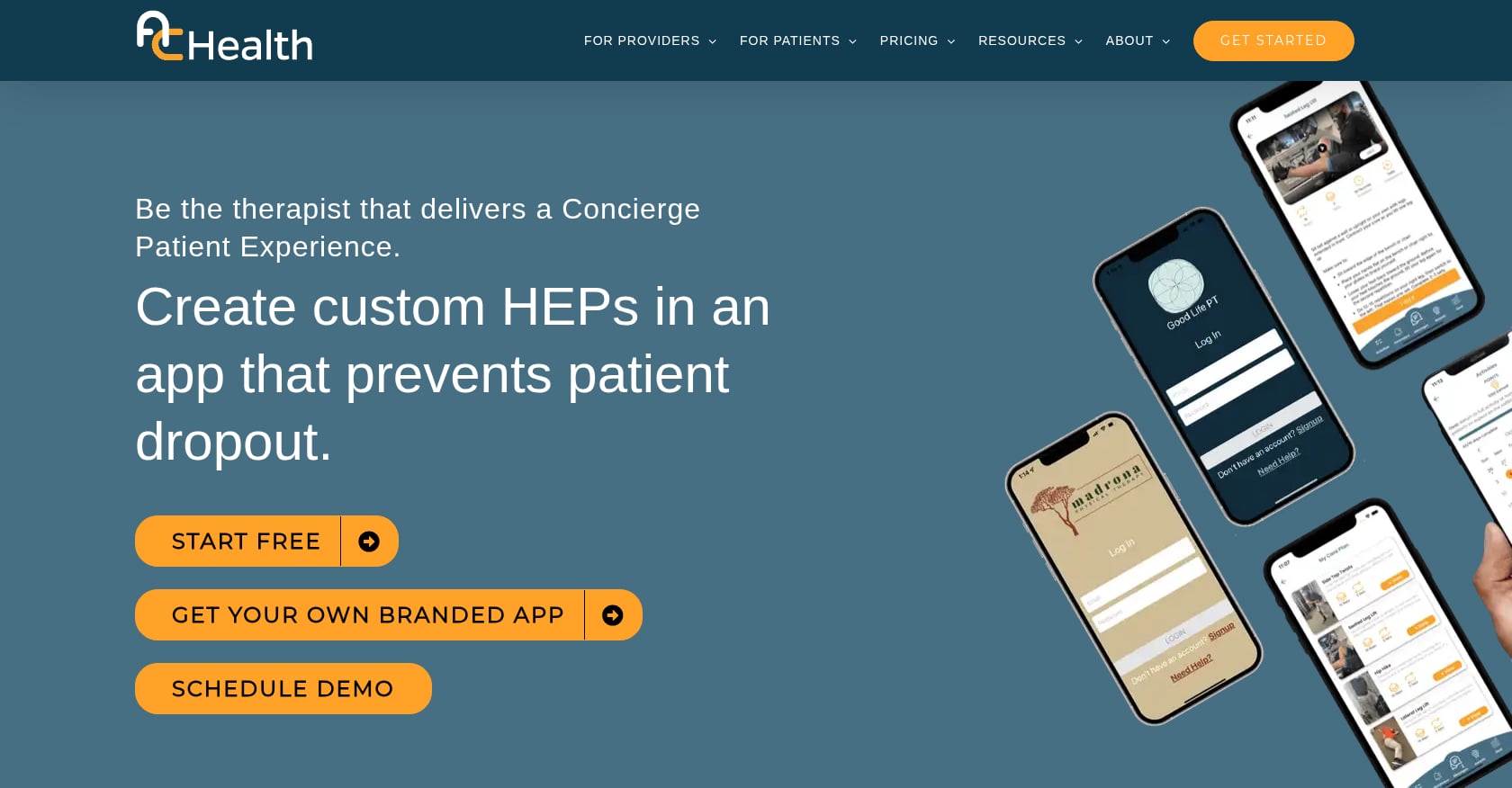
Best for: Small and growing therapy clinics that want personalized HEPs with custom video, HIPAA-secure messaging, and RTM workflows at transparent pricing.
AC Health is built around a simple idea: patients follow through when they see their own therapist’s demonstration, not a stock video of a stranger. It is a HIPAA-compliant provider-to-patient platform designed for PTs, OTs, SLPs, chiropractors, athletic trainers, and coaches who prescribe exercises or home assignments.
Pricing:
- Free: $0/mo, up to 5 active patients
- Basic: $14/mo, 6 to 15 active patients
- Professional: $29/mo, 16 to 30 active patients (adds printable care plans)
- Unlimited: $45/mo, 31+ active patients (adds Remote Therapeutic Monitoring)
- Clinic: $60/mo, for clinics with 2+ locations (3 unlimited channels, shareable libraries)
- White-label branded app: $400 upfront + $150/mo
Key features:
- One-tap custom video, photo, and text care plans created during the visit
- In-app behavior triggers and personalized patient reminders
- HIPAA-private video/photo/text messaging in a protected channel
- One-click access to patient exercise history, current plan, progress, and conversations
- Customizable reporting aligned to clinic KPIs
- RTM automation for CPT 98975, 98977, 98980, 98981 with 16-day automatic updates, code-state visual cues, and one-click report generation for CMS-1500
- Knowledge Tracks for post-discharge engagement and subscription content
- Optional white-label branded app with NPS surveys, in-app referrals, and third-party libraries
- Printable care plans on Professional tier and above
- Free educator program for PT/OT/SLP academic programs
User sentiment:
AC Health reports a 91 patient Net Promoter Score. Its Capterra profile shows 4.9 overall from 10 reviews, with praise for mobile capture, customization, and responsive support. App store feedback is mixed but shows active developer engagement: the Android listing shows 4.2/5 from 8 reviews, iOS 3.0/5 from 19 ratings, with developer replies addressing sign-out and glitch reports.
Tradeoffs:
- No CEU library (unlike MedBridge); the focus is clinical HEP and engagement
- Personalization-first workflow means clinicians need to record or build their own content
- EMR integrations are not prominently advertised
- Smaller vendor scale compared to MedBridge or Physitrack
- Clinics should pilot with a subset of patients before wide rollout based on app store feedback
Verdict: Choose AC Health if you want a HEP therapist app built around your own instruction, not a generic exercise library. It is especially strong for small clinics that need secure messaging, in-visit plan creation, and RTM-ready reporting without enterprise pricing.
2. HEP2Go
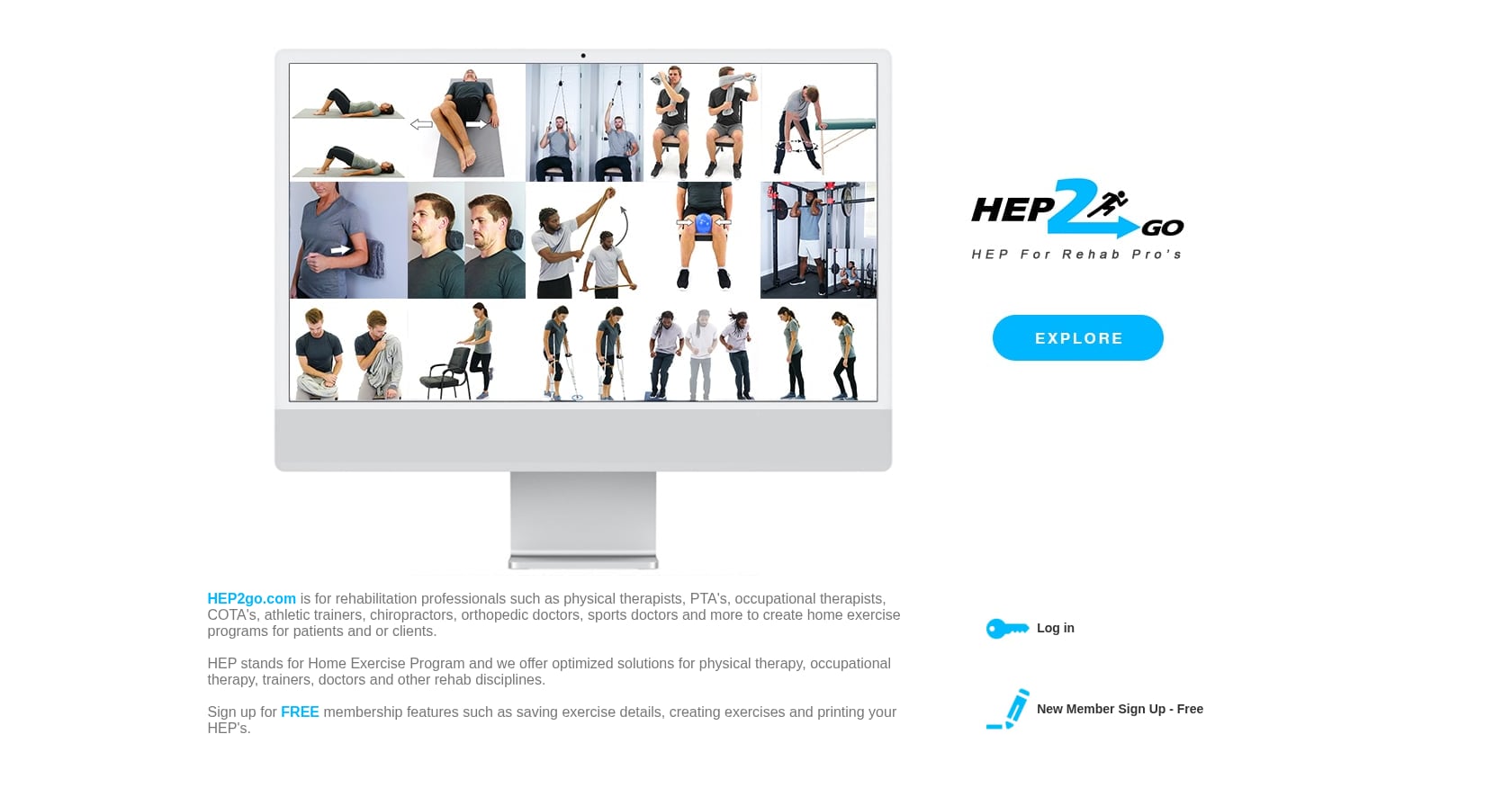
Best for: Students, solo clinicians, and budget-conscious therapists who only need printable or emailed exercise handouts.
HEP2Go has been a staple in therapy clinics for years. It is cheap, familiar, and does one thing adequately: let you build a printable exercise handout from a web-based library.
Pricing:
- Free: 2 saved routines
- Pro: $7/month or $70/year, unlimited saved routines
- Group discounts reported starting at $5/month per employee for 2 to 20 employees
Key features:
- Thousands of exercises and educational content
- Custom exercise uploads
- Print HEPs, QR codes, email delivery, SMS text delivery (Pro)
- Company logo branding (Pro)
- Google Translate integration (Pro)
- Copy-to-clipboard documentation support (Pro)
User sentiment:
Practitioners on Reddit still recommend HEP2Go for simple, free HEPs. One chiropractic subreddit user noted it works with ChiroTouch through a simple copy/paste for exercise lists and sets/reps. But the conversation has shifted. Multiple Reddit threads in 2025 and 2026 reference HEP2Go being hacked or blocked by hospital IT, with users describing malware downloads, redirects, and permanent organizational blocks. One August 2026 thread describes a hospital permanently blocking the site, with commenters referencing prior security incidents.
Tradeoffs:
- Limited patient engagement compared to app-first tools
- No strong native adherence tracking or RTM workflow
- Security and IT compliance concerns are part of the current community conversation
- More handout-oriented than care-continuity-oriented
- Not suited for clinics needing HIPAA messaging or outcomes reporting
Verdict: Choose HEP2Go if you need the cheapest way to make printable HEPs and nothing more. Do not choose it if your clinic needs a modern patient app, adherence tracking, secure messaging, or a tool likely to pass strict IT review. For a deeper look at the differences, read this AC Health vs HEP2Go comparison.
3. MedBridge
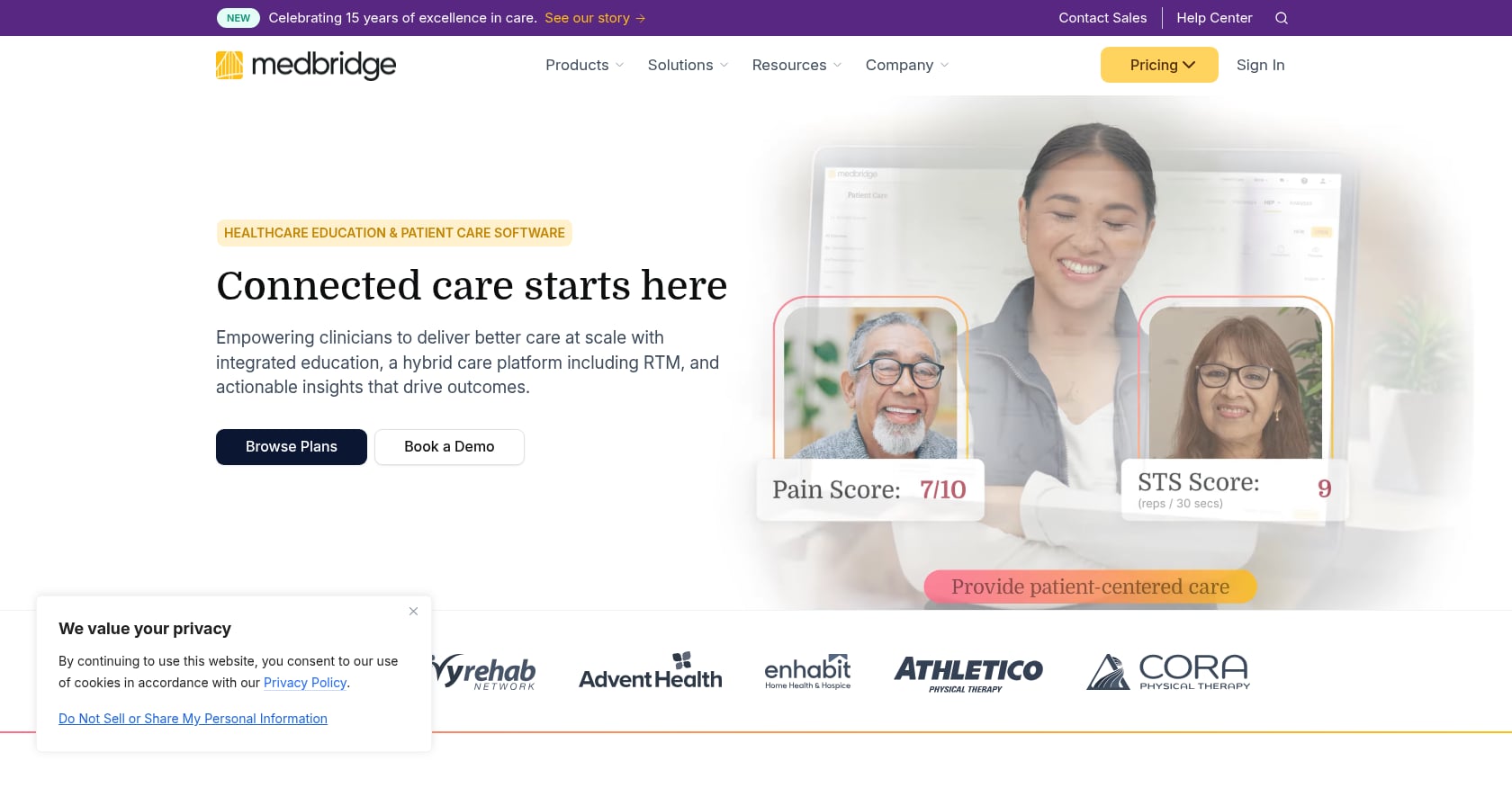
Best for: Clinics that already use MedBridge for CEUs and want HEP, patient education, and continuing education from one vendor.
MedBridge is the dominant name in rehab continuing education, and its HEP tools ride on that reputation. If your organization already pays for MedBridge CEUs, adding the HEP module is a natural extension.
Pricing:
- Individual Premium: $325/year (education + exercise library + MedBridge GO + patient portal)
- Small-business Care Essentials: $329/seat/year, with 100 HEP programs per seat per year (pooled), then $1.50 per extra program
- Care Elite: $329/seat/year, unlimited HEP programs, RTM/Guided Care Pathways at $10 per episode
Key features:
- 8,000+ exercises across 20 specialties
- Patient education library
- MedBridge GO app for iOS and Android
- Online patient portal with reminders, notifications, and gamification
- Spanish translation
- Program sharing and EMR documentation support
- Patient-reported outcomes and analytics on higher plans
- CEU/on-demand education library in bundled plans
User sentiment:
Capterra shows MedBridge at 4.5 out of 5 from 37 reviews, with praise for intuitive, visually engaging HEPs and CEU usefulness. Negative reviews cite customer service issues, invoice confusion, and overage visibility problems. On Reddit, therapists frequently say MedBridge is worth it if discounted, but some push back on pricing or new subscription constraints.
Tradeoffs:
- Higher annual cost than AC Health, HEP2Go, or Exercise Pro Live
- If a clinic only needs HEPs, the CEU-heavy bundle may be more than necessary
- Per-program and per-episode fees can matter at scale
- Less focused on therapist-recorded custom video than AC Health
- Some user complaints around billing and customer service complexity
Verdict: Choose MedBridge if your clinic wants HEPs, CEUs, patient education, and standardized content from one large platform. If your main goal is fast personalized HEP creation and secure patient messaging at a lower price, a lighter tool will serve you better.
4. Physitrack
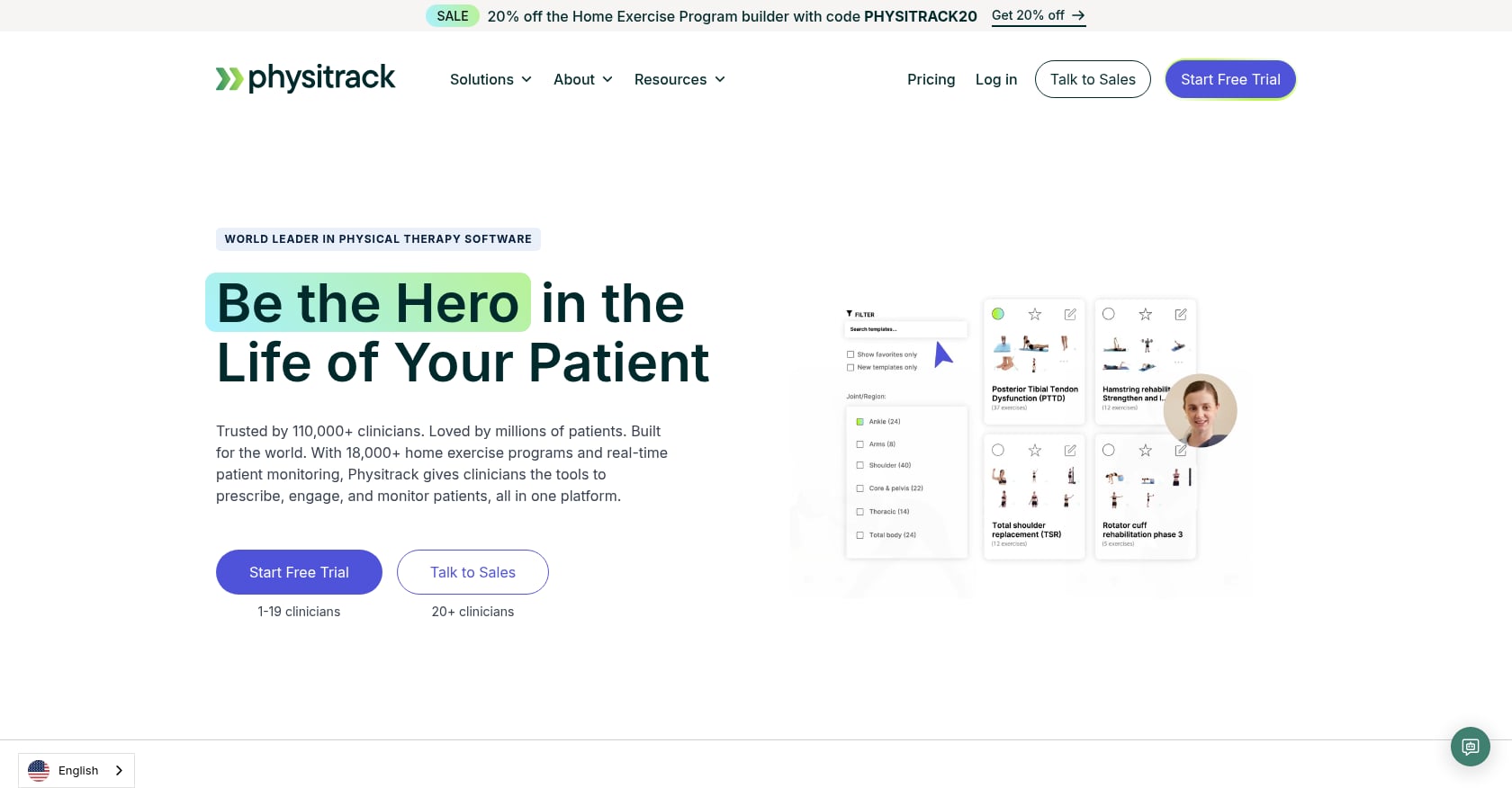
Best for: Clinics wanting a large video exercise library, strong patient app presence, detailed tracking, and multilingual or international support.
Physitrack has built one of the most recognizable patient-facing apps in rehab. PhysiApp boasts 4.9 stars on Google Play with 32,100+ reviews and over one million downloads, which is a significant installed base.
Pricing:
- U.S. support page: $23.99/practitioner/month or $259.09/year (10% annual discount)
- Public pricing page also shows $18.99/month for standard monthly under 20 practitioners
- U.S. RTM bundle: $30/user/month + $8 active-user charge in months with active RTM patients
- PhysiApp is free for patients
- 14-day risk-free trial; cancel anytime
Note: Because public pages show different price points, verify current U.S. pricing before purchasing.
Key features:
- 15,000 to 18,000+ exercise videos (depending on source)
- PhysiApp for iOS, Android, and web
- QR-code/EasyLink patient access
- Patient progress tracking and adherence feedback
- Telehealth trial
- EHR/practice management integrations
- Multilingual support (English plus 14 languages)
- U.S. RTM bundle with CEU/CPD content
User sentiment:
Despite PhysiApp’s high overall ratings, individual users still report friction. A Google Play reviewer complained about clicks not opening exercises and needing to restart the app. An iOS reviewer praised the exercise videos but wanted patients to be able to adjust reps and time as recovery progressed. On Reddit, a chiropractor noted Physitrack integrates well with Jane App. The app is generally well-regarded, but high aggregate ratings can mask real workflow problems.
Tradeoffs:
- Pricing is less straightforward because pages show different numbers
- Custom video creation is not the central differentiator; it is library and tracking-oriented
- Enterprise features may require onboarding and quotes
- RTM carries a per-active-user usage fee
- Patient app friction exists despite high aggregate ratings
Verdict: Choose Physitrack if you want a mature HEP platform with a massive library, strong patient app presence, and international or multilingual support. If therapist-recorded custom video and lower transparent pricing matter more than library size, compare AC Health’s approach first.
5. Exercise Pro Live
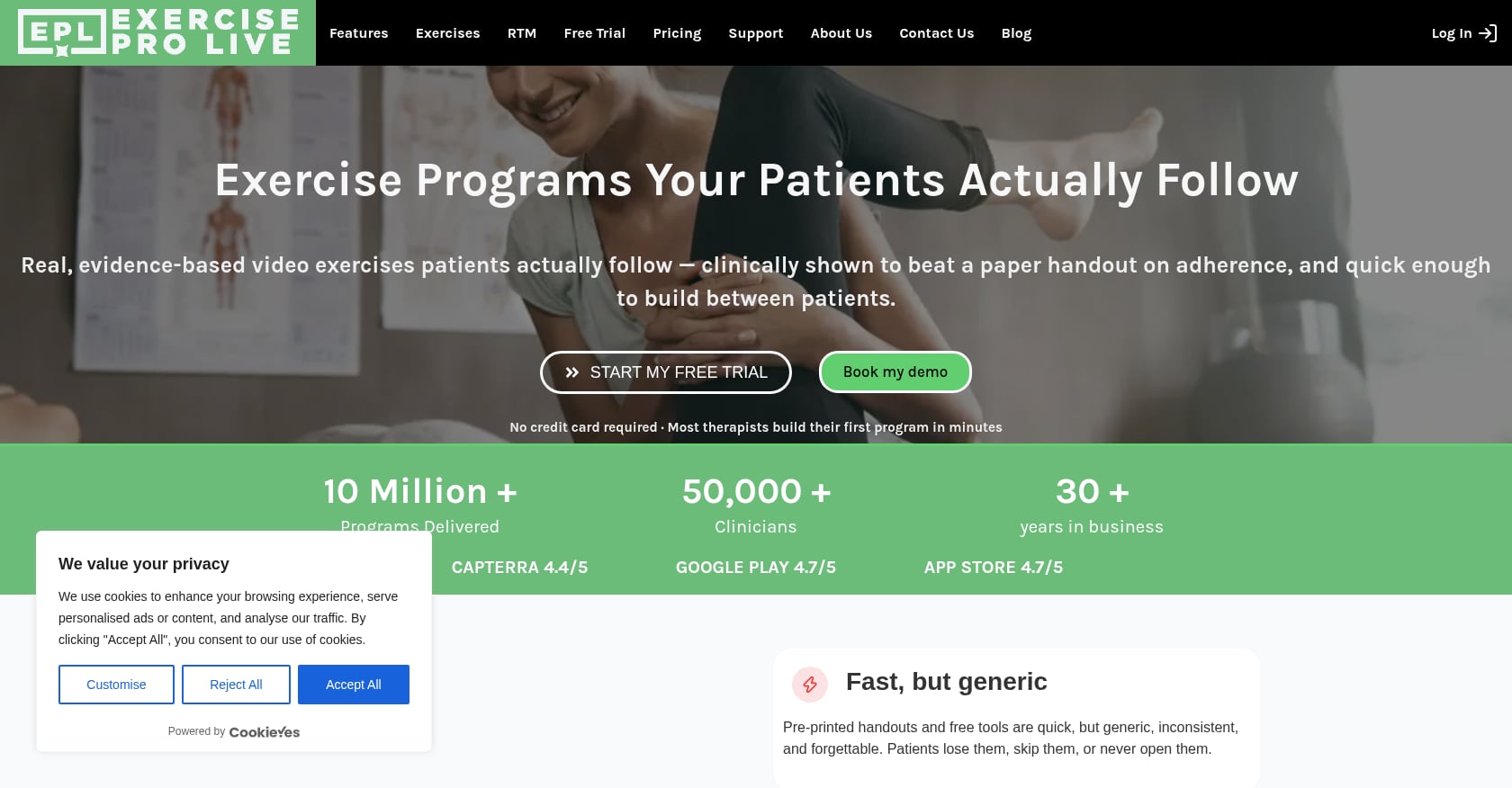
Best for: Budget-conscious clinics that want video HEPs and printable handouts without high annual per-seat costs.
Exercise Pro Live hits a price point that makes larger libraries accessible to solo practitioners and small teams. It positions itself as a practical middle ground between free handout builders and premium platforms.
Pricing:
- 1 user: $134/year standard, $99 intro discount, or $16.99/month
- 2 to 5 users: $89/year each ($69 intro), or $12.99/month/user
- 6 to 10 users: $79/year each ($65 intro), or $11.99/month/user
- 10+ users: custom/enterprise pricing
- Special discounts for APTA, PPS, NATA, Parker, Palmer, or TCC members
- 14-day free trial, no credit card required
- Auto-renewal and no-refund policy on signup (check terms before purchasing)
Key features:
- 7,000+ professional HD video exercises
- Web, smartphone, iPad, Mac/PC access
- Print handouts and email delivery
- Spanish and French translation
- Educational handouts
- Clinician and patient phone apps
- RTM tools included at no additional cost per vendor claims
User sentiment:
GetApp shows Exercise Pro Live at 4.4 out of 5 from 133 reviews. Users appreciate the large library, video quality, handout customization, and professional presentation. The consistent complaint: search functionality and inconsistent exercise naming make it harder to find the right exercise quickly.
Tradeoffs:
- Lower price but less polished than newer mobile-first platforms
- Search and naming friction can slow down HEP creation during visits
- No-refund and auto-renew terms should be reviewed before purchase
- RTM claims should be verified by your billing and compliance team
- Less emphasis on secure in-app patient communication
Verdict: Choose Exercise Pro Live if you want an affordable video-based HEP library with printable handouts. It is a solid budget option, but clinics that rely on fast custom video capture and secure patient communication should weigh alternatives.
6. Rehab Guru
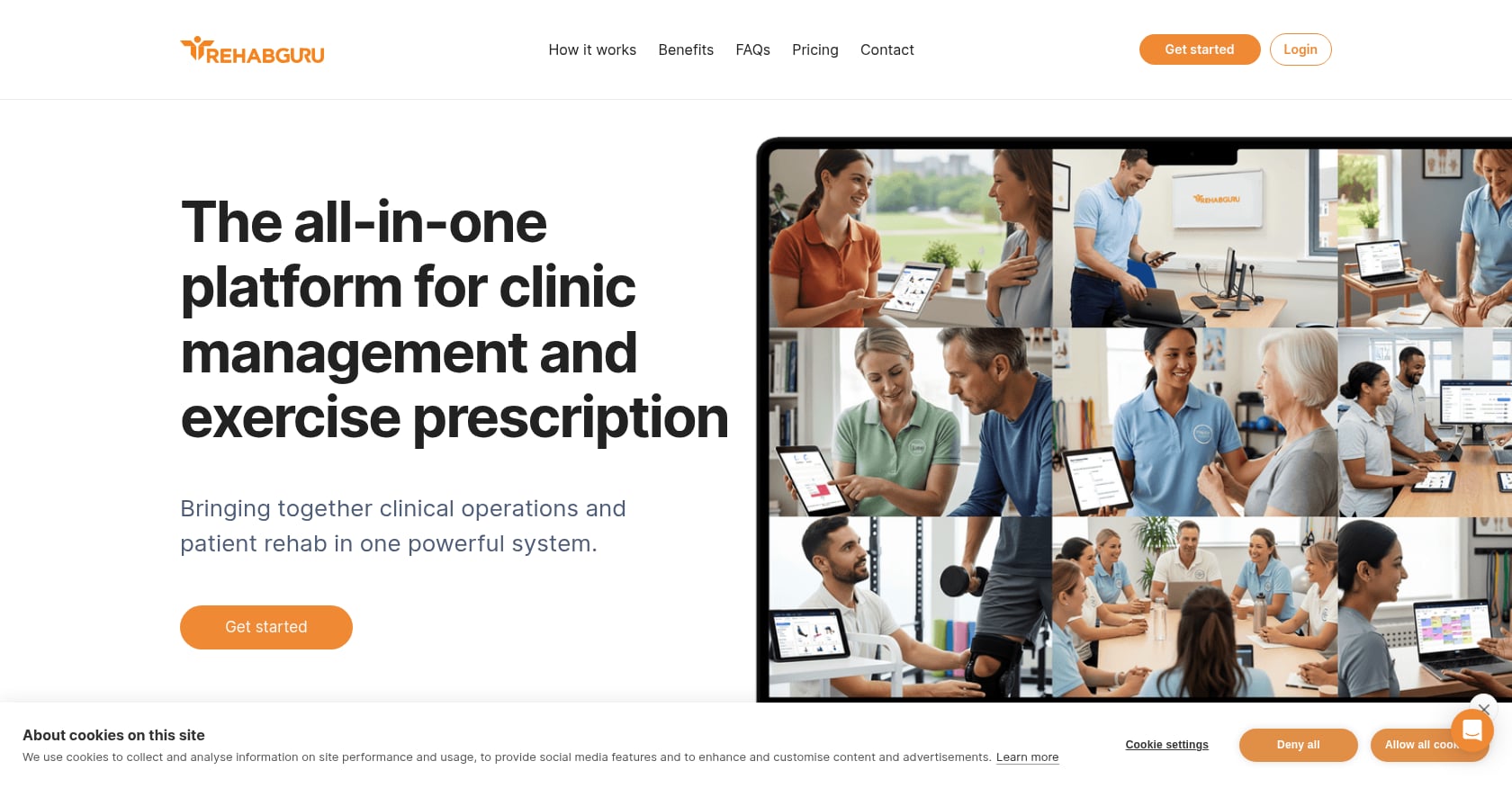
Best for: UK and international rehab, physiotherapy, and sports medicine clinics wanting modular exercise prescription plus notes, forms, bookings, and branded portals.
Rehab Guru takes a modular approach. Instead of bundling everything into one flat fee, it lets clinics add exercise prescription, treatment notes, forms, bookings, payments, and AI modules as needed.
Pricing:
- Exercise prescription: from £12/month for a sole clinician
- Tiered per-user discounts for teams; enterprise bulk discounts available
- 30-day free trial of Pro plan (no payment method required)
- Free plan available after trial: up to 6 clients, data retained but features limited
Key features:
- 6,000+ exercises with custom exercise creation
- PDF export and branded portal/PDFs
- Unlimited clients, programmes, and templates
- Remote monitoring and outcome tracking
- Client portal and free client apps
- Evidence-based templates
- WhatsApp appointment reminders (no per-message charge from Rehab Guru)
- Optional add-ons: treatment notes, forms, bookings, payments, AI modules
User sentiment:
Trustpilot shows Rehab Guru at 4.8 from 40 reviews. Recent reviews praise it as affordable, easy for team members, strong for custom programs, and responsive in customer support. Trustpilot notes the company has not recently invited customers, so the review sample may not be fully representative.
Tradeoffs:
- Pricing in GBP with VAT implications
- U.S. HIPAA and RTM workflow fit should be confirmed before adopting
- Broader clinic software, not just a lightweight HEP tool
- U.S. practices may prefer a platform with RTM CPT-code-specific reporting
Verdict: Choose Rehab Guru if you want a modular rehab clinic platform with exercise prescription, notes, bookings, and branded materials. U.S. clinics should verify HIPAA, RTM, and payer documentation fit before choosing it over a U.S.-focused platform.
7. PtEverywhere
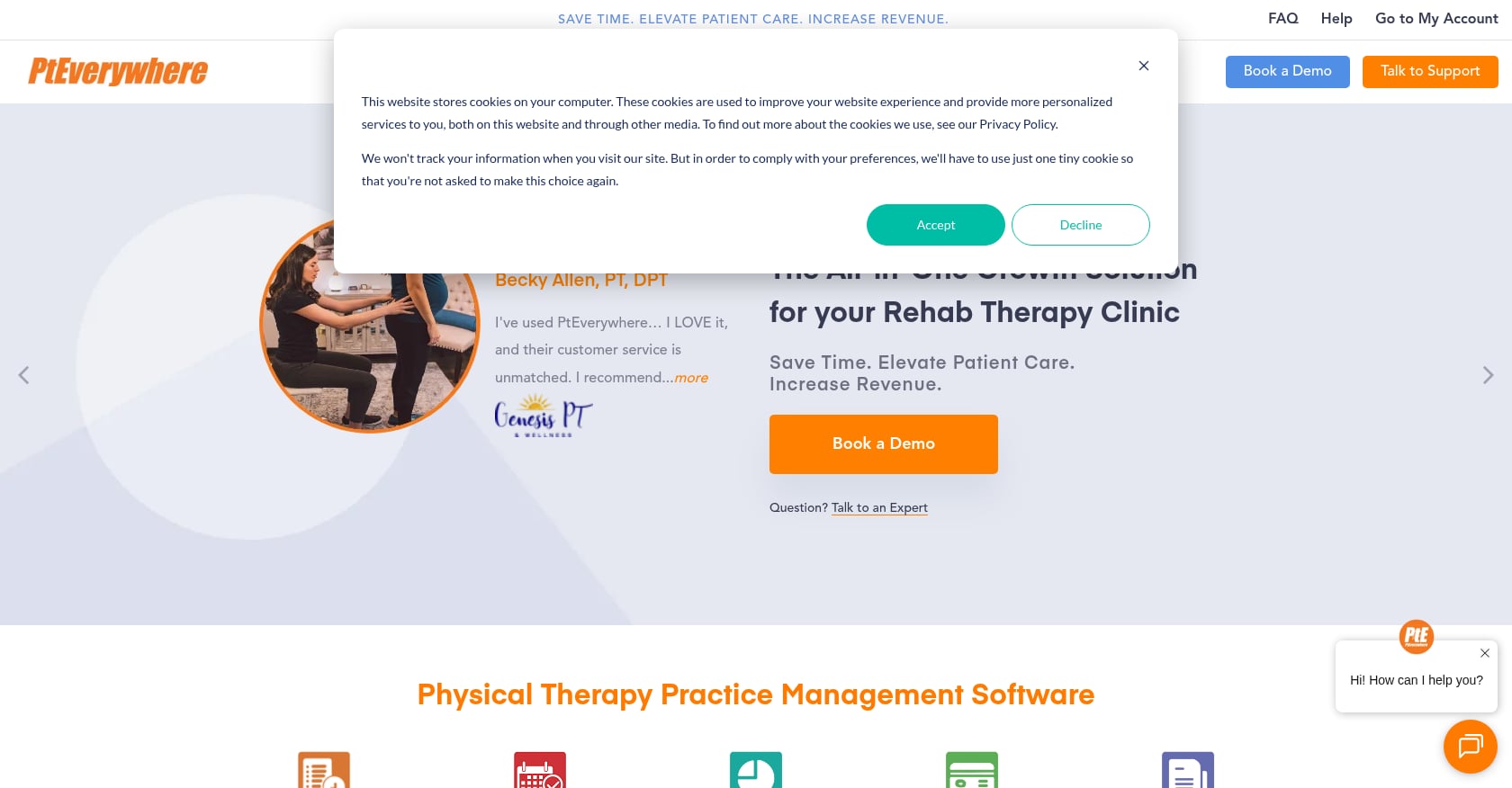
Best for: Cash-based and hybrid PT practices that want scheduling, charting, billing, messaging, patient portal, and HEP in one system.
PtEverywhere positions itself as an all-in-one practice management solution. For clinic owners tired of juggling separate scheduling, documentation, billing, and HEP tools, consolidation is the pitch.
Pricing:
- Starter: $49/month (1 therapist, 20 visits/month limit)
- Standard: $149/month (1 therapist, unlimited visits)
- Pro: $199/month (adds SMS, telehealth, fax, premium integrations)
- Additional therapists: $75/month each (2 to 5), $60 (6 to 10), $50 (11+)
- Admin/receptionist accounts: $0
Key features:
- Patient dashboard, scheduling, charting/documentation
- Billing and invoicing
- Home exercise program module
- Reports and dashboard
- Secure messaging, tasks, and alerts
- Patient portal and mobile app
- AI scribe included
- SMS, telehealth, fax on Pro tier
User sentiment:
Capterra shows PtEverywhere at 4.8 from 16 reviews. One reviewer praised scheduling, charting, invoicing, and the app experience but said the HEP was hard to use and wanted CRM automation. Another said the software is strong overall but wanted an expanded HEP program. A 2026 Reddit thread notes PtEverywhere’s HEP module can embed YouTube/Vimeo or record an exercise on the spot, and patients access it through the portal app alongside scheduling and payments.
The pattern is clear: do not assume the HEP module is strong just because the EMR is strong.
Tradeoffs:
- Strong all-in-one practice system, but HEP is not its strongest module
- More expensive than standalone HEP apps if HEP is the primary need
- Starter plan’s 20 visits/month limit is restrictive for most clinics
- Best for practice-management consolidation, not for clinics that already have an EMR and want a better HEP layer
Verdict: Choose PtEverywhere if your HEP needs to live inside scheduling, documentation, billing, and patient payments. If you already have an EMR and want a focused HEP and engagement layer, a dedicated platform will likely serve patients better.
8. Limber Health
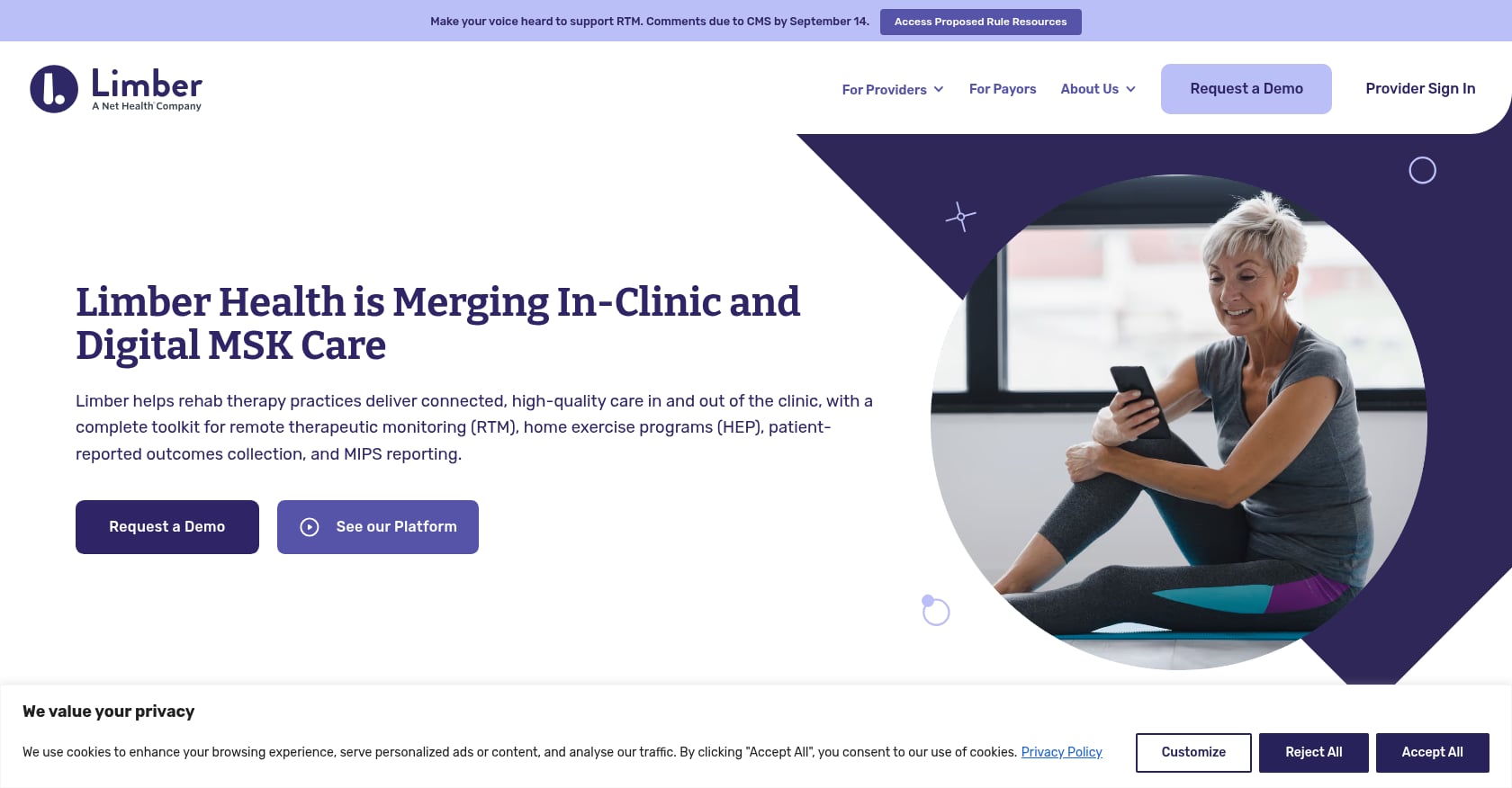
Best for: Larger rehab organizations and hybrid MSK care programs prioritizing RTM, patient-reported outcomes, MIPS reporting, and care navigation at enterprise scale.
Limber Health positions itself at the intersection of digital home exercise programs, Remote Therapeutic Monitoring, and quality reporting. It claims a library of 7,000+ professionally produced videos and pre-built protocols for enterprise-scale operations.
Pricing:
Pricing is not publicly listed. Expect demo-based or contract pricing. Request a quote.
Key features:
- Remote Therapeutic Monitoring platform
- Digital home exercise programs with 7,000+ videos
- Patient-reported outcomes
- MIPS and QCDR reporting support
- Care navigation workflows
- Real-time analytics
- Pre-built protocols and evidence-based patient education
- Hybrid care workflows
User sentiment:
Google Play shows Limber Health Home Exercise at 4.2 stars from 784 reviews with 100,000+ downloads. The app is only available to patients enrolled by a provider. Recent reviews are mixed: one user says it is helpful when it works but became unusable after login issues. Another complains about audio control behavior. A third says images did not load and their PT had to print a PDF instead. Third-party aggregators note complaints about the inability to log partial sessions or select individual exercises from a full session.
Before any HEP therapist platform rollout, assign a test program to yourself and complete it like a patient. Small UX problems become big adherence problems.
Tradeoffs:
- Pricing opacity makes comparison difficult
- More enterprise and hybrid-care oriented than small-clinic HEP buyers need
- Patient app friction appears consistently in reviews
- Care navigation and RTM workflows may require significant operational commitment
- Less suited for clinics that mainly want fast custom videos during visits
Verdict: Choose Limber if your organization needs an enterprise-grade hybrid MSK platform with RTM, outcomes, MIPS, and care navigation. Smaller clinics wanting transparent pricing and therapist-recorded custom HEPs should look elsewhere.
Why the Biggest Exercise Library Is Not Always the Best HEP App
Competitor platforms brag about 6,000, 8,000, or 18,000 exercises. That number sounds impressive on a marketing page, but it can actually slow therapists down.
When a therapist searches a large library for “standing hip abduction with band at ankle height, slight forward lean, cue to keep pelvis level,” they often find a dozen close matches and zero exact ones. Reddit users describe this frustration repeatedly. One practitioner comparing tools said neither MedBridge nor HEP2Go always had the exact exercise needed and criticized poor-quality photos for some entries.
This is what you might call the large library trap. More exercises can mean more scrolling, more “almost right” selections, and more time spent customizing text descriptions to compensate for videos that do not match your cues.
Custom video solves this differently. When a therapist records a 15-second clip during the visit showing the exact exercise with the patient’s equipment and the therapist’s verbal cues, there is nothing to search for. The patient sees what was demonstrated. That is the core argument for AC Health’s approach: custom exercise instructions created in the moment, not selected from a catalog.
Both approaches have a place. Large libraries are useful for breadth, templates, and situations where the therapist does not have time to record. But for the exercises that matter most, where form and cueing determine outcomes, custom video is faster and clearer.
What About RTM?
Remote Therapeutic Monitoring has become a selling point for many HEP therapist platforms. The promise: bill for monitoring patient exercise activity between visits and generate new revenue without adding visits.
APTA describes RTM as involving two sets of codes. CPT 98975, 98976, and 98977 cover RTM services (setup, device supply, monitoring). CPT 98980 and 98981 cover RTM treatment management services. CMS’s 2026 update added codes 98979, 98984, and 98985 as “sometimes therapy” services beginning January 1, 2026, and revised device-supply descriptors.
But RTM is not simple. Practitioners on Reddit express real confusion and skepticism. One thread describes therapists being told that part of a live check-in must be dedicated to reviewing RTM data. Another 2026 thread includes concerns that patients may sign up and forget to log HEP activity, limiting billable codes beyond setup.
Before choosing a platform based on RTM claims, ask these questions:
- Does the platform track days of patient use and time thresholds automatically?
- Does it produce reports you can attach to CMS-1500 claims?
- Does it support patient consent documentation?
- Does it require a separate RTM login for the patient?
- Are there per-patient, per-episode, or revenue-share fees?
- Who handles patient follow-up when activity drops?
- How are copays explained to patients?
For clinics ready to explore RTM workflows, AC Health supports CPT codes 98975, 98977, 98980, and 98981 with a 16-day automatic update, code-state visual cues, and one-click report generation for CMS-1500 attachment. Learn more in this RTM workflow guide.
RTM software should reduce work, not create a second workflow. And no platform guarantees reimbursement. That depends on payer, locality, documentation, device qualification, plan of care, and patient eligibility.
How to Choose the Right HEP App for Your Clinic
Start with your actual workflow, not a feature list. Ask yourself:
- Do you create the HEP during the visit or after hours?
- Do you need custom video, or is a stock library enough?
- Do patients prefer an app, a printout, an email, or all three?
- Do you need HIPAA-secure messaging?
- Do you need adherence tracking?
- Do you need RTM reporting?
- Do you need EMR integration, or is PDF/report export sufficient?
The 5-Fit Scoring Model
Score each platform 1 to 5 across these dimensions:
Clinical fit. Can the plan match your actual cues? Can you edit sets and reps quickly? Does it support your specialty (pelvic health, vestibular, neuro, hand therapy, SLP, pediatrics)?
Patient fit. Is the app easy to open? Does it send reminders? Are videos clear? Can the patient ask questions safely? Can low-tech patients print instead? For guidance on making instructions accessible, see this piece on reducing patient confusion.
Workflow fit. Can you finish the HEP before the patient leaves? Can you reuse templates? Can you see patient history quickly? Therapists need tools that save time during the visit, not after it.
Compliance fit. HIPAA-secure communication? PHI kept out of texts and email? Audit and reporting features? RTM documentation support?
Economic fit. Seat price, patient caps, active-patient fees, per-HEP fees, RTM per-episode fees, setup fees, white-label fees, training time, and switching costs. Ask whether pricing includes everything or whether the real cost surfaces after signup.
If You Are…
- A student or solo therapist on a tight budget: HEP2Go gets you started for free
- A small clinic wanting personalized HEPs and secure messaging: AC Health fits best
- A clinic that needs CEUs bundled with HEPs: MedBridge makes sense
- A multilingual or international practice needing a large library: Physitrack is strong
- A cash-pay PT wanting one system for everything: PtEverywhere consolidates well
- A large organization needing RTM, MIPS, and care navigation: Limber Health or Physitrack depending on scale
For clinics with multiple locations, the ability to share libraries and standardize care plans across sites becomes a decisive factor.
Final Recommendation
For most small and mid-sized therapy clinics, AC Health is the strongest overall HEP therapist solution. It combines custom video creation during the visit, HIPAA-secure messaging, patient behavior nudges, printable care plans, transparent monthly pricing starting at $0, and RTM automation on its Unlimited tier. It is not the biggest library. It is the most friction-free path between the visit and what the patient does at home.
If your clinic mainly needs free printable handouts, HEP2Go works. If CEUs are central to your purchase, MedBridge bundles well. If you need enterprise-grade RTM and outcomes reporting, Limber or Physitrack may fit. But for the therapist who wants patients to actually do their exercises and wants to spend less time on admin, AC Health removes the most barriers.
Schedule an AC Health demo or start with the free plan for up to 5 active patients.
Frequently Asked Questions
What does HEP mean for therapists?
HEP stands for home exercise program, a personalized set of therapeutic exercises a therapist assigns for a patient to complete between clinic visits. HEPs are typically introduced during evaluation and reviewed for proper form before the patient performs them independently at home. The term applies across physical therapy, occupational therapy, speech-language pathology, chiropractic, and athletic training.
What is the best free HEP software?
HEP2Go is the most well-known free HEP handout builder, with a free tier and Pro at $7/month. But “free” has trade-offs. HEP2Go offers limited patient engagement, no robust tracking, and community-reported security concerns. AC Health also offers a permanent free tier for up to 5 active patients with custom video, messaging, and reminders included.
Can HEP apps actually improve patient adherence?
Evidence says yes, with caveats. A randomized controlled trial in stroke patients found 75.6% three-month adherence with a mobile video-guided HEP compared to 55.2% with paper. App-based delivery with reminders and remote support addresses the most common reasons HEPs fail: forgetting, form uncertainty, and lack of accountability.
What HEP software supports RTM?
AC Health supports RTM workflows for CPT 98975, 98977, 98980, and 98981 on its Unlimited tier. MedBridge offers RTM on Care Elite plans with a $10/episode fee. Physitrack has a U.S. RTM bundle at $30/user/month plus an $8 active-user charge. Exercise Pro Live claims RTM tools at no extra cost. No platform guarantees reimbursement, which depends on payer rules, documentation, and patient eligibility.
Is HEP2Go HIPAA compliant?
HEP2Go does not prominently position itself as HIPAA compliant in the sources reviewed. Given community-reported security incidents and hospital IT blocks, clinics with PHI or security requirements should verify directly with HEP2Go and their own compliance teams before relying on it for patient data.
Do patients need to download an app?
It depends on the platform. PhysiApp (Physitrack’s patient app) and the AC Health patient app require downloads. Some platforms also offer web-based portals or QR-code access. Most HEP therapist tools offer printable options as a fallback for patients who prefer paper.
What should a small clinic look for in HEP software?
Prioritize fast in-visit creation, patient reminders, HIPAA-secure messaging, printable options, transparent pricing without per-program fees, and the ability to track whether patients actually complete their programs. A large exercise library is less important than whether your patients understand and follow through on the exercises you prescribe.
{ “@context”: “https://schema.org”, “@type”: “FAQPage”, “@id”: “#faq”, “mainEntity”: [ { “@type”: “Question”, “@id”: “#faq-question-1”, “name”: “What does HEP mean for therapists?”, “acceptedAnswer”: { “@type”: “Answer”, “text”: “HEP stands for home exercise program, a personalized set of therapeutic exercises a therapist assigns for a patient to complete between clinic visits. HEPs are typically introduced during evaluation and reviewed for [proper form](https://www.gethealthie.com/blog/physical-therapy-home-exercise-program) before the patient performs them independently at home. The term applies across physical therapy, occupational therapy, speech-language pathology, chiropractic, and athletic training.” } }, { “@type”: “Question”, “@id”: “#faq-question-2”, “name”: “What is the best free HEP software?”, “acceptedAnswer”: { “@type”: “Answer”, “text”: “HEP2Go is the most well-known free HEP handout builder, with a free tier and Pro at $7/month. But \”free\” has trade-offs. HEP2Go offers limited patient engagement, no robust tracking, and community-reported security concerns. AC Health also offers a permanent free tier for up to 5 active patients with custom video, messaging, and reminders included.” } }, { “@type”: “Question”, “@id”: “#faq-question-3”, “name”: “Can HEP apps actually improve patient adherence?”, “acceptedAnswer”: { “@type”: “Answer”, “text”: “Evidence says yes, with caveats. A randomized controlled trial in stroke patients found 75.6% three-month adherence with a mobile video-guided HEP compared to 55.2% with paper. App-based delivery with reminders and remote support addresses the most common reasons HEPs fail: forgetting, form uncertainty, and lack of accountability.” } }, { “@type”: “Question”, “@id”: “#faq-question-4”, “name”: “What HEP software supports RTM?”, “acceptedAnswer”: { “@type”: “Answer”, “text”: “AC Health supports RTM workflows for CPT 98975, 98977, 98980, and 98981 on its Unlimited tier. MedBridge offers RTM on Care Elite plans with a $10/episode fee. Physitrack has a U.S. RTM bundle at $30/user/month plus an $8 active-user charge. Exercise Pro Live claims RTM tools at no extra cost. No platform guarantees reimbursement, which depends on payer rules, documentation, and patient eligibility.” } }, { “@type”: “Question”, “@id”: “#faq-question-5”, “name”: “Is HEP2Go HIPAA compliant?”, “acceptedAnswer”: { “@type”: “Answer”, “text”: “HEP2Go does not prominently position itself as HIPAA compliant in the sources reviewed. Given community-reported security incidents and hospital IT blocks, clinics with PHI or security requirements should verify directly with HEP2Go and their own compliance teams before relying on it for patient data.” } }, { “@type”: “Question”, “@id”: “#faq-question-6”, “name”: “Do patients need to download an app?”, “acceptedAnswer”: { “@type”: “Answer”, “text”: “It depends on the platform. PhysiApp (Physitrack’s patient app) and the AC Health patient app require downloads. Some platforms also offer web-based portals or QR-code access. Most HEP therapist tools offer printable options as a fallback for patients who prefer paper.” } }, { “@type”: “Question”, “@id”: “#faq-question-7”, “name”: “What should a small clinic look for in HEP software?”, “acceptedAnswer”: { “@type”: “Answer”, “text”: “Prioritize fast in-visit creation, patient reminders, HIPAA-secure messaging, printable options, transparent pricing without per-program fees, and the ability to track whether patients actually complete their programs. A large exercise library is less important than whether your patients understand and follow through on the exercises you prescribe.” } } ] }